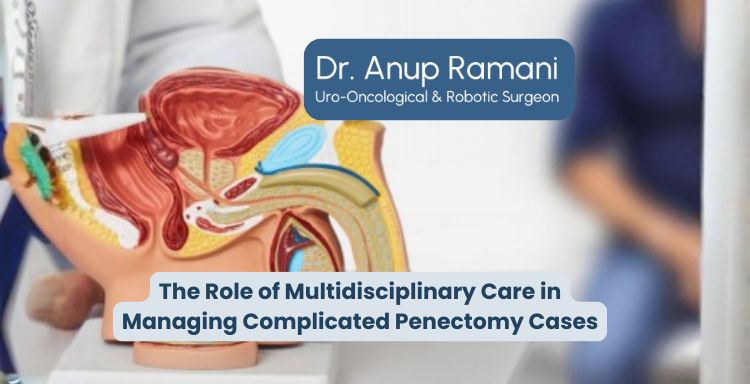
Dr Anup Ramani @ Copyright 2024
By Dr. Anup Ramani
Objective
Complicated cases of penile cancer, especially those requiring partial or total penectomy, demand more than just surgical intervention. A multidisciplinary team approach – including urologists, oncologists, mental health experts and rehabilitation specialists – ensures the patient receives holistic care. This article explains how collaborative management improves surgical outcomes, emotional recovery and quality of life after complex penis cancer treatment.
Why Complicated Penis Cancer Surgery Requires a Multidisciplinary Approach
Penile cancer, while rare, can become life-threatening if not treated promptly. In complicated cases – such as those with deep tissue invasion, lymph node involvement or delayed diagnosis – penis cancer surgery becomes technically challenging. Partial penectomy or total penectomy surgery may be required to remove cancer while attempting to preserve urinary and sexual function.
However, surgery alone isn’t enough to address the full scope of a patient’s needs. These procedures deeply impact physical appearance, sexual identity, psychological well-being and quality of life. That’s why a multidisciplinary team is essential. It brings together professionals from different specialties who work in harmony to create a personalized treatment plan.
This team usually includes penis cancer surgeons, urologists, medical and radiation oncologists, psychologists, sexual health experts, nurses and physiotherapists. Each contributes specific expertise that improves outcomes and supports recovery in every phase of the treatment journey – from diagnosis and surgery to rehabilitation and emotional healing.
When care is coordinated across specialties, the chances of miscommunication, delays or overlooked issues decrease. This leads to more comprehensive and compassionate penis cancer treatment, especially in complex or advanced-stage cases.
The Role of Urologists in Planning Complex Partial Penectomy and Total Penectomy Procedures
Urologists play a central role in managing penile cancer, especially when partial or total penectomy surgery is necessary. These specialists are responsible for accurately diagnosing the extent of the disease and recommending the most effective surgical intervention.
In complicated cases, a partial penectomy surgeon must carefully assess the location, size and depth of the tumor. If cancer is limited to the distal penis, a partial penectomy may suffice. However, if the tumor extends deeply or involves the entire shaft, a total penectomy is required. The urologist’s goal is to ensure cancer control while preserving function as much as possible.
In both cases, surgical planning must be precise. Urologists evaluate preoperative imaging, assess urethral involvement and determine how much tissue can be safely spared. For patients needing penis cancer treatment in India, access to an experienced urologist significantly influences the outcome.
They also coordinate with anesthesiologists, surgical nurses and postoperative teams to reduce risks such as bleeding, infection and urinary complications. Their leadership in the operating room sets the tone for successful cancer removal and physical recovery.
What Our Patients Are Saying
How Oncologists Guide Cancer Staging and Treatment Decisions in Penis Cancer Treatment
Oncologists are vital to the multidisciplinary care team. Their role begins at diagnosis and continues throughout and beyond penis cancer treatment. They assess the stage of the disease using scans, biopsies and lymph node evaluations to determine how far the cancer has spread.
This staging process influences every treatment decision. For example, if the tumor is localized, surgery might be enough. But if cancer has spread to lymph nodes or other organs, radiotherapy or chemotherapy may be needed. Oncologists help decide the right timing and dosage for these treatments, ensuring they support surgical outcomes without causing unnecessary harm.
In some cases, oncologists recommend neoadjuvant (before surgery) or adjuvant (after surgery) therapies to improve long-term survival. They also guide follow-up imaging and blood tests to monitor for recurrence. Close coordination with urologists ensures a seamless treatment plan.
Mental Health Professionals Supporting Emotional Recovery After Penis Cancer Surgery
Undergoing penis cancer surgery – especially total penectomy – can have deep psychological effects. Men may struggle with body image, loss of masculinity, anxiety or depression. These emotional challenges are often more difficult to manage than the physical recovery.
Mental health professionals – such as psychologists, counselors or psychiatrists – are essential in helping patients process these emotions. They offer a safe space to talk about fears, self-esteem issues and future concerns. Early intervention from mental health specialists can reduce the risk of long-term depression and help patients rebuild confidence.
Counseling can also support communication between patients and their partners. Many men worry about how their partner will react to their physical changes or reduced sexual function. A therapist helps couples navigate these conversations, fostering honesty and understanding.
In holistic penis cancer treatment in India and other countries, mental health support is becoming standard in cancer care protocols. It allows patients to regain emotional balance, improve their relationships and find meaning after major changes.
Emotional and Psychological Effects Following Penectomy Surgery
The psychological impact of penectomy can be profound. Patients may feel a loss of masculinity, identity or confidence after the surgery. Depression and anxiety are common, especially in younger patients or those with active sex lives before surgery.
Many patients go through a grieving process after the surgery, mourning the loss of their organ and the roles it played in their lives. Some may feel ashamed or socially withdrawn, particularly if they fear how others – including intimate partners – will react to their new appearance.
This emotional distress is just as important to treat as the physical side effects. Seeking help from a psychologist or counselor who specializes in penis cancer treatment can make a significant difference. Group therapy, peer support and one-on-one sessions can all provide reassurance that these feelings are normal and manageable.
In penis cancer treatment in Mumbai and in top cancer centers, more attention is now being given to the mental and emotional recovery after surgery. A holistic approach improves both quality of life and long-term mental well-being.
Rehabilitation and Sexual Health Specialists in Post-Penectomy Patient Care
After surgery, men may face functional challenges related to urination, mobility and intimacy. Rehabilitation and sexual health specialists help patients regain independence and rediscover intimacy post-surgery.
Rehabilitation therapists can assist with mobility if lymph node removal causes swelling or discomfort. They also guide patients in adapting to changes in urination, such as using a perineal urethrostomy after total penectomy surgery.
Sexual health specialists focus on restoring confidence and helping men redefine their sexual identity. They may introduce alternatives to penetrative sex, suggest assistive devices or work with partners to rebuild intimacy.
These specialists play an essential role in ensuring that recovery isn’t just physical. Their input helps patients feel whole again and reclaim parts of their life that may feel lost after penis cancer treatment.
Wound Care and Nursing Teams Ensuring Safe Recovery After Partial Penectomy
Nurses and wound care specialists are the backbone of recovery. Their day-to-day care ensures patients avoid complications and heal properly after partial or total penectomy.
Nurses help manage surgical dressings, monitor wounds for signs of infection and educate patients about hygiene. They also manage catheters, pain control and mobility during the hospital stay.
Wound care teams play a special role in preventing complications like delayed healing, infections or skin breakdown. They ensure that post-operative recovery stays on track, which is especially important in older patients or those with diabetes.
Beyond medical tasks, nurses also provide emotional reassurance, answer questions and build trust with patients. Their consistent presence is vital in the early, vulnerable days of recovery from penis cancer surgery.
Coordinated Follow-Up Care for Better Outcomes in Penis Cancer Surgery Patients
After the initial surgery and treatment, patients need regular follow-ups to detect any signs of cancer recurrence or manage side effects. A coordinated follow-up plan brings together all specialists – urologists, oncologists, mental health experts and more – to monitor the patient’s progress.
These follow-ups may include physical exams, imaging tests, blood work and psychosocial evaluations. Surveillance is especially important in patients with high-grade tumors or those who had lymph nodes removed.
A multidisciplinary team ensures that no concern goes unaddressed. Whether it’s a physical issue like swelling or a psychological symptom like anxiety, each member of the team contributes to a complete care plan.
This integrated model improves survival, reduces complications and provides a better long-term quality of life after penis cancer surgery.
Benefits of Multidisciplinary Care in Managing Complex Penis Cancer Treatment Cases
A multidisciplinary approach in complicated penis cancer treatment offers several clear benefits. First, it enables more accurate diagnosis, better surgical planning and timely integration of chemotherapy or radiation when needed. Second, it ensures that emotional, sexual and physical recovery are addressed together – not in isolation.
With shared decision-making, the patient is at the center of care. This team-based strategy reduces errors, prevents delays and allows specialists to focus on their strengths while collaborating toward a common goal: the patient’s health and well-being.
By combining the skills of penis cancer surgeons, oncologists, therapists, nurses and others, patients experience fewer complications, lower recurrence rates and higher satisfaction. For those seeking penis cancer treatment in India, especially in high-volume centers, multidisciplinary care leads to improved outcomes and restored dignity in the face of a life-changing diagnosis.
FAQs:
What is a multidisciplinary team in penis cancer treatment?
It’s a group of specialists – including urologists, oncologists, psychologists and nurses – working together to provide complete care for patients.
Why is mental health support important after partial or total penectomy?
It helps patients cope with emotional challenges, body image issues and depression following major life changes.
Can sexual function be restored after penectomy surgery?
Full function may not return, especially after total penectomy, but sexual health specialists help patients explore new forms of intimacy.
How do oncologists support treatment planning in penile cancer?
They help assess cancer stage, decide on chemotherapy or radiation and coordinate with the surgeon for optimal timing.
What are the long-term benefits of coordinated post-surgery care?
It improves cancer monitoring, supports emotional recovery and ensures better quality of life with fewer complications.
About Author

Uro-Oncological & Robotic Surgeon
Dr. Anup Ramani is a robotic uro-oncological surgeon and an internationally recognized expert in robotic surgery for prostate, kidney and urinary bladder cancers. With more than two decades of robotic experience and 2,000+ robotic procedures, he brings unmatched precision and outcomes to complex uro-oncology cases. He is widely published in his field and is known for a personal, transparent approach-often spending over an hour in initial consultations to educate patients on its disease, surgery and recovery. His expertise spans prostate cancer treatment, kidney and bladder cancer surgery, adrenal gland surgery, kidney stone treatment, penile cancer surgery and enlarged prostate management. Dr. Ramani advocates the advantages of robotic surgery-magnified 3D vision, tremor-filtered precision, minimal scarring, lower blood loss and faster recovery-helping patients return to life sooner.

Table of Contents
Recent Blogs
Best Uro-Oncological surgeon
Specialist in India for Robotic Surgery
MCh, DNB, MS, DNB
Dr. Anup Ramani
CONTACT
Uro-Oncologist in India,
Best Robotic Surgeon for Uro Oncology Surgery
1407, One Lodha Place Next to World Towers Senapati Bapat Marg, Worli, Mumbai. 400013.
Dr Anup Ramani @ Copyright 2024 – Website Maintenance, SEO & GEO by Opal Infotech
- Partial penectomy is done in cases where glans and distal penis is involved with carcinoma.
- Partial penectomy is a type of organ-preserving surgery. Preservation of sexual and micturational function depends on the surgical dissection and reconstruction of residual urethra.
- Patients who develop stones in the kidney or ureter, often experience severe pain.
- This condition usually needs a procedure to remove the kidney stones.
- This procedure is called ureteroscopy and is performed very commonly.
- It does not require any cuts and hence it is painless.
- The procedure is performed with an endoscope inserted through the penis under spinal anesthesia.
- The scope is inserted through the penis into the kidney and stones are dissolved with a laser.
- The procedure takes about 40-50 minutes.
- A catheter (urine pipe) is kept after the procedure to drain the bladder. A stent is kept in the kidney at the same time.
- Patient is mobile and walking in the room the same evening.
- Hospital stay is one night and patient is discharged the next day after removal of the catheter.
- Patient has to come back after six weeks to remove the stent in the kidney.
- Patients can resume office a week after surgery and heavy activities like running, weight lifting, a month after the procedure.
- We offer fixed packages for this procedure which can be obtained by calling our helpline +91 9967666060.
- Men with an enlarged prostate, which is a normal ageing changes, often experiencing difficulty passing urine. This condition usually needs a procedure to trim the prostate and relieve the blockage.
- This procedure is called TURP and is performed very commonly.
- It does not require any cuts and hence it is painless.
- The procedure is performed with an endoscope inserted through the penis under spinal anaesthesia.
- The overgrown prostate is dissolved with a laser bloodlessly.
- The procedure takes about 40 minutes.
- A catheter (urine pipe) is kept after the procedure to drain the bladder.
- Patient is mobile and walking in the room the same evening.
- Hospital stay is two nights and patient is discharged with the catheter, which is removed after 4 days.
- Patients can resume office a week after surgery and heavy activities like running, weight lifting, a month after the procedure.
- We offer fixed packages for this procedure which can be obtained by calling our helpline +91 9967666060.
-
Robotic adrenalectomy is a sophisticated, complex surgery and it is very important that an experienced surgeon performs this surgery to avoid major complications.
-
Once the anesthesia is done, and patient positioned, three micro cuts (3mm each) are made in the patient’s abdomen.
-
The arms of the Da Vinci robot are connected to the cuts via ports (tubes).
-
Dr. Ramani then sits in the controlling console to perform the surgery.
-
On an average, a robotic adrenalectomy takes one hour.
-
The surgery is almost completely bloodless and there has never been any need to transfuse blood after surgery.
-
A urine catheter and bag to drain the bladder is inserted during surgery.
-
A tiny drain pipe may be inserted in the surgical side of the abdomen, connected to a bag.
-
Patient is kept nil-by-mouth the day of the surgery, with IV fluids. Sips of water are started the next day and solid food by day three.
-
The drain pipe, if kept, is removed in the room on day 2 after surgery.
-
The catheter is removed on day two after surgery.
-
Total hospital stay for robotic adrenalectomy is 4 nights (including night before surgery).
-
Post discharge, a doctor from the surgical team visits the patient at home/ hotel room once every day.
On the day of discharge, patient is totally self-sufficient. They are able to walk freely without any pain, dress themselves, shower, toilet and they do not need to hire any nurse or help at home. Almost all patients are back to work within 2 weeks of surgery.
Heavy activities like running, weight lifting can be resumed after a month
Follow up after an adrenalectomy is in the form of CT scans, once a year for 5 years.
Local patients usually meet Dr. Ramani after two weeks to discuss report.Outstation patients are counselled on a phone consultation.
- Dr. Ramani is one of the very few surgeons in India who has the expertise to perform a robotic surgery for bladder cancer, which includes removing the urinary bladder and reconstructing a new bladder robotically.
- Robotic radical cystectomy is an extremely sophisticated, complex surgery and it is very important that an experienced surgeon performs this surgery to avoid major complications.
- Once the anaesthesia is done, and patient positioned, six micro cuts (3mm each) are made in the patient’s abdomen.
- The arms of the Da Vinci robot are connected to the cuts via ports (tubes).
- Dr. Ramani then sits in the controlling console to perform the surgery.
- On an average, a robotic radical cystectomy with an ileal conduit takes 3-4 hours.
- The surgery is almost completely bloodless and there has never been any need to transfuse blood after surgery.
- A urine catheter and bag to drain the new bladder is inserted during surgery.
- Two tiny drain pipe in inserted in the surgical side of the abdomen, connected to a bag.
- Patient is kept nil-by-mouth for 4 days after surgery with IV supplementation of patient’s daily requirements of calories, fats, carbohydrates, proteins and electrolytes.
- The drain pipes are removed in the room on day 3-5 after surgery.
- Total hospital stay for radical cystectomy is 8 nights (including night before surgery).
- Post discharge, a doctor from the surgical team visits the patient at home/ hotel room once every day.
- On the day of discharge, patient is totally self-sufficient. They are able to walk freely without any pain, dress themselves, shower, toilet and they do not need to hire any nurse or help at home.
- Almost all patients are back to work within 6 weeks of surgery. Heavy activities like running, weight lifting can be resumed after two months.
Follow up after a radical a cystectomy is in the form of CT scans, once a year for 5 years.
Histopathology report: Local patients usually meet Dr. Ramani after two weeks to discuss report.
Outstation patients are counselled on a phone consult. Depending on the report, patient may or may not need chemotherapy after surgery.
If chemo is needed, patients may choose to get it done with a medical oncologist of their choice or avail the services of one of the four medical oncologists on our team.
- Robotic partial nephrectomy is a sophisticated, complex surgery and it is very important that an experienced surgeon performs this surgery to avoid major complications. Robotic radical (total) nephrectomy is
- relatively easier but still requires significant experience to consistently deliver results.
- Once the anaesthesia is done, and patient positioned, five micro cuts (3mm each) are made in the patient’s abdomen.
- The arms of the Da Vinci robot are connected to the cuts via ports (tubes).
- Dr. Ramani then sits in the controlling console to perform the surgery.
- On an average, a robotic radical nephrectomy takes one hour and a robotic partial nephrectomy takes about an hour and half.
- The surgery is almost completely bloodless and there has never been any need to transfuse blood after surgery.
- A urine catheter and bag to drain the bladder is inserted during surgery.
- A tiny drain pipe in inserted in the surgical side of the abdomen, connected to a bag.
- Patient is kept nil-by-mouth the day of the surgery, with IV fluids. Sips of water are started the next day and solid food by day three.
- The drain pipe is removed in the room on day 3 after surgery. The catheter is removed on day two after surgery.
- Total hospital stay for radical/partial nephrectomy is 4 nights (including night before surgery).
- Post discharge, a doctor from the surgical team visits the patient at home/ hotel room once every day.
- On the day of discharge, patient is totally self- sufficient.
- They are able to walk freely without any pain, dress themselves, shower, toilet and they do not need to hire any nurse or help at home.
- Almost all patients are back to work within 2-3 weeks of surgery.
- Heavy activities like running, weight lifting can be resumed after a month.
- Follow up after a radical/partial Nephrectomy is in the form of CT scans, once a year for 5 years.
- Local patients usually meet Dr. Ramani after two weeks to discuss report.
- Outstation patients are counselled on a phone consultation.