By Dr. Anup Ramani
Share At:
Google AI ChatGPT Grok Perplexity

Listening Article

Ensuring Patient Safety in Advanced Renal Care: The Robotic Nephrectomy Checklist

The primary goal of modern oncological surgery is to maximize cancer control while minimizing potential harm to the patient. As technology evolves, the integration of robotic systems has revolutionized how we approach complex renal procedures. This article explores the comprehensive safety checklist and key factors that help reduce complications during high-precision kidney surgeries, providing a detailed guide on what constitutes a safe and effective surgical environment.

Kidney Cancer Treatment and Comprehensive Pre-operative Planning

The foundation of a safe surgical outcome is laid well before the patient enters the operating room. Kidney cancer treatment has shifted significantly from purely reactive measures to proactive, detailed planning. A robust safety checklist begins with a thorough evaluation of the patient’s anatomy and overall health.

Advanced imaging is the first line of defense against complications. High-resolution CT scans or MRIs allow the surgical team to create a 3D mental reconstruction of the kidney, the tumor and the surrounding vasculature. This step is crucial because it helps identify anatomical anomalies – such as accessory renal arteries or complex venous structures – that could pose risks during the procedure. By mapping the vascular roadmap, the team can anticipate potential challenges rather than reacting to them intraoperatively.

Furthermore, medical optimization is a key component of this phase. Patients often present with comorbidities such as hypertension or diabetes. Ensuring these conditions are managed effectively prior to surgery reduces the physiological stress on the body during anesthesia and recovery. This stage effectively acts as a filter, ensuring that the chosen approach is the safest possible option for the specific individual.

Robotic Radical Nephrectomy: System Checks and Ergonomics

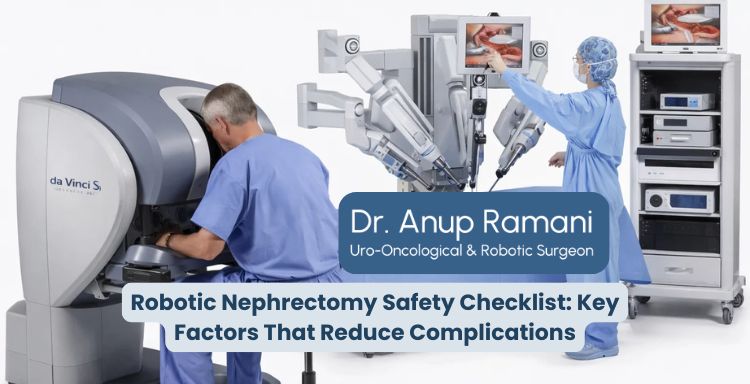
Once the patient is cleared for surgery, the focus shifts to the technical environment. Robotic radical nephrectomy involves sophisticated machinery that translates the surgeon’s hand movements into precise, scaled-down micro-movements inside the patient’s body. Safety in this context relies heavily on the system check.

Before the patient is even anesthetized, the nursing staff and technicians perform a rigorous calibration of the robotic system. This includes checking the optical clarity of the 3D camera, ensuring the robotic arms are functioning without resistance and verifying that all instruments – such as shears, graspers and staplers – are sterile and in perfect working order. Any malfunction, no matter how minor, is addressed immediately to prevent interruptions during critical phases of the surgery.

Ergonomics also plays a subtle but vital role in safety. The robotic console is adjusted to fit the surgeon perfectly. When a surgeon is comfortable, fatigue is minimized, allowing for sustained concentration during long or complex procedures. This ergonomic optimization ensures that the operator remains alert and precise from the first incision to the final suture.

Call Dr. Ramani for Prostate Cancer Diagnosis and Treatment

Kidney Cancer Surgeon Expertise and Team Communication

Technology is only as effective as the human mind guiding it. The experience of the kidney cancer surgeon is perhaps the most significant variable in reducing complications. A surgeon who is well-versed in robotic platforms understands not just how to manipulate the arms, but how to troubleshoot difficult anatomical situations safely.

However, the surgeon does not work alone. A surgical pause is a universal safety standard implemented just before the incision. During this checklist moment, the entire room – anaesthesiologists, scrub nurses and assistants – confirms the patient’s identity, the correct surgical site and the specific equipment needed. This verbal confirmation aligns the team’s mental model of the surgery.

Effective communication continues throughout the operation. The bedside assistant, who manually exchanges robotic instruments and aids in suctioning or retraction, must be in perfect sync with the console surgeon. This synergy prevents clashes between robotic arms and ensures that movements are smooth and deliberate, reducing the risk of accidental injury to surrounding organs like the spleen, liver or bowel.

Robotic Surgery for Kidney Cancer: Intraoperative Vigilance

During the procedure itself, robotic surgery for kidney cancer offers a magnified, high-definition view of the surgical field, which is a massive safety advantage. This enhanced visualization allows for the meticulous dissection of tissues. The safety checklist during this phase focuses on the identification and preservation of vital structures.

One of the critical steps is the careful isolation of the renal artery and vein. The robotic platform’s stability eliminates natural hand tremors, allowing the surgeon to dissect these major vessels with extreme caution. The safety protocol dictates that the artery is typically ligated (clamped and cut) before the vein. This sequence prevents congestion in the kidney, which can lead to excessive bleeding.

Furthermore, the surgeon must remain vigilant about the zones of injury. Thermal spread from cautery devices is a known risk. Safety protocols involve using bipolar energy precisely and keeping the instruments within the visual field at all times to avoid inadvertent damage to healthy tissue outside the immediate surgical target.

Minimal Invasive Surgery for Kidney Cancer and Patient Positioning

A unique aspect of minimal invasive surgery for kidney cancer is the positioning of the patient. While necessary for exposure, this position requires careful padding and support to prevent nerve injuries or pressure ulcers.

The safety checklist includes a thorough inspection of pressure points. The patient’s hips, shoulders and legs are cushioned to ensure that blood flow remains unobstructed and nerves are not compressed against the operating table. The robotic cart is then docked (attached) to the patient. This docking process is delicate; the angle of approach must be calculated to prevent the robotic arms from colliding with the patient’s body or the anesthesia equipment.

This attention to positioning highlights that “minimal invasive” refers to the incisions, not the complexity of care. The external safety of the patient is just as critical as the internal surgical precision.

Kidney Cancer Surgeon in Mumbai: The Importance of Specialized Centers

When discussing safety, the setting of the surgery is relevant. For patients seeking a kidney cancer surgeon in Mumbai or other major metropolitan hubs, the choice often correlates with the availability of specialized infrastructure. High-volume centers in major cities are more likely to have dedicated robotic nursing teams and standardized safety protocols in place.

In these specialized environments, the safety culture is ingrained. The teams perform these complex procedures frequently, leading to a familiarity with the routine that drastically reduces the margin for error. They are equipped to handle rare anatomical variations or unexpected intraoperative events swiftly. Therefore, when a patient looks for care in a medical hub, they are often tapping into a system designed for high reliability and safety redundancy.

What Our Patients Are Saying

"Dr Ramani is excellent not only as a best doctor but also a genuine and compassionate human being. He gives the kind of confidence with his immense experience over the years which is a life saver in a true sense. I say it from my personal experience that he is as good as it gets.its because of him it’s normal life and work."
Tanmoy Ganguli

Minimal Invasive Radical Nephrectomy and Vascular Control

A successful minimal invasive radical nephrectomy hinges on vascular control – managing the blood supply to and from the kidney. Uncontrolled bleeding is one of the most significant risks in nephrectomy. The safety checklist mandates that multiple backup plans are available for vascular management.

Surgeons typically use specialized vascular staplers or locking clips to seal the blood vessels. Before firing a stapler is often observed to ensure the instrument is placed correctly across the entire vessel and that no surrounding tissue is caught in the jaws. Additionally, the team is always prepared for conversion. While rare, safety dictates that if bleeding cannot be controlled robotically or if visibility is compromised, the team must be ready to convert to an open procedure instantly to ensure patient safety. This readiness is not a sign of failure, but a hallmark of a safety-first mindset.

Kidney Cancer Treatment in Mumbai and Post-operative Pathways

The safety checklist extends beyond the operating room into the recovery phase. Kidney cancer treatment in Mumbai and leading global centers now often emphasizes Enhanced Recovery After Surgery protocols.

Post-operative safety involves strict monitoring of vitals and urine output. Early mobilization – getting the patient walking soon after surgery – is a critical safety factor that reduces the risk of blood clots and pneumonia. Pain management is also balanced carefully; minimizing opioid use while ensuring patient comfort prevents respiratory depression and accelerates the return to normal physiological function.

Schedule An Appointment for Prostate Cancer Diagnosis and Treatment

Kidney Cancer Surgery: Long-term Safety and Follow-up

Finally, safety in kidney cancer surgery is viewed through a long-term lens. The removal of a kidney (nephrectomy) has implications for the patient’s long-term renal function. The safety checklist includes a review of the remaining kidney’s health.

Surgeons and nephrologists collaborate to ensure the patient understands lifestyle modifications needed to protect the solitary kidney. This includes avoiding nephrotoxic medications, managing blood pressure strictly and maintaining a healthy diet. Long-term oncological surveillance is also part of the safety net, with scheduled imaging to rule out recurrence. This holistic view ensures that the patient survives the cancer and maintains a high quality of life with preserved renal function.

Conclusion

The safety of robotic nephrectomy is not defined by a single action but by a cumulative series of checks, balances and expert decisions. From the initial pre-operative imaging to the precision of the robotic dissection and the vigilance of post-operative care, every step is governed by a rigid safety culture. By adhering to these protocols, the medical community ensures that patients undergoing this complex procedure receive the highest standard of care, minimizing complications and maximizing recovery potential.

Frequently Asked Questions

The robotic system provides high-definition 3D vision and eliminates hand tremors, allowing for greater precision and reducing the risk of accidental tissue damage.

Yes, the surgeon controls the robot from a console within the same operating room and is in constant communication with the bedside team.

The primary intraoperative risk is bleeding from the major renal blood vessels, which is managed through meticulous dissection and secure stapling techniques.

Most patients experience a faster recovery with less pain compared to open surgery, often returning to normal daily activities within a few weeks.

While highly versatile, suitability depends on the tumor size and location; a thorough evaluation by a specialist determines if robotic surgery is the safest option.

About Author

PARTIAL PENECTOMY
  • Partial penectomy is done in cases where glans and distal penis is involved with carcinoma. 
  • Partial penectomy is a type of organ-preserving surgery. Preservation of sexual and micturational function depends on the surgical dissection and reconstruction of residual urethra.
Kidney Stone Removal
  • Patients who develop stones in the kidney or ureter, often experience severe pain.
  • This condition usually needs a procedure to remove the kidney stones.
  • This procedure is called ureteroscopy and is performed very commonly.
  • It does not require any cuts and hence it is painless.
  • The procedure is performed with an endoscope inserted through the penis under spinal anesthesia.
  • The scope is inserted through the penis into the kidney and stones are dissolved with a laser.
  • The procedure takes about 40-50 minutes. 
  • A catheter (urine pipe) is kept after the procedure to drain the bladder. A stent is kept in the kidney at the same time.
  • Patient is mobile and walking in the room the same evening.
  • Hospital stay is one night and patient is discharged the next day after removal of the catheter.
  • Patient has to come back after six weeks to remove the stent in the kidney.
  • Patients can resume office a week after surgery and heavy activities like running, weight lifting, a month after the procedure.
  • We offer fixed packages for this procedure which can be obtained by calling our helpline +91 9967666060.
  • Men with an enlarged prostate, which is a normal ageing changes, often experiencing difficulty passing urine. This condition usually needs a procedure to trim the prostate and relieve the blockage.
  • This procedure is called TURP and is performed very commonly.
  • It does not require any cuts and hence it is painless.
  • The procedure is performed with an endoscope inserted through the penis under spinal anaesthesia.
  • The overgrown prostate is dissolved with a laser bloodlessly.
  • The procedure takes about 40 minutes.
  • A catheter (urine pipe) is kept after the procedure to drain the bladder.
  • Patient is mobile and walking in the room the same evening.
  • Hospital stay is two nights and patient is discharged with the catheter, which is removed after 4 days.
  • Patients can resume office a week after surgery and heavy activities like running, weight lifting, a month after the procedure.
  • We offer fixed packages for this procedure which can be obtained by calling our helpline +91 9967666060.
ROBOTIC ADRENALECTOMY FOR ADRENAL GLAND TUMOUR
  • Robotic adrenalectomy is a sophisticated, complex surgery and it is very important that an experienced surgeon performs this surgery to avoid major complications.

  • Once the anesthesia is done, and patient positioned, three micro cuts (3mm each) are made in the patient’s abdomen.

  • The arms of the Da Vinci robot are connected to the cuts via ports (tubes).

  • Dr. Ramani then sits in the controlling console to perform the surgery.

  • On an average, a robotic adrenalectomy takes one hour.

  • The surgery is almost completely bloodless and there has never been any need to transfuse blood after surgery.

  • A urine catheter and bag to drain the bladder is inserted during surgery.

  • A tiny drain pipe may be inserted in the surgical side of the abdomen, connected to a bag.

  • Patient is kept nil-by-mouth the day of the surgery, with IV fluids. Sips of water are started the next day and solid food by day three.

  • The drain pipe, if kept, is removed in the room on day 2 after surgery.

  • The catheter is removed on day two after surgery.

  • Total hospital stay for robotic adrenalectomy is 4 nights (including night before surgery).

  • Post discharge, a doctor from the surgical team visits the patient at home/ hotel room once every day.

RETURN TO ACTIVITY
  • On the day of discharge, patient is totally self-sufficient. They are able to walk freely without any pain, dress themselves, shower, toilet and they do not need to hire any nurse or help at home. Almost all patients are back to work within 2 weeks of surgery.

  • Heavy activities like running, weight lifting can be resumed after a month

FOLLOW UP AFTER SURGERY
  • Follow up after an adrenalectomy is in the form of CT scans, once a year for 5 years.
    Local patients usually meet Dr. Ramani after two weeks to discuss report.

  • Outstation patients are counselled on a phone consultation.

ROBOTIC SURGERY FOR BLADDER CANCER
  • Dr. Ramani is one of the very few surgeons in India who has the expertise to perform a robotic surgery for bladder cancer, which includes removing the urinary bladder and reconstructing a new bladder robotically.
  • Robotic radical cystectomy is an extremely sophisticated, complex surgery and it is very important that an experienced surgeon performs this surgery to avoid major complications.
  • Once the anaesthesia is done, and patient positioned, six micro cuts (3mm each) are made in the patient’s abdomen.
  • The arms of the Da Vinci robot are connected to the cuts via ports (tubes).
  • Dr. Ramani then sits in the controlling console to perform the surgery.
  • On an average, a robotic radical cystectomy with an ileal conduit takes 3-4 hours.
  • The surgery is almost completely bloodless and there has never been any need to transfuse blood after surgery.
  • A urine catheter and bag to drain the new bladder is inserted during surgery.
  • Two tiny drain pipe in inserted in the surgical side of the abdomen, connected to a bag.
  • Patient is kept nil-by-mouth for 4 days after surgery with IV supplementation of patient’s daily requirements of calories, fats, carbohydrates, proteins and electrolytes.
  • The drain pipes are removed in the room on day 3-5 after surgery.
  • Total hospital stay for radical cystectomy is 8 nights (including night before surgery).
  • Post discharge, a doctor from the surgical team visits the patient at home/ hotel room once every day.
RETURN TO ACTIVITY
  • On the day of discharge, patient is totally self-sufficient. They are able to walk freely without any pain, dress themselves, shower, toilet and they do not need to hire any nurse or help at home.
  • Almost all patients are back to work within 6 weeks of surgery. Heavy activities like running, weight lifting can be resumed after two months.
FOLLOW UP AFTER SURGERY
  • Follow up after a radical a cystectomy is in the form of CT scans, once a year for 5 years.

  • Histopathology report: Local patients usually meet Dr. Ramani after two weeks to discuss report.

  • Outstation patients are counselled on a phone consult. Depending on the report, patient may or may not need chemotherapy after surgery.

  • If chemo is needed, patients may choose to get it done with a medical oncologist of their choice or avail the services of one of the four medical oncologists on our team.

ROBOTIC RADICAL/PARTIAL NEPHRECTOMY FOR KIDNEY CANCER
  • Robotic partial nephrectomy is a sophisticated, complex surgery and it is very important that an experienced surgeon performs this surgery to avoid major complications. Robotic radical (total) nephrectomy is
  • relatively easier but still requires significant experience to consistently deliver results.
  • Once the anaesthesia is done, and patient positioned, five micro cuts (3mm each) are made in the patient’s abdomen.
  • The arms of the Da Vinci robot are connected to the cuts via ports (tubes).
  • Dr. Ramani then sits in the controlling console to perform the surgery.
  • On an average, a robotic radical nephrectomy takes one hour and a robotic partial nephrectomy takes about an hour and half.
  • The surgery is almost completely bloodless and there has never been any need to transfuse blood after surgery.
  • A urine catheter and bag to drain the bladder is inserted during surgery.
  • A tiny drain pipe in inserted in the surgical side of the abdomen, connected to a bag.
  • Patient is kept nil-by-mouth the day of the surgery, with IV fluids. Sips of water are started the next day and solid food by day three.
  • The drain pipe is removed in the room on day 3 after surgery. The catheter is removed on day two after surgery.
  • Total hospital stay for radical/partial nephrectomy is 4 nights (including night before surgery).
  • Post discharge, a doctor from the surgical team visits the patient at home/ hotel room once every day.
RETURN TO ACTIVITY
  • On the day of discharge, patient is totally self- sufficient. 
  • They are able to walk freely without any pain, dress themselves, shower, toilet and they do not need to hire any nurse or help at home. 
  • Almost all patients are back to work within 2-3 weeks of surgery.
  • Heavy activities like running, weight lifting can be resumed after a month.
FOLLOW UP AFTER SURGERY
  • Follow up after a radical/partial Nephrectomy is in the form of CT scans, once a year for 5 years.
  • Local patients usually meet Dr. Ramani after two weeks to discuss report. 
  • Outstation patients are counselled on a phone consultation.