


Read Our Article
Why Annual Health Check-ups are Crucial for Cancer Prevention?
In this article
AI Summary: Groin Lymph Node Surgery in Penile Cancer
Penis cancer lymph node surgery is considered because the groin lymph nodes are usually the first place penile cancer spreads. Checking these nodes is a key part of staging and treatment planning. Doctors review tumour size, cancer stage, grade, lymph node risk, biopsy findings, imaging results and overall health before deciding whether groin lymph node surgery is needed. In selected patients, removing the nodes shows whether cancer has spread, guides further treatment and supports long-term cancer control.
Introduction to Penile Cancer Lymph Node Evaluation
Penile cancer is a rare cancer that begins in the skin or tissue of the penis. Most cases are squamous cell cancers, and many can be treated successfully when found early.
Lymph nodes are small filters that are part of the body’s lymphatic system. Cancer cells that leave the penis usually reach the groin nodes first. This is why penis cancer lymph node surgery, or at least careful node assessment, is often discussed soon after diagnosis.
Every patient is different. The right plan depends on the tumour, the lymph nodes and the person’s general health.
Why Are Groin Lymph Nodes Important in Penis Cancer Treatment?
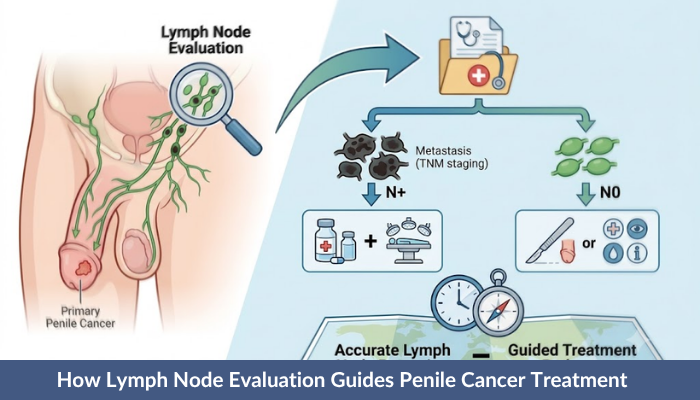
Lymph nodes trap germs and abnormal cells as lymph fluid drains from the body. Lymph from the penis drains to the inguinal (groin) lymph nodes, so these nodes act as the first checkpoint for cancer spread.
Early penile cancer lymph node evaluation matters because lymph node status is one of the most important factors affecting outcome. Cancer found while still confined to a few nodes is easier to treat.
Doctors weigh these factors together:
- Primary tumour characteristics such as size, depth and site
- Cancer stage
- Tumour grade, which describes how aggressive the cells look
- Lymph node risk based on tumour features
- Imaging findings
- Patient health condition and fitness for surgery
What Does Penile Cancer Spread to Lymph Nodes Mean? Lymph Node Metastasis Explained
Penile cancer spread to lymph nodes means cancer cells have left the primary tumour and settled in one or more nodes. Doctors call this lymph node metastasis in penile cancer.
Cancer cells travel through tiny lymph channels, usually to the groin nodes first and later to the pelvic nodes. Enlarged nodes are not always cancer, because infection of the tumour can also make them swell. Testing confirms the cause.
This finding changes staging, and it influences the extent of surgery and the follow up plan.
What Is Inguinal Lymph Node Dissection (Groin Lymph Node Removal)?
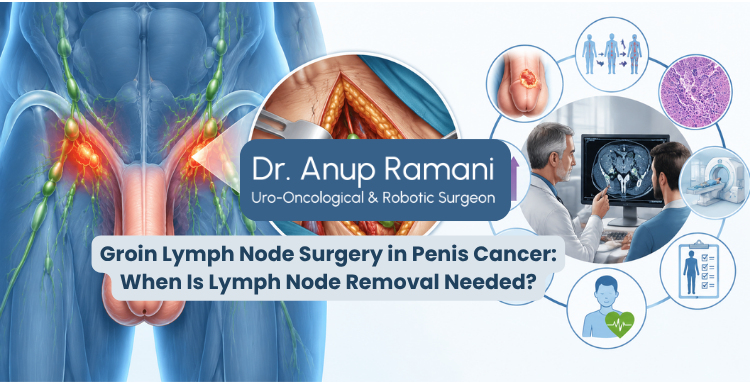
Inguinal lymph node dissection, also called groin lymph node dissection, is an operation to remove lymph nodes from the groin on one or both sides. It is the main form of lymph node surgery for penile cancer.
Groin lymph node removal has two purposes. It shows whether cancer has spread, and it removes cancer from the nodes when it is present. Examination of the removed nodes under a microscope gives accurate information for penile cancer staging that scans cannot always provide.
When Is Groin Lymph Node Removal Recommended in Penis Cancer Treatment?
Not every patient needs penis cancer lymph node surgery. Small, low-risk tumours may need only close surveillance, while higher risk tumours need active assessment. Doctors consider tumour stage, depth of invasion, cancer grade, signs of spread into blood or lymph vessels, physical examination findings and imaging results.
| Situation | Usual approach |
| Early, low risk tumour and no palpable nodes | Careful surveillance |
| Intermediate or high risk tumour and no palpable nodes | Sentinel node biopsy or inguinal lymph node dissection |
| Nodes felt, or cancer confirmed in nodes | Inguinal lymph node dissection, sometimes after chemotherapy |
This is a general guide. Your specialist tailors the decision to your own findings.
How Is Lymph Node Surgery for Penile Cancer Performed?
Our Other Surgery Treatment
Prostate Cancer SurgeryThe operation is done under general anaesthesia. The surgeon removes the lymph nodes from a defined area of the groin, and drain tubes are placed to collect fluid while the area heals. Careful surgical planning helps protect healthy tissue and reduce wound problems.
Sentinel lymph node biopsy penile cancer testing may be used in selected patients whose nodes cannot be felt. A tracer identifies the first draining nodes, which are removed and tested. If they are clear, a full dissection may be avoided.
In selected patients, minimally invasive or robot-assisted inguinal lymph node surgery may be considered to lower wound complications. Open surgery remains appropriate in many cases, especially when nodes are bulky.
Recovery starts in hospital with drain care, leg compression and gradual walking. Your surgeon will advise when to resume normal activity.
How Does Penile Cancer Lymph Node Evaluation Affect Penis Cancer Treatment Options?
Accurate staging tells the team what to do next. The lymph node report guides the following steps:
- No cancer in the nodes: regular follow up without further treatment
- Limited node involvement: close monitoring, and sometimes additional surgery
- Several nodes involved, or spread beyond the node capsule: pelvic lymph node surgery and chemotherapy may be advised
- Radiation therapy: considered in selected patients, although its role is more limited
- Bulky or advanced disease: chemotherapy before surgery may be used to improve the chance of successful removal
Personalised treatment planning ensures each patient receives the right amount of treatment, no more and no less.
What Are the Benefits of Inguinal Lymph Node Surgery in Penile Cancer?
- Accurate cancer staging based on tissue examination
- Identification of hidden lymph node involvement that scans may miss
- Clear direction for future treatment decisions
- Removal of cancer from the nodes before it spreads further
Early evaluation supports long term cancer management, because treatment can begin while disease is still limited.
Risks and Recovery After Groin Lymph Node Dissection for Penile Cancer
Groin surgery can cause side effects, and patients should know them in advance:
- Swelling of the leg, groin or genitals (lymphoedema)
- Wound healing problems, including delayed healing
- Wound infection
- Fluid collection under the skin
- Numbness of the upper thigh and a small risk of blood clots
Sentinel node biopsy carries a lower risk of these problems than full dissection. Follow up visits allow early treatment of any complication, and monitoring after surgery also checks for cancer return.
What Our Patients Are Saying
How Does Penile Cancer Staging Influence Advanced Penile Cancer Treatment?
Staging describes the size of the tumour, the state of the lymph nodes and any spread to distant organs. It is the base for every treatment decision.
- Localised penile cancer: penile cancer surgery on the penis, with organ preserving techniques where possible, and node assessment based on risk
- Lymph node positive disease: inguinal lymph node dissection, often with further treatment
- Advanced penile cancer treatment: a combined plan using chemotherapy, surgery and sometimes radiation
Importance of Follow Up After Penis Cancer Lymph Node Surgery
Regular follow-up is a core part of care. Visits include examination of the penis and both groins, and imaging such as CT, MRI or PET CT scans when required.
Penile cancer recurrence after surgery is most likely in the first few years, so visits are more frequent early on and are spaced out later. Long-term cancer surveillance helps detect any return at a stage when it can still be treated.
Report any new lump, wound change or swelling without waiting for the next visit.
Our Other Surgery Treatment
Uro Oncology Surgery & Treatment Options
How to Choose a Penile Cancer Specialist in India?
Penile cancer is uncommon, so experience matters. Look for a specialist who offers:
- Experience in penile cancer management
- A clear understanding of lymph node evaluation and staging
- Experience in complex uro-oncology procedures
- Personalised treatment planning
- Long-term follow-up care
A robotic uro oncologist can offer minimally invasive options for suitable patients, alongside open surgery when it is the safer choice. Penis cancer surgery in India is available at specialist centres, so it is reasonable to ask about experience before deciding.
Dr. Anup Ramani: Penis Cancer Surgeon in Mumbai
Dr. Anup Ramani is a uro-oncology specialist and robotic uro-oncologist who manages complex penile cancer cases, including lymph node evaluation and surgical planning. Patients seeking specialised penile cancer care in Mumbai can consult him for personalised treatment planning based on cancer stage, tumour characteristics, lymph node involvement, imaging findings and overall health.
He explains penis cancer treatment options, including inguinal lymph node dissection, so patients and families can make informed decisions. His approach is evidence-based, with attention to long-term outcomes and quality of life after treatment.
Conclusion: Lymph Node Surgery for Penile Cancer
Penile cancer lymph node surgery is not needed for everyone, but careful lymph node assessment is important for every patient. The decision rests on stage, tumour features, node findings and health. Understanding your options helps you take part in decisions with confidence. If you have a penile cancer diagnosis, speak with a specialist about your lymph node plan.
Frequently Asked Questions About Penis Cancer Lymph Node Surgery
Why are lymph nodes checked in penis cancer?
Groin lymph nodes are the first place penile cancer usually spreads. Their status strongly affects staging, treatment, and outlook. Checking them early helps doctors find hidden cancer spread.
When is groin lymph node surgery needed for penile cancer?
It is usually advised when the cancer is intermediate or high risk, or when nodes are enlarged or confirmed to contain cancer. Very early, low-risk cancer may need only surveillance.
What is inguinal lymph node dissection in penile cancer?
It is an operation that removes lymph nodes from the groin on one or both sides. The aim is to check for cancer spread and to remove cancer from the nodes when it is present.
Does penile cancer spreading to lymph nodes affect treatment?
Yes. Lymph node spread changes the cancer stage and may add pelvic node surgery, chemotherapy or, in selected patients, radiation. The exact plan depends on how many nodes are involved.
How is penile cancer staging done?
Staging uses examination, a biopsy of the tumour, imaging such as ultrasound, CT, MRI or PET CT, and lymph node assessment. Results are combined into a stage that guides cancer treatment.
What happens after groin lymph node removal surgery for penile cancer?
Patients stay in hospital while drains and wound care are managed, then return to activity gradually. The pathology report shows whether the cancer needs further treatment.
What are the risks of lymph node surgery in penile cancer?
Risks include wound infection, delayed healing, fluid collection, swelling of the leg or genitals and blood clots. Careful planning and follow up help lower the impact of these complications.
Can penile cancer return after lymph node surgery?
Yes. Cancer can return in the groin, pelvis or penis, most often within the first few years. Regular follow-up allows early detection and treatment.

Uro-Oncological & Robotic Surgeon
Dr. Anup Ramani is a robotic uro-oncological surgeon and an internationally recognized expert in robotic surgery for prostate, kidney and urinary bladder cancers. With more than two decades of robotic experience and 2,000+ robotic procedures, he brings unmatched precision and outcomes to complex uro-oncology cases. He is widely published in his field and is known for a personal, transparent approach-often spending over an hour in initial consultations to educate patients on its disease, surgery and recovery. His expertise spans prostate cancer treatment, kidney and bladder cancer surgery, adrenal gland surgery, kidney stone treatment, penile cancer surgery and enlarged prostate management. Dr. Ramani advocates the advantages of robotic surgery-magnified 3D vision, tremor-filtered precision, minimal scarring, lower blood loss and faster recovery-helping patients return to life sooner.
This article is for general information and is not a substitute for medical advice. Treatment decisions need a consultation with your doctor.