By Dr. Anup Ramani
Share At:
Google AI ChatGPT Grok Perplexity

Listening Article

AI Summary:

Family support plays a major role in how well a cancer patient copes emotionally during diagnosis and treatment. Cancer patients commonly move through shock, fear, anger, and eventual acceptance, and families help most by listening without judgment, communicating honestly at the patient’s pace, and watching for signs of depression that need professional attention. Caregivers should also protect their own mental health, since caregiver burnout weakens the support a cancer patient receives at home.

Introduction

A cancer diagnosis is as much an emotional event as it is a medical one. Families often focus first on hospitals, reports, and treatment schedules, yet it is the emotional and mental health support at home that shapes how well a cancer patient copes day to day. This guide walks families through understanding a cancer patient’s emotional journey, communicating with sensitivity, protecting mental health, and caring for the caregiver’s own wellbeing along the way.

Understanding a Cancer Patient's Emotional Journey

What emotions does a cancer patient usually experience after diagnosis?

Most cancer patients move through a mix of shock, fear, denial, anger, sadness, and eventually acceptance. These emotions do not follow a fixed order, and a cancer patient may feel hopeful one day and overwhelmed the next. Families should expect this emotional cycle rather than assume something is wrong when moods shift.

Want to Discuss?
Call Us Now!

Why do cancer patients behave differently after a cancer diagnosis?

A cancer diagnosis threatens a person’s sense of control over their own body and future. This is why a cancer patient may become quieter, more irritable, more private, or unusually focused on small details of treatment. It is a natural response to uncertainty, not a change in character.

What challenges do families often overlook while supporting a cancer patient?

Families often focus entirely on medical appointments and forget the patient’s need for normalcy, privacy, and small joys. Financial strain, the caregiver’s own exhaustion, and the needs of children in the house are also commonly overlooked during a cancer journey.

What changes can families expect during cancer treatment?

Appetite, energy levels, sleep patterns, and mood can all shift during cancer treatment. Some cancer patients withdraw socially, while others want more company than before. Treatment schedules such as chemotherapy cycles or a fixed date for cancer surgery will also reorganize the household routine for weeks or months.

Giving Emotional Support to a Cancer Patient

How can family members emotionally support a cancer patient?

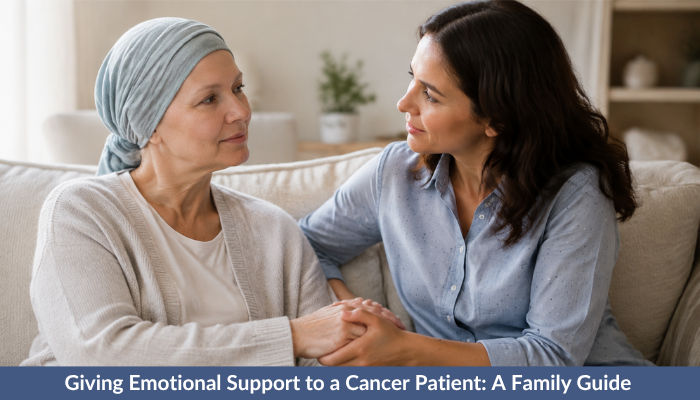
Listening without rushing to fix everything is the most powerful support a family can offer a cancer patient. Sitting with the patient, acknowledging their fear, and simply being present often matters more than advice. Consistency, patience, and small daily gestures of care build trust over the course of cancer treatment.

What should you say to someone diagnosed with cancer?

Simple, honest statements work best: I am here for you, we will get through this together, or tell me what you need today. Avoid false promises about outcomes and instead offer steady presence.

What should you avoid saying to a cancer patient?

Avoid comparing the patient’s cancer to someone else’s case, offering unsolicited cures, or saying things like just stay positive in a way that dismisses real fear. Statements that minimize the seriousness of cancer can make the patient feel unheard.

How can you help a patient stay positive without giving false hope?

Focus on what is known and controllable, such as the treatment plan and the surgeon’s experience, rather than promising a specific outcome. Celebrating small milestones, like completing a chemotherapy cycle or recovering well after cancer surgery, builds realistic optimism.

How do you encourage a cancer patient without pressuring them?

Offer choices instead of instructions. Asking would you like to try a short walk today respects the patient’s autonomy more than insisting they must exercise. Encouragement works best when the patient feels supported rather than managed.

How can family members reduce a cancer patient's anxiety?

Keeping routines predictable, explaining what to expect before each hospital visit, and staying calm during appointments all reduce anxiety. Breathing exercises and short relaxation practices before scans or cancer surgery can also help.

How can you help someone who feels hopeless after a cancer diagnosis?

Acknowledge the feeling instead of arguing against it, then gently connect the patient with their oncology team, a counselor, or a cancer support group. Professional help is important if hopelessness persists beyond a few weeks, as this can indicate depression linked to cancer.

How can you support a loved one who is afraid of cancer surgery?

Fear of cancer surgery is common and often eases once the patient understands the procedure clearly. Encourage them to ask their surgeon direct questions about the operation, recovery time, and expected results. Meeting an experienced cancer surgeon who explains the process in plain language, as Dr. Anup Ramani does during his consultations for robotic cancer surgery, can significantly reduce this fear.

What should you do if a cancer patient becomes angry or withdrawn?

Avoid taking the reaction personally, since anger and withdrawal are often the patient’s way of processing the loss of control that cancer brings. Stay available without forcing conversation, and give the patient space to come back on their own terms.

How can family members build confidence in a cancer patient?

Involve the patient in decisions about their own care, praise their effort during difficult treatment days, and remind them of their strength through past challenges. Confidence grows when patients feel like active participants in their cancer journey rather than passive recipients of care.

What Our Patients Are Saying

" Dr. Ramani was very professional in his approach. He spent a lot of time to discuss the problem and compassionately handled a very complicated case. He is always accessible and ready to go the extra mile to put the patient at ease. Highly recommended! "
Manish Maheswari
On Google

Communicating with a Cancer Patient and Their Doctors

How should family members talk to a cancer patient about their diagnosis?

Speak honestly, calmly, and at a pace the patient sets. Ask what level of detail they want rather than assuming, since some cancer patients want every medical fact while others prefer a simpler summary.

Should children be informed about a parent's cancer diagnosis?

Yes, age appropriate honesty is usually healthier than secrecy, since children often sense when something is wrong. A simple explanation that a parent has cancer and is receiving treatment from doctors, without frightening detail, helps children feel included rather than confused.

How much cancer related information should families share with relatives?

Share only what the patient is comfortable disclosing. Ask the patient directly who should know and how much detail to give, since privacy around a cancer diagnosis is a personal choice.

Should a cancer patient know every detail about their disease?

Most patients benefit from understanding their diagnosis, treatment plan, and prognosis, since this supports informed decisions. However, the pace and depth of information should always follow the patient’s own comfort level.

How can families communicate with the cancer treatment team effectively?

Prepare questions in advance, bring a notebook or phone to record answers, and designate one family member to coordinate communication with the oncology and surgery team. This avoids repeated questions and keeps everyone informed consistently.

What questions should family members ask during cancer doctor visits?

Useful questions include the stage of the cancer, available treatment options such as surgery, chemotherapy, or radiation, expected side effects, recovery timeline, and how to reach the team in an emergency. When a cancer surgery such as a robotic prostatectomy or nephrectomy is planned, ask specifically about the surgeon’s experience with that procedure, since outcomes are closely linked to surgical volume.

Protecting a Cancer Patient's Mental Health

How can families recognize depression in a cancer patient?

Persistent sadness, loss of interest in activities the patient once enjoyed, changes in sleep or appetite, and withdrawal from family for more than two weeks can indicate depression linked to cancer. This is different from the normal ups and downs of a cancer diagnosis and deserves professional evaluation.

How can caregivers help reduce loneliness in a cancer patient?

Regular visits, phone calls, and involving the patient in family conversations and decisions all reduce isolation. Connecting the patient with others who have faced similar cancer diagnoses can also ease loneliness.

Should cancer patients see a counselor or psychologist?

Yes, many cancer centers now include psychological support as part of standard cancer care, since the emotional burden of diagnosis and treatment is significant. A counselor can give the patient tools to manage anxiety, fear, and the identity changes that cancer can bring.

How can meditation and relaxation help a cancer patient?

Simple breathing exercises, guided meditation, and relaxation techniques can lower anxiety before appointments, procedures, or cancer surgery. These practices also help with sleep, which is often disrupted during cancer treatment.

What activities improve emotional wellbeing in a cancer patient?

Light hobbies, time in nature, music, gentle creative activities, and connection with supportive friends or family all contribute to emotional wellbeing during a cancer journey. The right activity depends on the patient’s energy level and personal interests.

Caring for the Family Caregiver During a Cancer Journey

How can caregivers avoid burnout while supporting a cancer patient?

Share responsibilities across family members, take scheduled breaks, and accept help when offered. Burnout reduces the quality of care a family can give, so protecting the caregiver’s own energy is part of good cancer care.

Why is caregiver mental health important during a cancer journey?

A caregiver who is exhausted or overwhelmed is less able to provide steady, patient support. Caregiver mental health directly affects the emotional environment the cancer patient experiences at home.

How can caregiving responsibilities be shared among family members?

Divide tasks by strength, such as one person handling hospital visits, another managing finances, and another coordinating meals. A shared schedule prevents any single family member from carrying the entire burden of cancer care.

When should families seek outside help for cancer caregiving?

When caregiving needs exceed what the family can safely manage, such as around the clock care after major cancer surgery, professional home nursing or hospice support should be considered.

How can caregivers balance work and cancer caregiving responsibilities?

Speak openly with employers about flexible arrangements where possible, use available leave policies, and lean on extended family or professional caregivers during intensive phases of cancer treatment, such as the days immediately after surgery.

Emotional steadiness at home does not replace medical treatment, but it strongly influences how a cancer patient experiences their diagnosis, treatment, and recovery. A family that listens well, communicates honestly, and looks after its own wellbeing gives the patient the strongest possible foundation for the road ahead.

We are Fast in Response
Contact Now!

Conclusion:

A cancer diagnosis tests a family’s patience, honesty, and emotional resilience just as much as it tests the patient’s own strength. Families who stay present, communicate openly, and seek professional mental health support when needed give their loved one a steadier foundation to face cancer treatment. Equally important, caregivers who protect their own wellbeing are better able to sustain that support throughout the full cancer journey, not just in the first difficult weeks.

Note: This article is for general education about cancer surgery, treatment, and family support, and does not replace medical advice. For diagnosis and treatment of prostate, kidney, urinary bladder, testicular, or penile cancer, consult a qualified oncologist or cancer surgeon directly.

About Author

PARTIAL PENECTOMY
  • Partial penectomy is done in cases where glans and distal penis is involved with carcinoma. 
  • Partial penectomy is a type of organ-preserving surgery. Preservation of sexual and micturational function depends on the surgical dissection and reconstruction of residual urethra.
Kidney Stone Removal
  • Patients who develop stones in the kidney or ureter, often experience severe pain.
  • This condition usually needs a procedure to remove the kidney stones.
  • This procedure is called ureteroscopy and is performed very commonly.
  • It does not require any cuts and hence it is painless.
  • The procedure is performed with an endoscope inserted through the penis under spinal anesthesia.
  • The scope is inserted through the penis into the kidney and stones are dissolved with a laser.
  • The procedure takes about 40-50 minutes. 
  • A catheter (urine pipe) is kept after the procedure to drain the bladder. A stent is kept in the kidney at the same time.
  • Patient is mobile and walking in the room the same evening.
  • Hospital stay is one night and patient is discharged the next day after removal of the catheter.
  • Patient has to come back after six weeks to remove the stent in the kidney.
  • Patients can resume office a week after surgery and heavy activities like running, weight lifting, a month after the procedure.
  • We offer fixed packages for this procedure which can be obtained by calling our helpline +91 9967666060.
  • Men with an enlarged prostate, which is a normal ageing changes, often experiencing difficulty passing urine. This condition usually needs a procedure to trim the prostate and relieve the blockage.
  • This procedure is called TURP and is performed very commonly.
  • It does not require any cuts and hence it is painless.
  • The procedure is performed with an endoscope inserted through the penis under spinal anaesthesia.
  • The overgrown prostate is dissolved with a laser bloodlessly.
  • The procedure takes about 40 minutes.
  • A catheter (urine pipe) is kept after the procedure to drain the bladder.
  • Patient is mobile and walking in the room the same evening.
  • Hospital stay is two nights and patient is discharged with the catheter, which is removed after 4 days.
  • Patients can resume office a week after surgery and heavy activities like running, weight lifting, a month after the procedure.
  • We offer fixed packages for this procedure which can be obtained by calling our helpline +91 9967666060.
ROBOTIC ADRENALECTOMY FOR ADRENAL GLAND TUMOUR
  • Robotic adrenalectomy is a sophisticated, complex surgery and it is very important that an experienced surgeon performs this surgery to avoid major complications.

  • Once the anesthesia is done, and patient positioned, three micro cuts (3mm each) are made in the patient’s abdomen.

  • The arms of the Da Vinci robot are connected to the cuts via ports (tubes).

  • Dr. Ramani then sits in the controlling console to perform the surgery.

  • On an average, a robotic adrenalectomy takes one hour.

  • The surgery is almost completely bloodless and there has never been any need to transfuse blood after surgery.

  • A urine catheter and bag to drain the bladder is inserted during surgery.

  • A tiny drain pipe may be inserted in the surgical side of the abdomen, connected to a bag.

  • Patient is kept nil-by-mouth the day of the surgery, with IV fluids. Sips of water are started the next day and solid food by day three.

  • The drain pipe, if kept, is removed in the room on day 2 after surgery.

  • The catheter is removed on day two after surgery.

  • Total hospital stay for robotic adrenalectomy is 4 nights (including night before surgery).

  • Post discharge, a doctor from the surgical team visits the patient at home/ hotel room once every day.

RETURN TO ACTIVITY
  • On the day of discharge, patient is totally self-sufficient. They are able to walk freely without any pain, dress themselves, shower, toilet and they do not need to hire any nurse or help at home. Almost all patients are back to work within 2 weeks of surgery.

  • Heavy activities like running, weight lifting can be resumed after a month

FOLLOW UP AFTER SURGERY
  • Follow up after an adrenalectomy is in the form of CT scans, once a year for 5 years.
    Local patients usually meet Dr. Ramani after two weeks to discuss report.

  • Outstation patients are counselled on a phone consultation.

ROBOTIC SURGERY FOR BLADDER CANCER
  • Dr. Ramani is one of the very few surgeons in India who has the expertise to perform a robotic surgery for bladder cancer, which includes removing the urinary bladder and reconstructing a new bladder robotically.
  • Robotic radical cystectomy is an extremely sophisticated, complex surgery and it is very important that an experienced surgeon performs this surgery to avoid major complications.
  • Once the anaesthesia is done, and patient positioned, six micro cuts (3mm each) are made in the patient’s abdomen.
  • The arms of the Da Vinci robot are connected to the cuts via ports (tubes).
  • Dr. Ramani then sits in the controlling console to perform the surgery.
  • On an average, a robotic radical cystectomy with an ileal conduit takes 3-4 hours.
  • The surgery is almost completely bloodless and there has never been any need to transfuse blood after surgery.
  • A urine catheter and bag to drain the new bladder is inserted during surgery.
  • Two tiny drain pipe in inserted in the surgical side of the abdomen, connected to a bag.
  • Patient is kept nil-by-mouth for 4 days after surgery with IV supplementation of patient’s daily requirements of calories, fats, carbohydrates, proteins and electrolytes.
  • The drain pipes are removed in the room on day 3-5 after surgery.
  • Total hospital stay for radical cystectomy is 8 nights (including night before surgery).
  • Post discharge, a doctor from the surgical team visits the patient at home/ hotel room once every day.
RETURN TO ACTIVITY
  • On the day of discharge, patient is totally self-sufficient. They are able to walk freely without any pain, dress themselves, shower, toilet and they do not need to hire any nurse or help at home.
  • Almost all patients are back to work within 6 weeks of surgery. Heavy activities like running, weight lifting can be resumed after two months.
FOLLOW UP AFTER SURGERY
  • Follow up after a radical a cystectomy is in the form of CT scans, once a year for 5 years.

  • Histopathology report: Local patients usually meet Dr. Ramani after two weeks to discuss report.

  • Outstation patients are counselled on a phone consult. Depending on the report, patient may or may not need chemotherapy after surgery.

  • If chemo is needed, patients may choose to get it done with a medical oncologist of their choice or avail the services of one of the four medical oncologists on our team.

ROBOTIC RADICAL/PARTIAL NEPHRECTOMY FOR KIDNEY CANCER
  • Robotic partial nephrectomy is a sophisticated, complex surgery and it is very important that an experienced surgeon performs this surgery to avoid major complications. Robotic radical (total) nephrectomy is
  • relatively easier but still requires significant experience to consistently deliver results.
  • Once the anaesthesia is done, and patient positioned, five micro cuts (3mm each) are made in the patient’s abdomen.
  • The arms of the Da Vinci robot are connected to the cuts via ports (tubes).
  • Dr. Ramani then sits in the controlling console to perform the surgery.
  • On an average, a robotic radical nephrectomy takes one hour and a robotic partial nephrectomy takes about an hour and half.
  • The surgery is almost completely bloodless and there has never been any need to transfuse blood after surgery.
  • A urine catheter and bag to drain the bladder is inserted during surgery.
  • A tiny drain pipe in inserted in the surgical side of the abdomen, connected to a bag.
  • Patient is kept nil-by-mouth the day of the surgery, with IV fluids. Sips of water are started the next day and solid food by day three.
  • The drain pipe is removed in the room on day 3 after surgery. The catheter is removed on day two after surgery.
  • Total hospital stay for radical/partial nephrectomy is 4 nights (including night before surgery).
  • Post discharge, a doctor from the surgical team visits the patient at home/ hotel room once every day.
RETURN TO ACTIVITY
  • On the day of discharge, patient is totally self- sufficient. 
  • They are able to walk freely without any pain, dress themselves, shower, toilet and they do not need to hire any nurse or help at home. 
  • Almost all patients are back to work within 2-3 weeks of surgery.
  • Heavy activities like running, weight lifting can be resumed after a month.
FOLLOW UP AFTER SURGERY
  • Follow up after a radical/partial Nephrectomy is in the form of CT scans, once a year for 5 years.
  • Local patients usually meet Dr. Ramani after two weeks to discuss report. 
  • Outstation patients are counselled on a phone consultation.