






By Dr. Anup Ramani
Share At:
Google AI ChatGPT Grok Perplexity

Listening Article

Objective

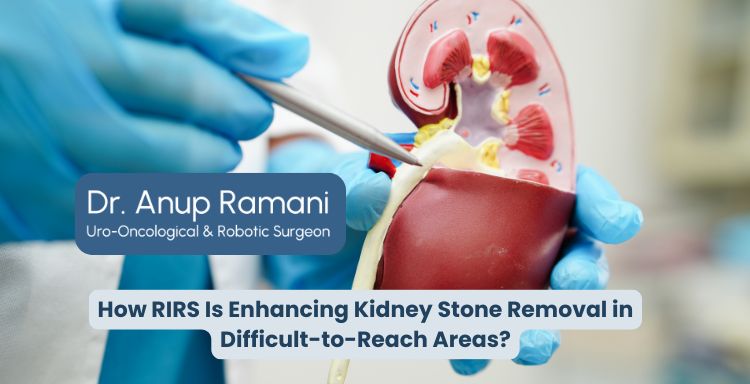
RIRS is changing the way doctors remove kidney stones, especially those that are hard to reach. This modern, minimal invasive surgery allows for safe and accurate treatment using advanced tools like flexible ureteroscopes and lasers. In this article, we’ll explain how RIRS helps treat complex kidney stones better than traditional methods, especially in areas of the kidney that are difficult to reach.

Understanding Difficult-to-Reach Kidney Stones and Their Treatment Challenges

Some kidney stones are harder to treat than others – not because they’re bigger, but because of where they are. Stones located in the lower pole of the kidney, inside narrow tubes called calyces or in abnormal kidney structures can be very tricky to access. These areas are deep, curved or tight, making it difficult for older treatment methods to work effectively.

For example, treatments like shockwave therapy (ESWL), which uses sound waves to break up stones from outside the body, often fail to reach these stones properly. Similarly, open surgery or even standard endoscopic methods may not bend or move enough to reach stones in these complex areas. This leads to incomplete treatment, leftover stones and the need for repeated surgeries.

Patients with these types of kidney stones often deal with pain, infections and long-term kidney issues. That’s why a newer, more flexible approach like RIRS is needed to solve the problem safely and effectively.

What Makes RIRS Superior for Accessing Hard-to-Reach Kidney Areas

RIRS stands out because it uses a special instrument called a flexible ureteroscope. This scope enters the body through the urine pathway – starting at the urethra, going through the bladder, up the ureter and into the kidney. There’s no need to cut the skin, so it’s much less invasive than open surgery.

Once inside the kidney, the flexible ureteroscope can bend and turn to reach nearly any corner of the kidney, even deep or narrow areas. Traditional tools don’t have this kind of flexibility, which is why they struggle in complex cases.

In RIRS, doctors also use a thin laser fiber through the scope. This laser breaks the stone into tiny pieces or dust, which can then pass naturally in urine or be removed with a small basket. This approach is especially helpful for removing a kidney stone from spots that were previously considered unreachable.

RIRS gives surgeons better control, fewer complications and a more complete treatment – making it ideal for tricky cases.

Email Dr. Ramani for Robotic Prostate Cancer Surgery

How Flexible Ureteroscopes Improve Navigation Inside the Kidney

The real magic of RIRS lies in the flexible ureteroscope. Unlike older instruments that are straight and stiff, flexible scopes can move in many directions. This is very helpful in the kidney, which has a complex shape with many curves and small chambers.

The flexible ureteroscope can bend as much as degrees, allowing the doctor to guide it into narrow parts of the kidney where stones often hide. It also has a tiny camera and light at the tip, so the surgeon can see everything clearly on a screen during the procedure.

This technology allows the doctor to locate the stone accurately and treat it without damaging healthy parts of the kidney. It also makes the surgery safer and more successful. In difficult cases where the stone is stuck in a narrow or twisted part of the kidney, this tool is a game-changer.

Thanks to these scopes, RIRS is now one of the most effective ways to perform surgery for kidney stones, especially in patients with unusual kidney shapes or previous surgeries.

What Our Patients Are Saying

"Dr. Anup Ramani is incredibly knowledgeable and took the time to answer all our questions. His commitment to healing and caring for others is truly inspiring. Highly recommend."
Dhara Sodha
On Google

Laser Fragmentation Advantages in Treating Deeply Located Kidney Stones

RIRS uses powerful lasers – like the Holmium or Thulium laser – to break kidney stones into small fragments. This process is called laser fragmentation and it’s one of the biggest benefits of RIRS.

Here’s how it works: the doctor passes a thin laser fiber through the ureteroscope and aims it at the stone. The laser energy breaks the stone into dust or small pieces. These can then pass naturally in urine or be removed with special tools.

This is a big advantage for stones in hard-to-reach places, like the lower pole of the kidney or tight calyceal spaces. Other treatments can’t reach these areas well or might damage the kidney trying to do so. But the laser used in RIRS is safe, accurate and works even in tight spaces.

Also, laser energy works on all types of stones – whether they’re made of calcium, uric acid or other materials. The stone doesn’t need to be removed in one big piece, which avoids the need for larger tools or bigger cuts.

This method reduces the chances of complications, shortens recovery time and increases the success of kidney stone removal by surgery.

Safety and Precision of RIRS in Managing Stones in Complex Renal Anatomy

Some people have kidneys that are shaped differently or have narrow internal structures due to birth defects or past surgeries. These make it harder and riskier to treat stones. But RIRS handles these situations very well.

Unlike traditional kidney stone removal surgery, RIRS enters the kidney through natural openings in the body. This means there’s no cutting through the skin or muscle, making it much safer and less painful.

Because RIRS is done under direct vision with a camera, the doctor can carefully guide the scope and laser to avoid hurting the kidney. This is especially important in complex cases, where small mistakes can lead to bleeding or injury.

In addition, because the laser is so precise, it only targets the stone and leaves healthy kidney tissue untouched. This makes RIRS a great choice for patients with hard-to-reach stones or unusual kidney shapes.

The result is a safer, less traumatic procedure with fewer side effects and better outcomes.

Kidney Stone Clearance Rates in Difficult Kidney Locations With RIRS

The main goal of any kidney stone treatment is to remove the stone completely, so it doesn’t come back or cause future problems. RIRS has shown very high success rates in this area, especially for stones that are difficult to access.

Studies show that RIRS can remove 85% to 95% of stones in tricky spots like the lower pole or calyceal diverticula. This is much better than shockwave therapy, which often fails to clear stones in deep areas.

Even better, RIRS can be repeated safely if more stones form later. It’s gentle on the kidney and can be used again without much risk. For patients who make stones often or have special kidney shapes, this makes RIRS a reliable long-term solution.

Also, since RIRS can access almost every part of the kidney, there’s less chance that stone fragments will be left behind. This reduces the risk of needing more surgeries and lowers the chances of infection or future pain.

For people looking for effective kidney stone removal in Mumbai or anywhere else, RIRS offers a modern, successful option that combines safety, precision and comfort.

Call us for Kidney Cancer Treatment

Conclusion

RIRS is making a big difference in how kidney stones are treated, especially when they are located in hard-to-reach areas. By using flexible scopes and advanced laser technology, doctors can now remove stones safely and completely without major surgery. This method is gentle on the kidney, has fewer risks and offers faster recovery. Whether stones are deep, curved or hidden in complex anatomy, RIRS provides a reliable and effective solution for kidney stone removal by surgery.

FAQs

RIRS is used to remove kidney stones, especially those in hard-to-reach areas, using a flexible scope and laser.

Yes, RIRS is less invasive, more precise and safer for stones located deep inside the kidney.

Most patients can go home the next day and return to normal activities within a few days.

Yes, RIRS works well for different types of stones, including calcium, uric acid and cystine stones.

About Author

PARTIAL PENECTOMY
  • Partial penectomy is done in cases where glans and distal penis is involved with carcinoma. 
  • Partial penectomy is a type of organ-preserving surgery. Preservation of sexual and micturational function depends on the surgical dissection and reconstruction of residual urethra.
Kidney Stone Removal
  • Patients who develop stones in the kidney or ureter, often experience severe pain.
  • This condition usually needs a procedure to remove the kidney stones.
  • This procedure is called ureteroscopy and is performed very commonly.
  • It does not require any cuts and hence it is painless.
  • The procedure is performed with an endoscope inserted through the penis under spinal anesthesia.
  • The scope is inserted through the penis into the kidney and stones are dissolved with a laser.
  • The procedure takes about 40-50 minutes. 
  • A catheter (urine pipe) is kept after the procedure to drain the bladder. A stent is kept in the kidney at the same time.
  • Patient is mobile and walking in the room the same evening.
  • Hospital stay is one night and patient is discharged the next day after removal of the catheter.
  • Patient has to come back after six weeks to remove the stent in the kidney.
  • Patients can resume office a week after surgery and heavy activities like running, weight lifting, a month after the procedure.
  • We offer fixed packages for this procedure which can be obtained by calling our helpline +91 9967666060.
  • Men with an enlarged prostate, which is a normal ageing changes, often experiencing difficulty passing urine. This condition usually needs a procedure to trim the prostate and relieve the blockage.
  • This procedure is called TURP and is performed very commonly.
  • It does not require any cuts and hence it is painless.
  • The procedure is performed with an endoscope inserted through the penis under spinal anaesthesia.
  • The overgrown prostate is dissolved with a laser bloodlessly.
  • The procedure takes about 40 minutes.
  • A catheter (urine pipe) is kept after the procedure to drain the bladder.
  • Patient is mobile and walking in the room the same evening.
  • Hospital stay is two nights and patient is discharged with the catheter, which is removed after 4 days.
  • Patients can resume office a week after surgery and heavy activities like running, weight lifting, a month after the procedure.
  • We offer fixed packages for this procedure which can be obtained by calling our helpline +91 9967666060.
ROBOTIC ADRENALECTOMY FOR ADRENAL GLAND TUMOUR
  • Robotic adrenalectomy is a sophisticated, complex surgery and it is very important that an experienced surgeon performs this surgery to avoid major complications.

  • Once the anesthesia is done, and patient positioned, three micro cuts (3mm each) are made in the patient’s abdomen.

  • The arms of the Da Vinci robot are connected to the cuts via ports (tubes).

  • Dr. Ramani then sits in the controlling console to perform the surgery.

  • On an average, a robotic adrenalectomy takes one hour.

  • The surgery is almost completely bloodless and there has never been any need to transfuse blood after surgery.

  • A urine catheter and bag to drain the bladder is inserted during surgery.

  • A tiny drain pipe may be inserted in the surgical side of the abdomen, connected to a bag.

  • Patient is kept nil-by-mouth the day of the surgery, with IV fluids. Sips of water are started the next day and solid food by day three.

  • The drain pipe, if kept, is removed in the room on day 2 after surgery.

  • The catheter is removed on day two after surgery.

  • Total hospital stay for robotic adrenalectomy is 4 nights (including night before surgery).

  • Post discharge, a doctor from the surgical team visits the patient at home/ hotel room once every day.

RETURN TO ACTIVITY
  • On the day of discharge, patient is totally self-sufficient. They are able to walk freely without any pain, dress themselves, shower, toilet and they do not need to hire any nurse or help at home. Almost all patients are back to work within 2 weeks of surgery.

  • Heavy activities like running, weight lifting can be resumed after a month

FOLLOW UP AFTER SURGERY
  • Follow up after an adrenalectomy is in the form of CT scans, once a year for 5 years.
    Local patients usually meet Dr. Ramani after two weeks to discuss report.

  • Outstation patients are counselled on a phone consultation.

ROBOTIC SURGERY FOR BLADDER CANCER
  • Dr. Ramani is one of the very few surgeons in India who has the expertise to perform a robotic surgery for bladder cancer, which includes removing the urinary bladder and reconstructing a new bladder robotically.
  • Robotic radical cystectomy is an extremely sophisticated, complex surgery and it is very important that an experienced surgeon performs this surgery to avoid major complications.
  • Once the anaesthesia is done, and patient positioned, six micro cuts (3mm each) are made in the patient’s abdomen.
  • The arms of the Da Vinci robot are connected to the cuts via ports (tubes).
  • Dr. Ramani then sits in the controlling console to perform the surgery.
  • On an average, a robotic radical cystectomy with an ileal conduit takes 3-4 hours.
  • The surgery is almost completely bloodless and there has never been any need to transfuse blood after surgery.
  • A urine catheter and bag to drain the new bladder is inserted during surgery.
  • Two tiny drain pipe in inserted in the surgical side of the abdomen, connected to a bag.
  • Patient is kept nil-by-mouth for 4 days after surgery with IV supplementation of patient’s daily requirements of calories, fats, carbohydrates, proteins and electrolytes.
  • The drain pipes are removed in the room on day 3-5 after surgery.
  • Total hospital stay for radical cystectomy is 8 nights (including night before surgery).
  • Post discharge, a doctor from the surgical team visits the patient at home/ hotel room once every day.
RETURN TO ACTIVITY
  • On the day of discharge, patient is totally self-sufficient. They are able to walk freely without any pain, dress themselves, shower, toilet and they do not need to hire any nurse or help at home.
  • Almost all patients are back to work within 6 weeks of surgery. Heavy activities like running, weight lifting can be resumed after two months.
FOLLOW UP AFTER SURGERY
  • Follow up after a radical a cystectomy is in the form of CT scans, once a year for 5 years.

  • Histopathology report: Local patients usually meet Dr. Ramani after two weeks to discuss report.

  • Outstation patients are counselled on a phone consult. Depending on the report, patient may or may not need chemotherapy after surgery.

  • If chemo is needed, patients may choose to get it done with a medical oncologist of their choice or avail the services of one of the four medical oncologists on our team.

ROBOTIC RADICAL/PARTIAL NEPHRECTOMY FOR KIDNEY CANCER
  • Robotic partial nephrectomy is a sophisticated, complex surgery and it is very important that an experienced surgeon performs this surgery to avoid major complications. Robotic radical (total) nephrectomy is
  • relatively easier but still requires significant experience to consistently deliver results.
  • Once the anaesthesia is done, and patient positioned, five micro cuts (3mm each) are made in the patient’s abdomen.
  • The arms of the Da Vinci robot are connected to the cuts via ports (tubes).
  • Dr. Ramani then sits in the controlling console to perform the surgery.
  • On an average, a robotic radical nephrectomy takes one hour and a robotic partial nephrectomy takes about an hour and half.
  • The surgery is almost completely bloodless and there has never been any need to transfuse blood after surgery.
  • A urine catheter and bag to drain the bladder is inserted during surgery.
  • A tiny drain pipe in inserted in the surgical side of the abdomen, connected to a bag.
  • Patient is kept nil-by-mouth the day of the surgery, with IV fluids. Sips of water are started the next day and solid food by day three.
  • The drain pipe is removed in the room on day 3 after surgery. The catheter is removed on day two after surgery.
  • Total hospital stay for radical/partial nephrectomy is 4 nights (including night before surgery).
  • Post discharge, a doctor from the surgical team visits the patient at home/ hotel room once every day.
RETURN TO ACTIVITY
  • On the day of discharge, patient is totally self- sufficient. 
  • They are able to walk freely without any pain, dress themselves, shower, toilet and they do not need to hire any nurse or help at home. 
  • Almost all patients are back to work within 2-3 weeks of surgery.
  • Heavy activities like running, weight lifting can be resumed after a month.
FOLLOW UP AFTER SURGERY
  • Follow up after a radical/partial Nephrectomy is in the form of CT scans, once a year for 5 years.
  • Local patients usually meet Dr. Ramani after two weeks to discuss report. 
  • Outstation patients are counselled on a phone consultation.