





Dr Anup Ramani @ Copyright 2024
By Dr. Anup Ramani
Objective
Prostate enlargement, medically known as Benign Prostatic Hyperplasia (BPH), is a common condition in older men and often leads to bladder dysfunction. When both issues occur together, they can significantly affect quality of life. TUR-P (Transurethral Resection of the Prostate) has proven to be an effective solution for treating both problems simultaneously. This article explores how TUR-P improves urinary symptoms, reduces bladder pressure and restores normal bladder function in patients facing this dual challenge.
Understanding Prostate Enlargement and Bladder Dysfunction: A Dual Clinical Challenge
Prostate enlargement is a non-cancerous growth of the prostate gland, typically seen in men over 50. As the prostate grows, it can press against the urethra – the tube through which urine exits the body – leading to a blockage. This obstruction prevents the bladder from emptying fully, resulting in a variety of urinary problems.
Bladder dysfunction is a common consequence of prolonged obstruction. When the bladder is forced to work harder to push urine past the enlarged prostate, it becomes overactive and irritated. This leads to symptoms such as frequent urination, urgency (a sudden, strong need to urinate), weak stream, incomplete emptying and nighttime urination (nocturia).
In some cases, the bladder may become so strained that it begins to retain urine even after a person has urinated – this is known as urinary retention. If left untreated, this can lead to infections, bladder stones or kidney damage. When patients have both an enlarged prostate and bladder dysfunction, treatment must target both problems to be effective. This is where TUR-P surgery becomes crucial.
How TUR-P Surgery Works for Patients With Both Prostate Enlargement and Bladder Dysfunction
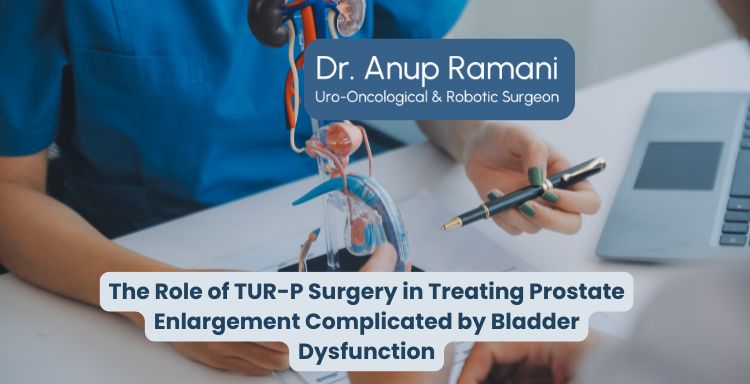
TUR-P or Transurethral Resection of the Prostate, is a minimal invasive surgical procedure used to treat enlarged prostate (BPH). It is often recommended when medications fail to relieve symptoms or when the prostate is significantly obstructing the urinary tract.
The procedure involves inserting a thin scope (called a resectoscope) through the urethra into the prostate. Using a heated wire loop, the surgeon removes small chips of prostate tissue that are pressing against the urethra. This clears the path for urine to flow freely from the bladder.
By eliminating the blockage, TUR-P surgery directly addresses the root cause of urinary symptoms and helps the bladder function more efficiently. Once the obstruction is removed, the bladder no longer has to strain during urination. This helps calm irritation, reduce urgency and improve overall bladder performance.
TUR-P for enlarged prostate treatment is especially helpful for patients who have both voiding symptoms and storage symptoms. It relieves the pressure and creates a better environment for the bladder to regain its normal function.
TUR-P as the Gold Standard for Treating Enlarged Prostate with Voiding Difficulties
Despite the availability of medications and newer minimal invasive procedures, TUR-P remains the gold standard for treating moderate to severe cases of enlarged prostate – especially when bladder dysfunction is involved. It has been used for decades and is known for delivering consistent, long-lasting results.
Medications may offer temporary relief by relaxing the prostate muscles or shrinking the gland, but they don’t physically remove the obstruction. In patients with significant blockage and long-standing symptoms, surgery becomes the more reliable option.
For those experiencing complications like urinary retention, frequent urinary tract infections or bladder stones, TUR-P is not only effective but often necessary. It improves both voiding and storage symptoms, making it ideal for men with combined prostate and bladder issues.
In leading hospitals offering enlarged prostate treatment and other parts of India, TUR-P is routinely recommended for men who have failed medical therapy or who present with complex symptoms. Its track record of safety and success makes it the preferred choice among urologists worldwide.
What Our Patients Are Saying
Improving Bladder Emptying With TUR-P: Restoring Normal Urinary Flow
One of the biggest benefits of TUR-P surgery for BPH is the dramatic improvement in bladder emptying. Before surgery, men with an enlarged prostate often have a weak urine stream, straining during urination and a constant feeling of incomplete emptying. These issues stem from the narrowing of the urethra due to prostate growth.
TUR-P resolves this by removing the extra prostate tissue blocking the urethra. After the surgery, the flow of urine becomes stronger and more consistent. Patients typically report significant relief from the sensation of incomplete emptying and notice they can urinate more freely.
This improvement helps reduce the risk of urinary retention – a condition where urine builds up in the bladder and cannot be fully released. Chronic retention can cause bladder muscle damage over time, so restoring normal flow is essential for long-term bladder health.
By relieving the obstruction, TUR-P also allows the bladder to return to its normal size and function. This is one of the most important goals of enlarged prostate surgery, especially when bladder dysfunction is part of the picture.
Reducing Bladder Pressure and Irritation After TUR-P Surgery
Prolonged obstruction from an enlarged prostate can cause the bladder to become overactive and irritable. The bladder muscles may become thickened and overly sensitive, leading to symptoms like urgency, frequency and urge incontinence. These storage symptoms are often more troublesome than voiding issues for many men.
TUR-P surgery helps by removing the root cause – the blockage. Once the pressure inside the bladder is reduced, the muscles can relax and start functioning normally again. Over time, many men see a noticeable drop in urgency and frequency, as the bladder no longer has to overcompensate to push out urine.
Reducing bladder pressure also lowers the risk of backflow of urine into the kidneys, which can be dangerous if left untreated. In this way, enlarged prostate (BPH) surgery not only improves quality of life but also helps preserve kidney function in the long term.
TUR-P allows the bladder to heal and reset. While some storage symptoms may take a few weeks to improve, the overall trend after surgery is toward less irritation and better control.
Outcomes of TUR-P in Patients with Chronic Bladder Dysfunction
Patients who have had bladder dysfunction for an extended period before undergoing TUR-P surgery may wonder how well their bladder will recover. The good news is that many experience significant improvements – even if their bladder has been weakened by years of obstruction.
Studies have shown that TUR-P helps improve bladder storage capacity, reduce nighttime urination (nocturia) and decrease the number of bathroom visits during the day. These improvements are especially meaningful for men who previously had disrupted sleep or were unable to travel or engage in social activities due to constant bathroom needs.
For some patients, bladder recovery may be gradual. The longer the bladder was under pressure, the longer it may take to regain normal tone. However, TUR-P sets the stage for healing by removing the primary obstacle.
In most cases, with time and appropriate follow-up, men regain much of their bladder function and experience far fewer complications. This is why TUR-P is often recommended in enlarged prostate surgerySS plans when bladder dysfunction has become chronic.
TUR-P vs Medication: Why Surgery Is More Effective for Combined Prostate and Bladder Problems
While medications can help manage mild to moderate symptoms of enlarged prostate, they have limitations – especially when bladder dysfunction is present. Alpha-blockers and 5-alpha-reductase inhibitors may reduce symptoms temporarily, but they don’t reverse the damage caused by prolonged bladder strain.
In contrast, TUR-P surgery provides immediate physical relief by removing obstructing tissue. It addresses both voiding and storage problems and prevents further damage to the bladder and kidneys.
Men who depend solely on medications may find their symptoms returning or worsening over time. Additionally, some patients don’t respond well to drugs or experience side effects such as dizziness, fatigue or sexual dysfunction.
For these reasons, TUR-P is often the more effective choice for men with both prostate enlargement and significant bladder symptoms. In experienced centers offering enlarged prostate treatment in Mumbai, TUR-P is routinely chosen over medication for long-term results and better bladder protection.
Post-TUR-P Recovery: How Patients Regain Bladder Function After Surgery
Recovery after TUR-P surgery is generally smooth, though every patient is different. Most men spend 1 to 2 days in the hospital, during which a catheter is used to help drain the bladder. Once the catheter is removed, many notice an immediate improvement in urinary flow.
However, it’s normal to experience some temporary symptoms during healing. These can include mild burning during urination, increased urgency or slight bleeding. These symptoms usually resolve within a few weeks as the tissues heal.
The bladder may take time to adjust to its new, obstruction-free environment. Doctors often recommend staying hydrated, avoiding caffeine and alcohol for a while and gradually resuming physical activity. Follow-up visits ensure that healing is on track and that bladder function is improving.
In the months after surgery, patients often report better sleep, more confidence in public settings and a renewed sense of comfort in daily life. With proper care, enlarged prostate treatment through TUR-P offers lasting relief and a return to normal bladder function.
FAQs
What makes TUR-P effective for treating both prostate enlargement and bladder dysfunction?
TUR-P removes the prostate tissue causing blockage, which helps restore normal urine flow and allows the bladder to function more efficiently.
How long does it take to recover after TUR-P surgery?
Most patients recover within 2 to 4 weeks, with noticeable improvements in urination and bladder control within the first few days.
Can TUR-P help with frequent nighttime urination?
Yes, by relieving pressure on the bladder, TUR-P often reduces nighttime urination and improves sleep quality.
Is TUR-P better than medication for enlarged prostate with bladder problems?
Yes, TUR-P provides long-term relief and better outcomes when bladder symptoms are severe or unresponsive to medication.
About Author

Uro-Oncological & Robotic Surgeon
Dr. Anup Ramani is a robotic uro-oncological surgeon and an internationally recognized expert in robotic surgery for prostate, kidney and urinary bladder cancers. With more than two decades of robotic experience and 2,000+ robotic procedures, he brings unmatched precision and outcomes to complex uro-oncology cases. He is widely published in his field and is known for a personal, transparent approach-often spending over an hour in initial consultations to educate patients on its disease, surgery and recovery. His expertise spans prostate cancer treatment, kidney and bladder cancer surgery, adrenal gland surgery, kidney stone treatment, penile cancer surgery and enlarged prostate management. Dr. Ramani advocates the advantages of robotic surgery-magnified 3D vision, tremor-filtered precision, minimal scarring, lower blood loss and faster recovery-helping patients return to life sooner.
Table of Contents

Recent Blogs
- The Role of TUR-P Surgery in Treating Prostate Enlargement Complicated by Bladder Dysfunction
- The Role of Multidisciplinary Care in Managing Comp ...
- The Role of TUR-P Surgery in Treating Prostate Enla ...
- The Growing Popularity of URS and RIRS for Treating ...
- How RIRS Is Enhancing Kidney Stone Removal in Diffi ...
Best Uro-Oncological surgeon
Specialist in India for Robotic Surgery
MCh, DNB, MS, DNB
Dr. Anup Ramani
CONTACT
Uro-Oncologist in India,
Best Robotic Surgeon for Uro Oncology Surgery
1407, One Lodha Place Next to World Towers Senapati Bapat Marg, Worli, Mumbai. 400013.
Dr Anup Ramani @ Copyright 2024 – Website Maintenance, SEO & GEO by Opal Infotech
- Partial penectomy is done in cases where glans and distal penis is involved with carcinoma.
- Partial penectomy is a type of organ-preserving surgery. Preservation of sexual and micturational function depends on the surgical dissection and reconstruction of residual urethra.
- Patients who develop stones in the kidney or ureter, often experience severe pain.
- This condition usually needs a procedure to remove the kidney stones.
- This procedure is called ureteroscopy and is performed very commonly.
- It does not require any cuts and hence it is painless.
- The procedure is performed with an endoscope inserted through the penis under spinal anesthesia.
- The scope is inserted through the penis into the kidney and stones are dissolved with a laser.
- The procedure takes about 40-50 minutes.
- A catheter (urine pipe) is kept after the procedure to drain the bladder. A stent is kept in the kidney at the same time.
- Patient is mobile and walking in the room the same evening.
- Hospital stay is one night and patient is discharged the next day after removal of the catheter.
- Patient has to come back after six weeks to remove the stent in the kidney.
- Patients can resume office a week after surgery and heavy activities like running, weight lifting, a month after the procedure.
- We offer fixed packages for this procedure which can be obtained by calling our helpline +91 9967666060.
- Men with an enlarged prostate, which is a normal ageing changes, often experiencing difficulty passing urine. This condition usually needs a procedure to trim the prostate and relieve the blockage.
- This procedure is called TURP and is performed very commonly.
- It does not require any cuts and hence it is painless.
- The procedure is performed with an endoscope inserted through the penis under spinal anaesthesia.
- The overgrown prostate is dissolved with a laser bloodlessly.
- The procedure takes about 40 minutes.
- A catheter (urine pipe) is kept after the procedure to drain the bladder.
- Patient is mobile and walking in the room the same evening.
- Hospital stay is two nights and patient is discharged with the catheter, which is removed after 4 days.
- Patients can resume office a week after surgery and heavy activities like running, weight lifting, a month after the procedure.
- We offer fixed packages for this procedure which can be obtained by calling our helpline +91 9967666060.
-
Robotic adrenalectomy is a sophisticated, complex surgery and it is very important that an experienced surgeon performs this surgery to avoid major complications.
-
Once the anesthesia is done, and patient positioned, three micro cuts (3mm each) are made in the patient’s abdomen.
-
The arms of the Da Vinci robot are connected to the cuts via ports (tubes).
-
Dr. Ramani then sits in the controlling console to perform the surgery.
-
On an average, a robotic adrenalectomy takes one hour.
-
The surgery is almost completely bloodless and there has never been any need to transfuse blood after surgery.
-
A urine catheter and bag to drain the bladder is inserted during surgery.
-
A tiny drain pipe may be inserted in the surgical side of the abdomen, connected to a bag.
-
Patient is kept nil-by-mouth the day of the surgery, with IV fluids. Sips of water are started the next day and solid food by day three.
-
The drain pipe, if kept, is removed in the room on day 2 after surgery.
-
The catheter is removed on day two after surgery.
-
Total hospital stay for robotic adrenalectomy is 4 nights (including night before surgery).
-
Post discharge, a doctor from the surgical team visits the patient at home/ hotel room once every day.
On the day of discharge, patient is totally self-sufficient. They are able to walk freely without any pain, dress themselves, shower, toilet and they do not need to hire any nurse or help at home. Almost all patients are back to work within 2 weeks of surgery.
Heavy activities like running, weight lifting can be resumed after a month
Follow up after an adrenalectomy is in the form of CT scans, once a year for 5 years.
Local patients usually meet Dr. Ramani after two weeks to discuss report.Outstation patients are counselled on a phone consultation.
- Dr. Ramani is one of the very few surgeons in India who has the expertise to perform a robotic surgery for bladder cancer, which includes removing the urinary bladder and reconstructing a new bladder robotically.
- Robotic radical cystectomy is an extremely sophisticated, complex surgery and it is very important that an experienced surgeon performs this surgery to avoid major complications.
- Once the anaesthesia is done, and patient positioned, six micro cuts (3mm each) are made in the patient’s abdomen.
- The arms of the Da Vinci robot are connected to the cuts via ports (tubes).
- Dr. Ramani then sits in the controlling console to perform the surgery.
- On an average, a robotic radical cystectomy with an ileal conduit takes 3-4 hours.
- The surgery is almost completely bloodless and there has never been any need to transfuse blood after surgery.
- A urine catheter and bag to drain the new bladder is inserted during surgery.
- Two tiny drain pipe in inserted in the surgical side of the abdomen, connected to a bag.
- Patient is kept nil-by-mouth for 4 days after surgery with IV supplementation of patient’s daily requirements of calories, fats, carbohydrates, proteins and electrolytes.
- The drain pipes are removed in the room on day 3-5 after surgery.
- Total hospital stay for radical cystectomy is 8 nights (including night before surgery).
- Post discharge, a doctor from the surgical team visits the patient at home/ hotel room once every day.
- On the day of discharge, patient is totally self-sufficient. They are able to walk freely without any pain, dress themselves, shower, toilet and they do not need to hire any nurse or help at home.
- Almost all patients are back to work within 6 weeks of surgery. Heavy activities like running, weight lifting can be resumed after two months.
Follow up after a radical a cystectomy is in the form of CT scans, once a year for 5 years.
Histopathology report: Local patients usually meet Dr. Ramani after two weeks to discuss report.
Outstation patients are counselled on a phone consult. Depending on the report, patient may or may not need chemotherapy after surgery.
If chemo is needed, patients may choose to get it done with a medical oncologist of their choice or avail the services of one of the four medical oncologists on our team.
- Robotic partial nephrectomy is a sophisticated, complex surgery and it is very important that an experienced surgeon performs this surgery to avoid major complications. Robotic radical (total) nephrectomy is
- relatively easier but still requires significant experience to consistently deliver results.
- Once the anaesthesia is done, and patient positioned, five micro cuts (3mm each) are made in the patient’s abdomen.
- The arms of the Da Vinci robot are connected to the cuts via ports (tubes).
- Dr. Ramani then sits in the controlling console to perform the surgery.
- On an average, a robotic radical nephrectomy takes one hour and a robotic partial nephrectomy takes about an hour and half.
- The surgery is almost completely bloodless and there has never been any need to transfuse blood after surgery.
- A urine catheter and bag to drain the bladder is inserted during surgery.
- A tiny drain pipe in inserted in the surgical side of the abdomen, connected to a bag.
- Patient is kept nil-by-mouth the day of the surgery, with IV fluids. Sips of water are started the next day and solid food by day three.
- The drain pipe is removed in the room on day 3 after surgery. The catheter is removed on day two after surgery.
- Total hospital stay for radical/partial nephrectomy is 4 nights (including night before surgery).
- Post discharge, a doctor from the surgical team visits the patient at home/ hotel room once every day.
- On the day of discharge, patient is totally self- sufficient.
- They are able to walk freely without any pain, dress themselves, shower, toilet and they do not need to hire any nurse or help at home.
- Almost all patients are back to work within 2-3 weeks of surgery.
- Heavy activities like running, weight lifting can be resumed after a month.
- Follow up after a radical/partial Nephrectomy is in the form of CT scans, once a year for 5 years.
- Local patients usually meet Dr. Ramani after two weeks to discuss report.
- Outstation patients are counselled on a phone consultation.