




By Dr. Anup Ramani
Share At:
Google AI ChatGPT Grok Perplexity

Listening Article

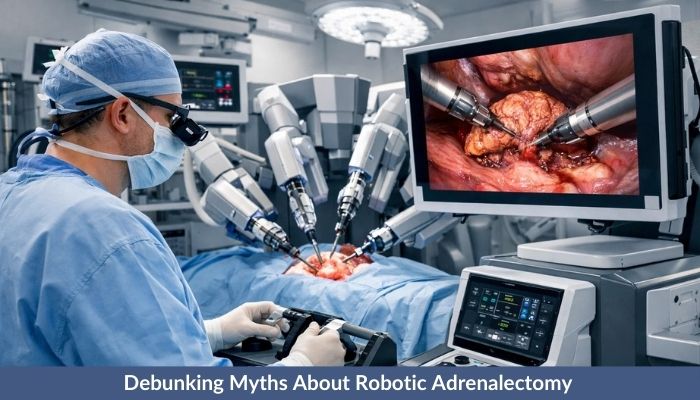
Adrenal gland surgery is an essential treatment for various conditions related to the adrenal glands. However, there are numerous misconceptions about the procedure. These myths can make people nervous and misinformed about what to expect during the process. As more people are opting for advanced treatments like robotic adrenalectomy, it’s crucial to clear up these myths to ensure patients understand their options, what the surgery involves and how it can benefit them. Below, we will debunk the top 10 myths about adrenal gland surgery, with insights from experienced surgeons who specialize in adrenal gland treatment.

 
We are Available on Chat, Call, Email!
White Email Us
 

Adrenal Gland Surgery Requires Removal of Both Glands

One of the most persistent myths about adrenal gland surgery is that both adrenal glands will need to be removed. This is not true. Most adrenal gland surgeries are focused on removing just one gland, often due to tumors or adrenal disorders affecting a single gland. The other adrenal gland can typically compensate for the loss of function. Surgical removal of both glands, also known as bilateral adrenalectomy, is rarely necessary and typically occurs only in very specific medical conditions, such as bilateral tumors or adrenal insufficiency.

Adrenal Gland Surgery is Only Performed for Cancerous Tumors

While it’s true that adrenal glands are commonly removed when they harbor cancerous tumors, many people are unaware that adrenalectomy can also be performed for non-cancerous conditions. Benign conditions such as adrenal adenomas, pheochromocytomas or Cushing’s syndrome can also necessitate surgery to prevent complications such as hypertension, hormone imbalances or excessive hormone production.

Robotic Adrenalectomy is Only for Highly Complex Cases

A major misconception about robotic adrenalectomy surgery is that it’s reserved only for extremely complex cases. In fact, robotic adrenalectomy can be used for a wide range of adrenal gland surgeries, from benign tumors to functional adrenal disorders. This technology is available to patients with both simple and complicated adrenal conditions, as it enhances precision, reduces recovery time and minimizes scarring even for less complex cases.

Traditional Open Surgery is Always More Effective Than Robotic Surgery for Adrenal Gland Removal

Despite the increasing use of robotic surgery in adrenal gland removal, some patients still believe that traditional open surgery is the more effective option. However, robotic adrenalectomy surgery has been proven to have numerous advantages, including reduced blood loss, faster recovery, smaller incisions and a lower risk of infection. Surgeons who specialize in robotic adrenalectomy have consistently shown that robotic surgery leads to superior outcomes in terms of precision, healing and patient satisfaction.

Recovery After Robotic Adrenalectomy is the Same as Traditional Open Surgery

Although robotic adrenalectomy surgery is minimal invasive, there’s a myth that the recovery process is identical to traditional open surgery. In reality, the recovery after robotic surgery tends to be faster and less painful due to the smaller incisions and reduced trauma to surrounding tissues. Most patients undergoing robotic adrenalectomy can return to their normal activities in a much shorter time frame compared to those who undergo open surgery.

Adrenal Gland Removal Leads to Severe Hormonal Imbalances or Life-Altering Consequences

Many people fear that adrenal gland removal will result in life-altering hormone imbalances, especially after the adrenal gland surgery. However, most patients only experience temporary imbalances that are easily managed. The remaining adrenal gland typically compensates for the loss of the removed gland and hormone therapy is not usually required. The myth that adrenalectomy always leads to permanent hormone issues is not accurate for the majority of patients.

Adrenal Gland Surgery is Only Needed for Severe, Advanced Conditions

Another myth surrounding adrenal gland treatment is the misconception that surgery is only necessary when a condition becomes severe or advanced. In reality, surgery is often performed earlier in the disease process to prevent complications or to address issues before they worsen. For instance, functional adrenal tumors that cause hypertension or other symptoms may be surgically removed as a preventive measure, not just when they’ve progressed significantly.

Adrenal Gland Surgery is the Same Across the Board for All Patients

There’s a myth that adrenal gland surgery is the same for every patient, regardless of the underlying condition. In truth, the approach to adrenalectomy varies significantly depending on the patient’s specific condition, the size and type of tumor and whether it is malignant or benign. Surgeons will tailor their approach to the individual needs of the patient, considering factors such as the location of the tumor, the patient’s overall health and the surgical method most appropriate for their case.

What Our Patients Are Saying

"Dr. Anup Ramani is incredibly knowledgeable and took the time to answer all our questions. His commitment to healing and caring for others is truly inspiring. Highly recommend."
Dhara Sodha
On Google

Robotic Surgery is Too Expensive and Not Accessible for Most Patients

Some people mistakenly believe that robotic adrenal gland surgery is prohibitively expensive and not widely available. However, the costs associated with robotic surgery have become more comparable to traditional open surgery over time due to its increased adoption across many hospitals and surgical centers. The accessibility of robotic surgery has also improved and many centers now offer robotic adrenalectomy surgery as a standard procedure for adrenal gland removal, making it more widely available to patients than ever before.

The Adrenal Gland Surgery Procedure is Too New to Be Trusted

Some patients might hesitate to undergo robotic adrenal gland surgery because they perceive it as a new or experimental procedure. In fact, robotic surgery for adrenal gland removal has been extensively tested and refined over several years. It has become a trusted and established method with proven benefits, including high success rates, minimal complications and faster recovery times. Robotic adrenalectomy surgery is a trusted, evidence-based approach that is continually improving, making it a reliable option for patients needing adrenal gland treatment.

 
Want to Discuss?
White Call Us Now!
 

Why Choose Dr. Anup Ramani in Robotic Urology

Our team has a legacy of over two decades of international expertise in robotic surgery, particularly in adrenal gland treatment and removal. We are pioneers in robotic surgery for various conditions, including prostate cancer, kidney disorders, bladder cancer and adrenal gland surgery. Our practice is renowned for offering cutting-edge robotic adrenalectomy, ensuring the highest standards of care and surgical precision. With an extensive portfolio of publications and a deep commitment to advancing minimal invasive techniques, we provide our patients with the best possible outcomes. Our global experience allows us to offer personalized care tailored to each patient’s specific needs, leading to faster recovery, reduced risks and enhanced results.

Conclusion

Adrenal gland surgery, particularly through robotic techniques like robotic adrenalectomy, offers significant advantages over traditional surgical methods. However, many misconceptions persist about the procedure, leading to unnecessary fear and confusion. By debunking these myths, patients can make more informed decisions about their treatment options. Whether it’s for a benign tumor, adrenal disorder or a cancerous growth, adrenalectomy surgery is a well-established, effective solution with promising outcomes.

By choosing an experienced surgeon who specializes in robotic adrenalectomy, patients can benefit from quicker recovery times, reduced complications and the best possible care.

FAQs

Yes, robotic adrenalectomy offers enhanced precision, reduced blood loss and faster recovery compared to traditional open surgery.

Most patients do not require hormone replacement, as the remaining adrenal gland typically compensates for the loss.

Recovery time is usually shorter with robotic surgery and many patients return to normal activities within a few weeks.

Yes, robotic adrenalectomy is increasingly available at many hospitals and surgical centers worldwide.

Yes, adrenalectomy can be performed for benign tumors, adrenal disorders and hormone imbalances, not just cancer.

About Author

PARTIAL PENECTOMY
  • Partial penectomy is done in cases where glans and distal penis is involved with carcinoma. 
  • Partial penectomy is a type of organ-preserving surgery. Preservation of sexual and micturational function depends on the surgical dissection and reconstruction of residual urethra.
Kidney Stone Removal
  • Patients who develop stones in the kidney or ureter, often experience severe pain.
  • This condition usually needs a procedure to remove the kidney stones.
  • This procedure is called ureteroscopy and is performed very commonly.
  • It does not require any cuts and hence it is painless.
  • The procedure is performed with an endoscope inserted through the penis under spinal anesthesia.
  • The scope is inserted through the penis into the kidney and stones are dissolved with a laser.
  • The procedure takes about 40-50 minutes. 
  • A catheter (urine pipe) is kept after the procedure to drain the bladder. A stent is kept in the kidney at the same time.
  • Patient is mobile and walking in the room the same evening.
  • Hospital stay is one night and patient is discharged the next day after removal of the catheter.
  • Patient has to come back after six weeks to remove the stent in the kidney.
  • Patients can resume office a week after surgery and heavy activities like running, weight lifting, a month after the procedure.
  • We offer fixed packages for this procedure which can be obtained by calling our helpline +91 9967666060.
  • Men with an enlarged prostate, which is a normal ageing changes, often experiencing difficulty passing urine. This condition usually needs a procedure to trim the prostate and relieve the blockage.
  • This procedure is called TURP and is performed very commonly.
  • It does not require any cuts and hence it is painless.
  • The procedure is performed with an endoscope inserted through the penis under spinal anaesthesia.
  • The overgrown prostate is dissolved with a laser bloodlessly.
  • The procedure takes about 40 minutes.
  • A catheter (urine pipe) is kept after the procedure to drain the bladder.
  • Patient is mobile and walking in the room the same evening.
  • Hospital stay is two nights and patient is discharged with the catheter, which is removed after 4 days.
  • Patients can resume office a week after surgery and heavy activities like running, weight lifting, a month after the procedure.
  • We offer fixed packages for this procedure which can be obtained by calling our helpline +91 9967666060.
ROBOTIC ADRENALECTOMY FOR ADRENAL GLAND TUMOUR
  • Robotic adrenalectomy is a sophisticated, complex surgery and it is very important that an experienced surgeon performs this surgery to avoid major complications.

  • Once the anesthesia is done, and patient positioned, three micro cuts (3mm each) are made in the patient’s abdomen.

  • The arms of the Da Vinci robot are connected to the cuts via ports (tubes).

  • Dr. Ramani then sits in the controlling console to perform the surgery.

  • On an average, a robotic adrenalectomy takes one hour.

  • The surgery is almost completely bloodless and there has never been any need to transfuse blood after surgery.

  • A urine catheter and bag to drain the bladder is inserted during surgery.

  • A tiny drain pipe may be inserted in the surgical side of the abdomen, connected to a bag.

  • Patient is kept nil-by-mouth the day of the surgery, with IV fluids. Sips of water are started the next day and solid food by day three.

  • The drain pipe, if kept, is removed in the room on day 2 after surgery.

  • The catheter is removed on day two after surgery.

  • Total hospital stay for robotic adrenalectomy is 4 nights (including night before surgery).

  • Post discharge, a doctor from the surgical team visits the patient at home/ hotel room once every day.

RETURN TO ACTIVITY
  • On the day of discharge, patient is totally self-sufficient. They are able to walk freely without any pain, dress themselves, shower, toilet and they do not need to hire any nurse or help at home. Almost all patients are back to work within 2 weeks of surgery.

  • Heavy activities like running, weight lifting can be resumed after a month

FOLLOW UP AFTER SURGERY
  • Follow up after an adrenalectomy is in the form of CT scans, once a year for 5 years.
    Local patients usually meet Dr. Ramani after two weeks to discuss report.

  • Outstation patients are counselled on a phone consultation.

ROBOTIC SURGERY FOR BLADDER CANCER
  • Dr. Ramani is one of the very few surgeons in India who has the expertise to perform a robotic surgery for bladder cancer, which includes removing the urinary bladder and reconstructing a new bladder robotically.
  • Robotic radical cystectomy is an extremely sophisticated, complex surgery and it is very important that an experienced surgeon performs this surgery to avoid major complications.
  • Once the anaesthesia is done, and patient positioned, six micro cuts (3mm each) are made in the patient’s abdomen.
  • The arms of the Da Vinci robot are connected to the cuts via ports (tubes).
  • Dr. Ramani then sits in the controlling console to perform the surgery.
  • On an average, a robotic radical cystectomy with an ileal conduit takes 3-4 hours.
  • The surgery is almost completely bloodless and there has never been any need to transfuse blood after surgery.
  • A urine catheter and bag to drain the new bladder is inserted during surgery.
  • Two tiny drain pipe in inserted in the surgical side of the abdomen, connected to a bag.
  • Patient is kept nil-by-mouth for 4 days after surgery with IV supplementation of patient’s daily requirements of calories, fats, carbohydrates, proteins and electrolytes.
  • The drain pipes are removed in the room on day 3-5 after surgery.
  • Total hospital stay for radical cystectomy is 8 nights (including night before surgery).
  • Post discharge, a doctor from the surgical team visits the patient at home/ hotel room once every day.
RETURN TO ACTIVITY
  • On the day of discharge, patient is totally self-sufficient. They are able to walk freely without any pain, dress themselves, shower, toilet and they do not need to hire any nurse or help at home.
  • Almost all patients are back to work within 6 weeks of surgery. Heavy activities like running, weight lifting can be resumed after two months.
FOLLOW UP AFTER SURGERY
  • Follow up after a radical a cystectomy is in the form of CT scans, once a year for 5 years.

  • Histopathology report: Local patients usually meet Dr. Ramani after two weeks to discuss report.

  • Outstation patients are counselled on a phone consult. Depending on the report, patient may or may not need chemotherapy after surgery.

  • If chemo is needed, patients may choose to get it done with a medical oncologist of their choice or avail the services of one of the four medical oncologists on our team.

ROBOTIC RADICAL/PARTIAL NEPHRECTOMY FOR KIDNEY CANCER
  • Robotic partial nephrectomy is a sophisticated, complex surgery and it is very important that an experienced surgeon performs this surgery to avoid major complications. Robotic radical (total) nephrectomy is
  • relatively easier but still requires significant experience to consistently deliver results.
  • Once the anaesthesia is done, and patient positioned, five micro cuts (3mm each) are made in the patient’s abdomen.
  • The arms of the Da Vinci robot are connected to the cuts via ports (tubes).
  • Dr. Ramani then sits in the controlling console to perform the surgery.
  • On an average, a robotic radical nephrectomy takes one hour and a robotic partial nephrectomy takes about an hour and half.
  • The surgery is almost completely bloodless and there has never been any need to transfuse blood after surgery.
  • A urine catheter and bag to drain the bladder is inserted during surgery.
  • A tiny drain pipe in inserted in the surgical side of the abdomen, connected to a bag.
  • Patient is kept nil-by-mouth the day of the surgery, with IV fluids. Sips of water are started the next day and solid food by day three.
  • The drain pipe is removed in the room on day 3 after surgery. The catheter is removed on day two after surgery.
  • Total hospital stay for radical/partial nephrectomy is 4 nights (including night before surgery).
  • Post discharge, a doctor from the surgical team visits the patient at home/ hotel room once every day.
RETURN TO ACTIVITY
  • On the day of discharge, patient is totally self- sufficient. 
  • They are able to walk freely without any pain, dress themselves, shower, toilet and they do not need to hire any nurse or help at home. 
  • Almost all patients are back to work within 2-3 weeks of surgery.
  • Heavy activities like running, weight lifting can be resumed after a month.
FOLLOW UP AFTER SURGERY
  • Follow up after a radical/partial Nephrectomy is in the form of CT scans, once a year for 5 years.
  • Local patients usually meet Dr. Ramani after two weeks to discuss report. 
  • Outstation patients are counselled on a phone consultation.