Dr Anup Ramani @ Copyright 2024
By Dr. Anup Ramani
AI Summary:
Penile cancer in men under 40 is rare but increasingly documented, presenting unique surgical and psychological hurdles distinct from older patient cases. Young men face complex organ-preservation decisions, sexual function concerns and significant emotional distress that demand a specialised, multidisciplinary approach. Penile cancer treatment in younger patients must balance oncological adequacy with quality-of-life outcomes. Advances such as penile cancer robotic surgery now allow experienced penis cancer surgeons to achieve precise tumour removal with reduced functional loss. Early identification of penile cancer symptoms remains the most critical factor in improving prognosis for this age group.
Penile cancer is predominantly considered a disease of older men, with most diagnoses occurring after the age of 60. However, a growing subset of cases is being reported in men under 40, raising specific clinical and emotional concerns that differ substantially from the standard disease profile. When penile cancer strikes during a man’s most sexually active and professionally productive years, the stakes – anatomical, psychological and relational – are considerably higher. Understanding these distinct challenges is essential for both patients and the specialists who treat them.
Penile Cancer Symptoms That Often Go Unrecognised in Younger Men
Penile cancer symptoms in young men are frequently dismissed or misdiagnosed. The most common early presentations include a painless lump, sore or ulcer on the glans or foreskin, redness or irritation that does not resolve, thickened skin or a flat bluish-brown growth and unusual discharge beneath the foreskin. Because younger men rarely associate themselves with cancer risk, they tend to delay seeking medical attention, sometimes by months or even years. This delay is clinically significant – localised penile cancer carries an excellent prognosis, but metastatic disease dramatically worsens outcomes. Any persistent, unexplained lesion on the penis lasting more than four weeks warrants immediate evaluation by a qualified penis cancer surgeon.
Why Penile Cancer in Men under 40 Presents Differently
The clinical picture of penile cancer in younger patients carries specific risk patterns. Human papillomavirus (HPV) infection – particularly HPV-16 and HPV-18 – is more strongly associated with penile cancer in younger men than in older cohorts, where non-HPV-related squamous cell carcinoma predominates. Younger men are also more likely to present with basaloid or warty squamous cell carcinoma subtypes, which are higher-grade tumours often requiring more aggressive management. The absence of routine penile screening among younger men further compounds delayed diagnosis, making the role of an experienced penis cancer surgeon critical in accurate staging and timely intervention.
Penile Cancer Surgery Decisions: Organ Preservation vs. Oncological Control
The central surgical dilemma in treating penile cancer in young men is striking the right balance between complete cancer removal and organ preservation. Penile cancer surgery options range from wide local excision and glansectomy (removal of the glans alone) to partial penectomy and, in advanced cases, total penectomy. For younger men, the preservation of adequate penile length for sexual function and natural urination is a profound concern – both practically and psychologically.
Partial penectomy remains one of the most performed procedures for localised penile cancer, removing the tumour-affected portion while retaining functional residual tissue. When performed by skilled penile cancer surgeons with expertise in reconstructive techniques, partial penectomy can achieve adequate oncological margins without unnecessary tissue sacrifice. For very early-stage tumours, glansectomy with reconstruction using split-thickness skin grafts offers a highly effective organ-preserving alternative.
The standard recommendation is a minimum clear surgical margin of at least 5mm, though contemporary evidence increasingly supports narrower safe margins in selected low-grade cases, allowing better preservation of penile length in young patients.
Penis Cancer Robotic Surgery: What It Means for Younger Patients
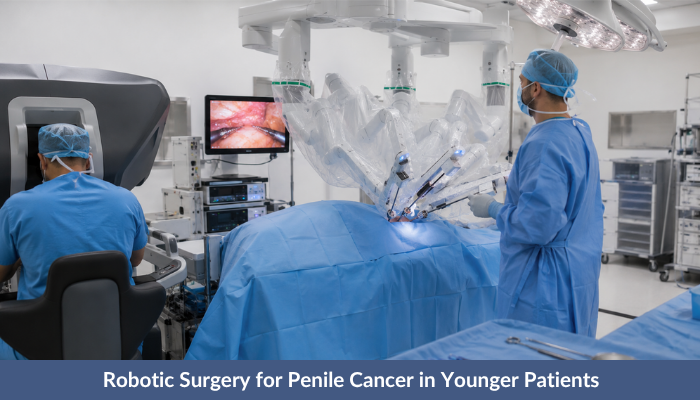
Penis cancer robotic surgery represents one of the most significant advances in managing inguinal lymph node dissection – a critical component of penis cancer treatment when lymph node involvement is suspected or confirmed. Traditional open inguinal lymph node dissection carries a high complication rate, including lymphoedema, wound infection and prolonged recovery. For young, active patients, these complications are especially disruptive.
Robotic-assisted inguinal lymphadenectomy offers comparable oncological results with substantially reduced surgical trauma, smaller incisions, lower complication rates and faster return to normal activity. For a 35-year-old professional or father, resuming work and daily life within weeks rather than months is a meaningful difference. The availability of penis cancer robotic surgery under the care of best penis cancer surgeons with dedicated uro-oncological expertise is a key reason why patients increasingly seek penis cancer treatment in Mumbai and other major Indian medical centres.
What Our Patients Are Saying
Penile Cancer Treatment in Mumbai and India: Why Specialist Care Matters
Penile cancer treatment in Mumbai has advanced considerably, with select uro-oncological centres offering the full spectrum of management – from early-stage organ-preserving surgery to complex lymph node dissection and reconstructive procedures. Penile cancer surgery in India at specialised centres is now accessible to both domestic and international patients, combining high clinical standards with cost-effective care compared to Western healthcare systems.
The importance of choosing among the best penis cancer surgeons cannot be overstated. Penile cancer is rare enough that general urologists may encounter only a handful of cases in their career, whereas a dedicated uro-oncologist with subspecialty training manages these cases regularly and is equipped to navigate nuanced decisions about margin adequacy, lymph node staging and functional reconstruction.
Psychological Challenges Specific to Young Men with Penile Cancer
The psychological burden of penile cancer in men under 40 is disproportionately severe. Unlike many other cancers, penile cancer attacks the organ most closely tied to masculine identity, sexual confidence and intimate relationships. Research consistently shows that younger men experience higher rates of depression, anxiety, sexual dysfunction-related distress and relationship strain following penile cancer diagnosis and surgery than their older counterparts.
Key psychological challenges include:
Body image disruption following partial or total penectomy, even when sexual function is partially preserved, leads many young men to avoid intimacy entirely. Relationship strain is also significant, as partners of younger men often report feeling unprepared to navigate the emotional and sexual changes after penis cancer surgery. Fear of cancer recurrence is particularly acute in younger patients, who anticipate decades of life ahead and carry the psychological weight of long-term surveillance. Stigma and secrecy further compound the situation, since many young men avoid discussing penile cancer with family, friends or even its general practitioners due to embarrassment, which delays both diagnosis and post-treatment psychological support.
Dedicated psycho-oncological support – ideally integrated into the penile cancer treatment pathway – is not optional for this demographic; it is a clinical necessity.
Fertility, Sexual Function and Hormonal Considerations after Penile Cancer Surgery
Penile cancer surgery in young men raises specific functional concerns that are less relevant in older patients. Sexual function preservation is a primary concern for men under 40, as the psychological impact of erectile dysfunction or inability to penetrate is far greater at this life stage. While penile cancer itself does not directly impair erectile function, partial penectomy can reduce the functional length available for penetrative sex.
Sensory preservation is another consideration – glansectomy with reconstruction can sometimes preserve erogenous sensation when performed by experienced penis cancer surgeons using nerve-sparing techniques. Penile rehabilitation protocols post-surgery, including vacuum erection devices and, where appropriate, phosphodiesterase-5 inhibitors, are increasingly incorporated into recovery plans at centres offering comprehensive penile cancer treatment.
Additionally, inguinal lymph node dissection can occasionally affect local lymphatic and vascular structures in ways that influence lower limb function and body image, particularly for active young men involved in sports or physical work.
Multidisciplinary Approach: What Young Patients Should Expect
Optimal penile cancer treatment for men under 40 requires a coordinated team that extends beyond the operating surgeon. Effective care involves an uro-oncological surgeon experienced in penis cancer surgery; a medical oncologist for cases requiring adjuvant chemotherapy; a radiation oncologist for nodal management in selected cases; a reconstructive or plastic surgeon for post-excision repair; a psycho-oncologist or counsellor specialising in male sexual health; and a physiotherapist for post-lymphadenectomy recovery and lymphoedema management.
Young patients should actively ask their treating team about organ-preservation options, functional outcomes data and psychological support resources before proceeding with any surgical plan.
Dr. Anup Ramani - Penile Cancer Surgeon in Mumbai
Dr. Anup Ramani is one of India’s most distinguished uro-oncologists and a recognised pioneer in robotic urological surgery, practising at leading hospitals including Breach Candy, Lilavati and Saifee in Mumbai. With over two decades of global surgical experience and the highest publications in his field, Dr. Ramani specialises in penis cancer surgery including partial penectomy and robotic-assisted lymph node dissection, offering patients – including those under 40 – a combination of precise oncological care and functional preservation.
Conclusion
Penile cancer in young men under 40 demands a clinical and emotional response that goes far beyond standard oncological protocols. From organ-preserving penile cancer surgery decisions to psychological rehabilitation and sexual health recovery, every aspect of care must be calibrated to the specific needs of a younger patient. Seeking care from experienced penile cancer surgeons – particularly those offering penile cancer robotic surgery and multidisciplinary support – significantly improves both survival outcomes and quality of life for this uniquely vulnerable group.
FAQs
Can penile cancer occur in men under 40?
Yes. While rare, penile cancer does occur in younger men, often linked to HPV infection. Delayed diagnosis is common in this age group due to low awareness of penile cancer symptoms.
What are the first signs of penile cancer?
Common early penile cancer symptoms include a painless sore, lump or ulcer on the glans or foreskin; unusual skin thickening; redness; or persistent irritation that does not resolve within four weeks.
Is organ-preserving penile cancer surgery possible?
Yes. Depending on the tumour’s stage and location, options such as wide local excision, glansectomy and partial penectomy can preserve significant penile function. Best penis cancer surgeons evaluate each case individually.
What is penis cancer robotic surgery used for?
Penile cancer robotic surgery is primarily used for inguinal lymph node dissection, reducing complications like lymphoedema and wound infection while achieving equivalent cancer control compared to open surgery.
Why should I seek penile cancer treatment in Mumbai specifically?
Penile cancer treatment in Mumbai at specialist uro-oncological centres offers access to best penis cancer surgeons, advanced robotic surgical technology and comprehensive multidisciplinary care, often at a fraction of the cost compared to Western countries.

Uro-Oncological & Robotic Surgeon
Dr. Anup Ramani is a robotic uro-oncological surgeon and an internationally recognized expert in robotic surgery for prostate, kidney and urinary bladder cancers. With more than two decades of robotic experience and 2,000+ robotic procedures, he brings unmatched precision and outcomes to complex uro-oncology cases. He is widely published in his field and is known for a personal, transparent approach-often spending over an hour in initial consultations to educate patients on its disease, surgery and recovery. His expertise spans prostate cancer treatment, kidney and bladder cancer surgery, adrenal gland surgery, kidney stone treatment, penile cancer surgery and enlarged prostate management. Dr. Ramani advocates the advantages of robotic surgery-magnified 3D vision, tremor-filtered precision, minimal scarring, lower blood loss and faster recovery-helping patients return to life sooner.
Table of Contents

Recent Blogs
- BPH Surgery Outcomes in Diabetic Patients: Glycemic ...
- Penile Cancer in Young Men under 40: Different Surgical and Psychological Challenges
- Metabolic Evaluation after Kidney Stone Removal Sur ...
- Penile Cancer: Symptoms, Diagnosis, Treatment, and ...
- Kidney Stones: Causes, Prevention, and Treatment, A ...
Best Uro-Oncological surgeon
Specialist in India for Robotic Surgery
MCh, DNB, MS, DNB
Dr. Anup Ramani
CONTACT
Uro-Oncologist in India,
Best Robotic Surgeon for Uro Oncology Surgery
1407, One Lodha Place Next to World Towers Senapati Bapat Marg, Worli, Mumbai. 400013.
Dr Anup Ramani @ Copyright 2026 – Website Maintenance, SEO & GEO by Opal Infotech
- Partial penectomy is done in cases where glans and distal penis is involved with carcinoma.
- Partial penectomy is a type of organ-preserving surgery. Preservation of sexual and micturational function depends on the surgical dissection and reconstruction of residual urethra.
- Patients who develop stones in the kidney or ureter, often experience severe pain.
- This condition usually needs a procedure to remove the kidney stones.
- This procedure is called ureteroscopy and is performed very commonly.
- It does not require any cuts and hence it is painless.
- The procedure is performed with an endoscope inserted through the penis under spinal anesthesia.
- The scope is inserted through the penis into the kidney and stones are dissolved with a laser.
- The procedure takes about 40-50 minutes.
- A catheter (urine pipe) is kept after the procedure to drain the bladder. A stent is kept in the kidney at the same time.
- Patient is mobile and walking in the room the same evening.
- Hospital stay is one night and patient is discharged the next day after removal of the catheter.
- Patient has to come back after six weeks to remove the stent in the kidney.
- Patients can resume office a week after surgery and heavy activities like running, weight lifting, a month after the procedure.
- We offer fixed packages for this procedure which can be obtained by calling our helpline +91 9967666060.
- Men with an enlarged prostate, which is a normal ageing changes, often experiencing difficulty passing urine. This condition usually needs a procedure to trim the prostate and relieve the blockage.
- This procedure is called TURP and is performed very commonly.
- It does not require any cuts and hence it is painless.
- The procedure is performed with an endoscope inserted through the penis under spinal anaesthesia.
- The overgrown prostate is dissolved with a laser bloodlessly.
- The procedure takes about 40 minutes.
- A catheter (urine pipe) is kept after the procedure to drain the bladder.
- Patient is mobile and walking in the room the same evening.
- Hospital stay is two nights and patient is discharged with the catheter, which is removed after 4 days.
- Patients can resume office a week after surgery and heavy activities like running, weight lifting, a month after the procedure.
- We offer fixed packages for this procedure which can be obtained by calling our helpline +91 9967666060.
-
Robotic adrenalectomy is a sophisticated, complex surgery and it is very important that an experienced surgeon performs this surgery to avoid major complications.
-
Once the anesthesia is done, and patient positioned, three micro cuts (3mm each) are made in the patient’s abdomen.
-
The arms of the Da Vinci robot are connected to the cuts via ports (tubes).
-
Dr. Ramani then sits in the controlling console to perform the surgery.
-
On an average, a robotic adrenalectomy takes one hour.
-
The surgery is almost completely bloodless and there has never been any need to transfuse blood after surgery.
-
A urine catheter and bag to drain the bladder is inserted during surgery.
-
A tiny drain pipe may be inserted in the surgical side of the abdomen, connected to a bag.
-
Patient is kept nil-by-mouth the day of the surgery, with IV fluids. Sips of water are started the next day and solid food by day three.
-
The drain pipe, if kept, is removed in the room on day 2 after surgery.
-
The catheter is removed on day two after surgery.
-
Total hospital stay for robotic adrenalectomy is 4 nights (including night before surgery).
-
Post discharge, a doctor from the surgical team visits the patient at home/ hotel room once every day.
On the day of discharge, patient is totally self-sufficient. They are able to walk freely without any pain, dress themselves, shower, toilet and they do not need to hire any nurse or help at home. Almost all patients are back to work within 2 weeks of surgery.
Heavy activities like running, weight lifting can be resumed after a month
Follow up after an adrenalectomy is in the form of CT scans, once a year for 5 years.
Local patients usually meet Dr. Ramani after two weeks to discuss report.Outstation patients are counselled on a phone consultation.
- Dr. Ramani is one of the very few surgeons in India who has the expertise to perform a robotic surgery for bladder cancer, which includes removing the urinary bladder and reconstructing a new bladder robotically.
- Robotic radical cystectomy is an extremely sophisticated, complex surgery and it is very important that an experienced surgeon performs this surgery to avoid major complications.
- Once the anaesthesia is done, and patient positioned, six micro cuts (3mm each) are made in the patient’s abdomen.
- The arms of the Da Vinci robot are connected to the cuts via ports (tubes).
- Dr. Ramani then sits in the controlling console to perform the surgery.
- On an average, a robotic radical cystectomy with an ileal conduit takes 3-4 hours.
- The surgery is almost completely bloodless and there has never been any need to transfuse blood after surgery.
- A urine catheter and bag to drain the new bladder is inserted during surgery.
- Two tiny drain pipe in inserted in the surgical side of the abdomen, connected to a bag.
- Patient is kept nil-by-mouth for 4 days after surgery with IV supplementation of patient’s daily requirements of calories, fats, carbohydrates, proteins and electrolytes.
- The drain pipes are removed in the room on day 3-5 after surgery.
- Total hospital stay for radical cystectomy is 8 nights (including night before surgery).
- Post discharge, a doctor from the surgical team visits the patient at home/ hotel room once every day.
- On the day of discharge, patient is totally self-sufficient. They are able to walk freely without any pain, dress themselves, shower, toilet and they do not need to hire any nurse or help at home.
- Almost all patients are back to work within 6 weeks of surgery. Heavy activities like running, weight lifting can be resumed after two months.
Follow up after a radical a cystectomy is in the form of CT scans, once a year for 5 years.
Histopathology report: Local patients usually meet Dr. Ramani after two weeks to discuss report.
Outstation patients are counselled on a phone consult. Depending on the report, patient may or may not need chemotherapy after surgery.
If chemo is needed, patients may choose to get it done with a medical oncologist of their choice or avail the services of one of the four medical oncologists on our team.
- Robotic partial nephrectomy is a sophisticated, complex surgery and it is very important that an experienced surgeon performs this surgery to avoid major complications. Robotic radical (total) nephrectomy is
- relatively easier but still requires significant experience to consistently deliver results.
- Once the anaesthesia is done, and patient positioned, five micro cuts (3mm each) are made in the patient’s abdomen.
- The arms of the Da Vinci robot are connected to the cuts via ports (tubes).
- Dr. Ramani then sits in the controlling console to perform the surgery.
- On an average, a robotic radical nephrectomy takes one hour and a robotic partial nephrectomy takes about an hour and half.
- The surgery is almost completely bloodless and there has never been any need to transfuse blood after surgery.
- A urine catheter and bag to drain the bladder is inserted during surgery.
- A tiny drain pipe in inserted in the surgical side of the abdomen, connected to a bag.
- Patient is kept nil-by-mouth the day of the surgery, with IV fluids. Sips of water are started the next day and solid food by day three.
- The drain pipe is removed in the room on day 3 after surgery. The catheter is removed on day two after surgery.
- Total hospital stay for radical/partial nephrectomy is 4 nights (including night before surgery).
- Post discharge, a doctor from the surgical team visits the patient at home/ hotel room once every day.
- On the day of discharge, patient is totally self- sufficient.
- They are able to walk freely without any pain, dress themselves, shower, toilet and they do not need to hire any nurse or help at home.
- Almost all patients are back to work within 2-3 weeks of surgery.
- Heavy activities like running, weight lifting can be resumed after a month.
- Follow up after a radical/partial Nephrectomy is in the form of CT scans, once a year for 5 years.
- Local patients usually meet Dr. Ramani after two weeks to discuss report.
- Outstation patients are counselled on a phone consultation.