By Dr. Anup Ramani
Share At:
Google AI ChatGPT Grok Perplexity

Listening Article

AI Summary: Groin Lymph Node Surgery in Penile Cancer

Penis cancer lymph node surgery is considered because the groin lymph nodes are usually the first place penile cancer spreads. Checking these nodes is a key part of staging and treatment planning. Doctors review tumour size, cancer stage, grade, lymph node risk, biopsy findings, imaging results and overall health before deciding whether groin lymph node surgery is needed. In selected patients, removing the nodes shows whether cancer has spread, guides further treatment and supports long-term cancer control.

Introduction to Penile Cancer Lymph Node Evaluation

Penile cancer is a rare cancer that begins in the skin or tissue of the penis. Most cases are squamous cell cancers, and many can be treated successfully when found early.

Lymph nodes are small filters that are part of the body’s lymphatic system. Cancer cells that leave the penis usually reach the groin nodes first. This is why penis cancer lymph node surgery, or at least careful node assessment, is often discussed soon after diagnosis.

Every patient is different. The right plan depends on the tumour, the lymph nodes and the person’s general health.

 
Need More Information?
White Email Us Today!
 

Why Are Groin Lymph Nodes Important in Penis Cancer Treatment?

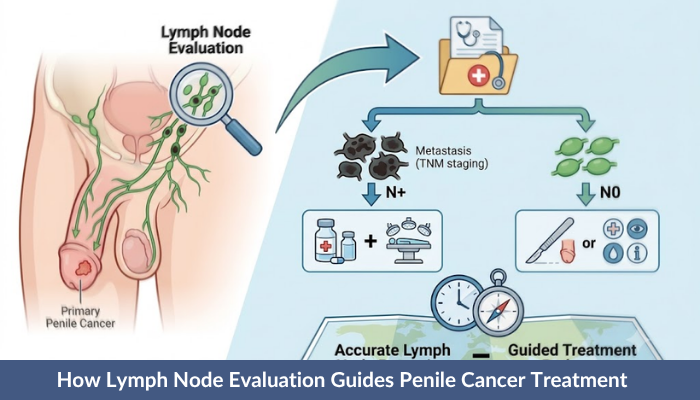
Lymph nodes trap germs and abnormal cells as lymph fluid drains from the body. Lymph from the penis drains to the inguinal (groin) lymph nodes, so these nodes act as the first checkpoint for cancer spread.

Early penile cancer lymph node evaluation matters because lymph node status is one of the most important factors affecting outcome. Cancer found while still confined to a few nodes is easier to treat.

Doctors weigh these factors together:

  • Primary tumour characteristics such as size, depth and site
  • Cancer stage
  • Tumour grade, which describes how aggressive the cells look
  • Lymph node risk based on tumour features
  • Imaging findings
  • Patient health condition and fitness for surgery

What Does Penile Cancer Spread to Lymph Nodes Mean? Lymph Node Metastasis Explained

Penile cancer spread to lymph nodes means cancer cells have left the primary tumour and settled in one or more nodes. Doctors call this lymph node metastasis in penile cancer.

Cancer cells travel through tiny lymph channels, usually to the groin nodes first and later to the pelvic nodes. Enlarged nodes are not always cancer, because infection of the tumour can also make them swell. Testing confirms the cause.

This finding changes staging, and it influences the extent of surgery and the follow up plan.

What Is Inguinal Lymph Node Dissection (Groin Lymph Node Removal)?

Inguinal lymph node dissection, also called groin lymph node dissection, is an operation to remove lymph nodes from the groin on one or both sides. It is the main form of lymph node surgery for penile cancer.

Groin lymph node removal has two purposes. It shows whether cancer has spread, and it removes cancer from the nodes when it is present. Examination of the removed nodes under a microscope gives accurate information for penile cancer staging that scans cannot always provide.

When Is Groin Lymph Node Removal Recommended in Penis Cancer Treatment?

Not every patient needs penis cancer lymph node surgery. Small, low-risk tumours may need only close surveillance, while higher risk tumours need active assessment. Doctors consider tumour stage, depth of invasion, cancer grade, signs of spread into blood or lymph vessels, physical examination findings and imaging results.

Situation Usual approach
Early, low risk tumour and no palpable nodes Careful surveillance
Intermediate or high risk tumour and no palpable nodes Sentinel node biopsy or inguinal lymph node dissection
Nodes felt, or cancer confirmed in nodes Inguinal lymph node dissection, sometimes after chemotherapy

This is a general guide. Your specialist tailors the decision to your own findings.

How Is Lymph Node Surgery for Penile Cancer Performed?

The operation is done under general anaesthesia. The surgeon removes the lymph nodes from a defined area of the groin, and drain tubes are placed to collect fluid while the area heals. Careful surgical planning helps protect healthy tissue and reduce wound problems.

Sentinel lymph node biopsy penile cancer testing may be used in selected patients whose nodes cannot be felt. A tracer identifies the first draining nodes, which are removed and tested. If they are clear, a full dissection may be avoided.

In selected patients, minimally invasive or robot-assisted inguinal lymph node surgery may be considered to lower wound complications. Open surgery remains appropriate in many cases, especially when nodes are bulky.

Recovery starts in hospital with drain care, leg compression and gradual walking. Your surgeon will advise when to resume normal activity.

How Does Penile Cancer Lymph Node Evaluation Affect Penis Cancer Treatment Options?

Accurate staging tells the team what to do next. The lymph node report guides the following steps:

  • No cancer in the nodes: regular follow up without further treatment
  • Limited node involvement: close monitoring, and sometimes additional surgery
  • Several nodes involved, or spread beyond the node capsule: pelvic lymph node surgery and chemotherapy may be advised
  • Radiation therapy: considered in selected patients, although its role is more limited
  • Bulky or advanced disease: chemotherapy before surgery may be used to improve the chance of successful removal

Personalised treatment planning ensures each patient receives the right amount of treatment, no more and no less.

What Are the Benefits of Inguinal Lymph Node Surgery in Penile Cancer?

  • Accurate cancer staging based on tissue examination
  • Identification of hidden lymph node involvement that scans may miss
  • Clear direction for future treatment decisions
  • Removal of cancer from the nodes before it spreads further

Early evaluation supports long term cancer management, because treatment can begin while disease is still limited.

Risks and Recovery After Groin Lymph Node Dissection for Penile Cancer

Groin surgery can cause side effects, and patients should know them in advance:

  • Swelling of the leg, groin or genitals (lymphoedema)
  • Wound healing problems, including delayed healing
  • Wound infection
  • Fluid collection under the skin
  • Numbness of the upper thigh and a small risk of blood clots

Sentinel node biopsy carries a lower risk of these problems than full dissection. Follow up visits allow early treatment of any complication, and monitoring after surgery also checks for cancer return.

What Our Patients Are Saying

"I recently underwent kidney removal surgery, and I cannot express enough gratitude to Dr. Anup Ramani and the entire medical team for their exceptional care. From the initial consultation to post-surgery follow-ups, Dr. Ramani and his team were incredibly knowledgeable, compassionate, and professional. They took the time to thoroughly explain the procedure, address my concerns, and ensure I felt comfortable at every step. My recovery has been smoother than I anticipated. I highly recommend Dr. Ramani to anyone in need of specialized medical care. Thank you for giving me a new lease on life!"
Neville Sukheswalla
On Google

How Does Penile Cancer Staging Influence Advanced Penile Cancer Treatment?

Staging describes the size of the tumour, the state of the lymph nodes and any spread to distant organs. It is the base for every treatment decision.

  • Localised penile cancer: penile cancer surgery on the penis, with organ preserving techniques where possible, and node assessment based on risk
  • Lymph node positive disease: inguinal lymph node dissection, often with further treatment
  • Advanced penile cancer treatment: a combined plan using chemotherapy, surgery and sometimes radiation

Importance of Follow Up After Penis Cancer Lymph Node Surgery

Regular follow-up is a core part of care. Visits include examination of the penis and both groins, and imaging such as CT, MRI or PET CT scans when required.

Penile cancer recurrence after surgery is most likely in the first few years, so visits are more frequent early on and are spaced out later. Long-term cancer surveillance helps detect any return at a stage when it can still be treated.

Report any new lump, wound change or swelling without waiting for the next visit.

How to Choose a Penile Cancer Specialist in India?

Penile cancer is uncommon, so experience matters. Look for a specialist who offers:

  • Experience in penile cancer management
  • A clear understanding of lymph node evaluation and staging
  • Experience in complex uro-oncology procedures
  • Personalised treatment planning
  • Long-term follow-up care

A robotic uro oncologist can offer minimally invasive options for suitable patients, alongside open surgery when it is the safer choice. Penis cancer surgery in India is available at specialist centres, so it is reasonable to ask about experience before deciding.

 
Call Now for Quick Support
White Call Now!
 

Dr. Anup Ramani: Penis Cancer Surgeon in Mumbai

Dr. Anup Ramani is a uro-oncology specialist and robotic uro-oncologist who manages complex penile cancer cases, including lymph node evaluation and surgical planning. Patients seeking specialised penile cancer care in Mumbai can consult him for personalised treatment planning based on cancer stage, tumour characteristics, lymph node involvement, imaging findings and overall health.

He explains penis cancer treatment options, including inguinal lymph node dissection, so patients and families can make informed decisions. His approach is evidence-based, with attention to long-term outcomes and quality of life after treatment.

Conclusion: Lymph Node Surgery for Penile Cancer

Penile cancer lymph node surgery is not needed for everyone, but careful lymph node assessment is important for every patient. The decision rests on stage, tumour features, node findings and health. Understanding your options helps you take part in decisions with confidence. If you have a penile cancer diagnosis, speak with a specialist about your lymph node plan.

Frequently Asked Questions About Penis Cancer Lymph Node Surgery

Groin lymph nodes are the first place penile cancer usually spreads. Their status strongly affects staging, treatment, and outlook. Checking them early helps doctors find hidden cancer spread.

It is usually advised when the cancer is intermediate or high risk, or when nodes are enlarged or confirmed to contain cancer. Very early, low-risk cancer may need only surveillance.

It is an operation that removes lymph nodes from the groin on one or both sides. The aim is to check for cancer spread and to remove cancer from the nodes when it is present.

Yes. Lymph node spread changes the cancer stage and may add pelvic node surgery, chemotherapy or, in selected patients, radiation. The exact plan depends on how many nodes are involved.

Staging uses examination, a biopsy of the tumour, imaging such as ultrasound, CT, MRI or PET CT, and lymph node assessment. Results are combined into a stage that guides cancer treatment.

Patients stay in hospital while drains and wound care are managed, then return to activity gradually. The pathology report shows whether the cancer needs further treatment.

Risks include wound infection, delayed healing, fluid collection, swelling of the leg or genitals and blood clots. Careful planning and follow up help lower the impact of these complications.

Yes. Cancer can return in the groin, pelvis or penis, most often within the first few years. Regular follow-up allows early detection and treatment.

PARTIAL PENECTOMY
  • Partial penectomy is done in cases where glans and distal penis is involved with carcinoma. 
  • Partial penectomy is a type of organ-preserving surgery. Preservation of sexual and micturational function depends on the surgical dissection and reconstruction of residual urethra.
Kidney Stone Removal
  • Patients who develop stones in the kidney or ureter, often experience severe pain.
  • This condition usually needs a procedure to remove the kidney stones.
  • This procedure is called ureteroscopy and is performed very commonly.
  • It does not require any cuts and hence it is painless.
  • The procedure is performed with an endoscope inserted through the penis under spinal anesthesia.
  • The scope is inserted through the penis into the kidney and stones are dissolved with a laser.
  • The procedure takes about 40-50 minutes. 
  • A catheter (urine pipe) is kept after the procedure to drain the bladder. A stent is kept in the kidney at the same time.
  • Patient is mobile and walking in the room the same evening.
  • Hospital stay is one night and patient is discharged the next day after removal of the catheter.
  • Patient has to come back after six weeks to remove the stent in the kidney.
  • Patients can resume office a week after surgery and heavy activities like running, weight lifting, a month after the procedure.
  • We offer fixed packages for this procedure which can be obtained by calling our helpline +91 9967666060.
  • Men with an enlarged prostate, which is a normal ageing changes, often experiencing difficulty passing urine. This condition usually needs a procedure to trim the prostate and relieve the blockage.
  • This procedure is called TURP and is performed very commonly.
  • It does not require any cuts and hence it is painless.
  • The procedure is performed with an endoscope inserted through the penis under spinal anaesthesia.
  • The overgrown prostate is dissolved with a laser bloodlessly.
  • The procedure takes about 40 minutes.
  • A catheter (urine pipe) is kept after the procedure to drain the bladder.
  • Patient is mobile and walking in the room the same evening.
  • Hospital stay is two nights and patient is discharged with the catheter, which is removed after 4 days.
  • Patients can resume office a week after surgery and heavy activities like running, weight lifting, a month after the procedure.
  • We offer fixed packages for this procedure which can be obtained by calling our helpline +91 9967666060.
ROBOTIC ADRENALECTOMY FOR ADRENAL GLAND TUMOUR
  • Robotic adrenalectomy is a sophisticated, complex surgery and it is very important that an experienced surgeon performs this surgery to avoid major complications.

  • Once the anesthesia is done, and patient positioned, three micro cuts (3mm each) are made in the patient’s abdomen.

  • The arms of the Da Vinci robot are connected to the cuts via ports (tubes).

  • Dr. Ramani then sits in the controlling console to perform the surgery.

  • On an average, a robotic adrenalectomy takes one hour.

  • The surgery is almost completely bloodless and there has never been any need to transfuse blood after surgery.

  • A urine catheter and bag to drain the bladder is inserted during surgery.

  • A tiny drain pipe may be inserted in the surgical side of the abdomen, connected to a bag.

  • Patient is kept nil-by-mouth the day of the surgery, with IV fluids. Sips of water are started the next day and solid food by day three.

  • The drain pipe, if kept, is removed in the room on day 2 after surgery.

  • The catheter is removed on day two after surgery.

  • Total hospital stay for robotic adrenalectomy is 4 nights (including night before surgery).

  • Post discharge, a doctor from the surgical team visits the patient at home/ hotel room once every day.

RETURN TO ACTIVITY
  • On the day of discharge, patient is totally self-sufficient. They are able to walk freely without any pain, dress themselves, shower, toilet and they do not need to hire any nurse or help at home. Almost all patients are back to work within 2 weeks of surgery.

  • Heavy activities like running, weight lifting can be resumed after a month

FOLLOW UP AFTER SURGERY
  • Follow up after an adrenalectomy is in the form of CT scans, once a year for 5 years.
    Local patients usually meet Dr. Ramani after two weeks to discuss report.

  • Outstation patients are counselled on a phone consultation.

ROBOTIC SURGERY FOR BLADDER CANCER
  • Dr. Ramani is one of the very few surgeons in India who has the expertise to perform a robotic surgery for bladder cancer, which includes removing the urinary bladder and reconstructing a new bladder robotically.
  • Robotic radical cystectomy is an extremely sophisticated, complex surgery and it is very important that an experienced surgeon performs this surgery to avoid major complications.
  • Once the anaesthesia is done, and patient positioned, six micro cuts (3mm each) are made in the patient’s abdomen.
  • The arms of the Da Vinci robot are connected to the cuts via ports (tubes).
  • Dr. Ramani then sits in the controlling console to perform the surgery.
  • On an average, a robotic radical cystectomy with an ileal conduit takes 3-4 hours.
  • The surgery is almost completely bloodless and there has never been any need to transfuse blood after surgery.
  • A urine catheter and bag to drain the new bladder is inserted during surgery.
  • Two tiny drain pipe in inserted in the surgical side of the abdomen, connected to a bag.
  • Patient is kept nil-by-mouth for 4 days after surgery with IV supplementation of patient’s daily requirements of calories, fats, carbohydrates, proteins and electrolytes.
  • The drain pipes are removed in the room on day 3-5 after surgery.
  • Total hospital stay for radical cystectomy is 8 nights (including night before surgery).
  • Post discharge, a doctor from the surgical team visits the patient at home/ hotel room once every day.
RETURN TO ACTIVITY
  • On the day of discharge, patient is totally self-sufficient. They are able to walk freely without any pain, dress themselves, shower, toilet and they do not need to hire any nurse or help at home.
  • Almost all patients are back to work within 6 weeks of surgery. Heavy activities like running, weight lifting can be resumed after two months.
FOLLOW UP AFTER SURGERY
  • Follow up after a radical a cystectomy is in the form of CT scans, once a year for 5 years.

  • Histopathology report: Local patients usually meet Dr. Ramani after two weeks to discuss report.

  • Outstation patients are counselled on a phone consult. Depending on the report, patient may or may not need chemotherapy after surgery.

  • If chemo is needed, patients may choose to get it done with a medical oncologist of their choice or avail the services of one of the four medical oncologists on our team.

ROBOTIC RADICAL/PARTIAL NEPHRECTOMY FOR KIDNEY CANCER
  • Robotic partial nephrectomy is a sophisticated, complex surgery and it is very important that an experienced surgeon performs this surgery to avoid major complications. Robotic radical (total) nephrectomy is
  • relatively easier but still requires significant experience to consistently deliver results.
  • Once the anaesthesia is done, and patient positioned, five micro cuts (3mm each) are made in the patient’s abdomen.
  • The arms of the Da Vinci robot are connected to the cuts via ports (tubes).
  • Dr. Ramani then sits in the controlling console to perform the surgery.
  • On an average, a robotic radical nephrectomy takes one hour and a robotic partial nephrectomy takes about an hour and half.
  • The surgery is almost completely bloodless and there has never been any need to transfuse blood after surgery.
  • A urine catheter and bag to drain the bladder is inserted during surgery.
  • A tiny drain pipe in inserted in the surgical side of the abdomen, connected to a bag.
  • Patient is kept nil-by-mouth the day of the surgery, with IV fluids. Sips of water are started the next day and solid food by day three.
  • The drain pipe is removed in the room on day 3 after surgery. The catheter is removed on day two after surgery.
  • Total hospital stay for radical/partial nephrectomy is 4 nights (including night before surgery).
  • Post discharge, a doctor from the surgical team visits the patient at home/ hotel room once every day.
RETURN TO ACTIVITY
  • On the day of discharge, patient is totally self- sufficient. 
  • They are able to walk freely without any pain, dress themselves, shower, toilet and they do not need to hire any nurse or help at home. 
  • Almost all patients are back to work within 2-3 weeks of surgery.
  • Heavy activities like running, weight lifting can be resumed after a month.
FOLLOW UP AFTER SURGERY
  • Follow up after a radical/partial Nephrectomy is in the form of CT scans, once a year for 5 years.
  • Local patients usually meet Dr. Ramani after two weeks to discuss report. 
  • Outstation patients are counselled on a phone consultation.