




Dr Anup Ramani @ Copyright 2024
By Dr. Anup Ramani
AI Summary: Kidney Cancer Second Opinion Before Kidney Removal
A kidney cancer second opinion reviews the diagnosis, original scan images, tumour characteristics, kidney function and the reasons behind a proposed operation. Partial nephrectomy may suit selected patients, while radical nephrectomy remains necessary for many others. The goal is the safest reasonable treatment plan, whether that confirms the original recommendation or points to an alternative.
Kidney Cancer Second Opinion Before Radical Nephrectomy
Being told an entire kidney needs removal because of suspected or confirmed cancer is difficult news, and wanting clarity before agreeing is natural. During a kidney cancer consultation, the specialist reviews why complete removal was recommended and whether kidney preserving surgery is appropriate.
This recommendation rarely rests on the presence of a mass alone. It usually reflects tumour size and position, proximity to blood vessels and the collecting system, the health of remaining kidney tissue, and overall condition. Reviewing these factors in an organised way supports informed consent.
The time available for another opinion depends on the tumour and clinical situation; confirm an appropriate timeframe with the treating team.
What Can a Kidney Cancer Second Opinion Clarify?
A reviewing specialist typically works through:
- How certain is the diagnosis, and is it based on imaging alone or tissue confirmation?
- What do the scans show about the tumour’s size, position and extent?
- Why has complete removal been recommended rather than a smaller operation?
- What does a partial nephrectomy assessment show about the feasibility and risks of preserving kidney tissue?
- Would further investigation change the plan?
- What are the realistic benefits, risks and alternatives?
A second opinion does not always change the plan, and that confirmation itself has value.
Kidney Cancer Consultation: Reports and Scan Images to Bring
When consulting a kidney cancer specialist in Mumbai, bring the following records:
- Original CT or MRI images, ideally DICOM files rather than printed pictures.
- The written radiology report.
- Earlier scans, to show how the finding has changed over time.
- Biopsy reports, if a biopsy has already been done.
- Pathology slides or tissue blocks, if requested.
- Recent creatinine and eGFR (estimated glomerular filtration rate).
- Relevant urine test results.
- The proposed operation in writing, and any existing recommendation.
- Records of previous kidney surgery or stone treatment.
- Medical history, current medicines, allergies and relevant family history.
Original scan images matter because a specialist reviewing them directly can sometimes see detail a written report does not fully capture. Existing images may be sufficient for an initial review. Repeat or additional imaging may be needed if the scans are outdated, incomplete or unsuitable for treatment planning.
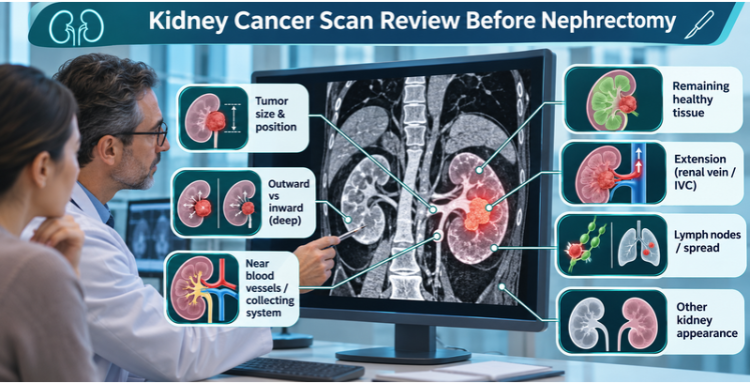
Kidney Cancer Scan Review Before Nephrectomy
Several features are weighed together, not one measurement alone:
- Tumour size and position, including depth from the surface.
- Whether it grows outward or lies largely within the kidney.
- Proximity to the major blood vessels and collecting system.
- How much functioning kidney tissue is likely to remain after surgery.
- Any sign of extension beyond the kidney, or renal vein or inferior vena cava involvement.
- Suspicious lymph nodes or other distant findings.
- The appearance of the other kidney.
Some centres use a numerical complexity score to describe how technically demanding a partial nephrectomy would be. It standardises communication; it does not decide the operation by itself.
Partial Nephrectomy vs Radical Nephrectomy: Key Differences
| Aspect | Partial Nephrectomy | Radical Nephrectomy |
|---|---|---|
| Extent of Removal | Tumour removed with a margin of tissue; suitable surrounding kidney preserved | Affected kidney removed entirely |
| Main Consideration | Cancer control while retaining functioning tissue where feasible | Cancer control when complete removal is appropriate |
| Important Risks | Bleeding, urine leak, possible conversion to complete removal during surgery | Reduced overall kidney function afterwards, general surgical risks |
Radical nephrectomy does not automatically mean the adrenal gland and nearby lymph nodes must also go; this depends on individual findings. It also helps to separate extent of surgery from surgical approach: open, laparoscopic and robotic techniques describe how an operation is performed, while partial or radical nephrectomy describes how much kidney is removed. Either extent can, in suitable cases, use any of these approaches.
Partial Nephrectomy Assessment: How Suitability Is Determined
For T1 tumours, which are confined to the kidney and measure up to 7 cm, partial nephrectomy is generally recommended when feasible. Tumour complexity, expected remaining function and surgical risks still require individual assessment, and a partial nephrectomy assessment weighs:
- Likelihood of achieving adequate cancer clearance.
- Expected functioning kidney tissue remaining afterwards, and baseline kidney function.
- Operative risk, including a solitary kidney, tumours affecting both kidneys, or conditions such as diabetes and chronic kidney disease.
- Previous kidney operations, surgical expertise and available resources at the treating centre.
- The patient’s overall health and priorities.
At experienced centres, selected larger or complex tumours may sometimes be considered for a kidney preserving approach, but this needs individual review. More opinions do not guarantee it; sometimes every specialist reaches the same conclusion.
When Radical Nephrectomy Is the Appropriate Recommendation
Complete removal may genuinely be the safer recommendation when the tumour’s size or position makes partial removal unsuitable, when partial removal would leave insufficient useful tissue behind, when there is real concern about achieving a safe cancer margin, when the tumour is locally advanced, or when the overall balance of risks favours complete removal. Each situation needs individual assessment. A recommendation for radical nephrectomy does not, on its own, mean the cancer has spread elsewhere; many tumours treated this way remain confined to the kidney.
Kidney Function Assessment Before Kidney Cancer Surgery
Kidney function sits alongside the tumour in this decision. Creatinine and eGFR reflect both kidneys together, so normal overall results do not necessarily mean each kidney contributes equally. Diabetes, high blood pressure, protein in the urine and pre existing kidney disease can all influence planning and expected performance afterwards.
A scan measuring each kidney’s function individually, or nephrology input, can sometimes add useful information before a final decision.
Kidney Biopsy Before Kidney Cancer Surgery: Is It Needed?
Any additional test should answer a specific clinical question, not simply add information. A kidney mass biopsy helps when the diagnosis is genuinely uncertain, when the result would change the planned treatment, or when active surveillance is being considered. It is not required before every operation, and the result can sometimes be inconclusive. A biopsy is, however, recommended before thermal ablation, since it confirms the diagnosis before the tumour tissue is destroyed and cannot be examined afterwards. Further imaging or radiology review can clarify a difficult finding, and genetic assessment may be suggested for a younger age at diagnosis, a strong family history, or tumours in both kidneys.
Kidney Cancer Treatment Alternatives to Immediate Surgery
Depending on the clinical picture, pathways besides immediate surgery may include active surveillance (monitoring selected small masses with regular imaging), thermal ablation for carefully selected patients and tumours, and other options considered by a multidisciplinary team where relevant. These are not interchangeable with surgery for every tumour and are reserved for specific situations. Metastatic disease, where cancer has spread beyond the kidney, usually needs a different treatment discussion, and kidney removal is not automatically the first step there.
What Our Patients Are Saying
Questions to Ask About Your Kidney Cancer Surgery
- What specific findings make complete removal preferable here?
- Could partial nephrectomy achieve appropriate cancer control?
- What are the main risks of each reasonable option?
- Could a planned partial nephrectomy convert to radical during surgery?
- How is this likely to affect my kidney function afterwards?
- Why is an open, laparoscopic or robotic approach being recommended?
- Are further tests needed before deciding?
- What are the risks of taking time for another opinion?
- What recovery and follow up should I expect?
These support informed consent; they do not replace a detailed recovery conversation with the surgical team.
Comparing Kidney Cancer Second Opinion Recommendations
Compare recommendations on the same terms rather than choosing the more reassuring option: whether both used the same scans and information, the reasoning behind each, how each addresses cancer control and expected kidney function, procedure specific risks, and any uncertainty left unresolved. If a genuine disagreement remains, ask whether a multidisciplinary or radiology review could help. The choice should rest on these factors, not on newer technology, cost, or a promise to preserve the kidney.
Dr. Anup Ramani: Kidney Cancer Specialist in Mumbai
Dr. Anup Ramani is a uro-oncological surgeon whose kidney cancer services include robotic partial nephrectomy and robotic radical nephrectomy. A kidney cancer second opinion involves reviewing the original scan images, tumour size and location, kidney function and the reasons for the proposed operation. The assessment considers whether kidney preserving surgery is appropriate or complete kidney removal offers the more suitable approach.
Kidney Cancer Second Opinion: Preparing for Your Decision
Bringing complete records, asking about the urgency of treatment, and understanding the balance between cancer control and preserving kidney tissue help patients move forward with confidence, whichever operation is chosen. Patients who would like their records reviewed this way are welcome to arrange an individual consultation.
Kidney Cancer Second Opinion FAQs
Should I get a second opinion before having a kidney removed?
It can confirm the operation is appropriate or clarify whether another approach fits better, and is reasonable for most patients facing this decision.
What records should I bring to a kidney cancer consultation?
Original scan images, radiology and biopsy reports, recent kidney function blood tests, the proposed operation in writing, and your relevant medical history.
Can partial nephrectomy replace complete kidney removal?
In selected cases, yes, but suitability depends on tumour size, position, complexity and kidney function, so it cannot be assumed for every patient.
Does tumour size alone determine whether the whole kidney must be removed?
No. Position, depth, blood vessel and collecting system relationships, and expected remaining function are weighed together with size.
Is a kidney biopsy always needed before surgery?
No. It helps in specific circumstances, such as genuine diagnostic uncertainty, but is not routine before every operation.
Does robotic kidney cancer surgery always preserve the kidney?
No. Robotic technique describes how an operation is performed, not how much tissue is removed; both radical and partial nephrectomy can be done robotically.
What should I do if two specialists recommend different operations?
Compare the reasoning behind each using the same scans and records, and consider whether a multidisciplinary or radiology review could help resolve the difference.
Can obtaining a second opinion delay necessary treatment?
It can, depending on how quickly treatment is needed, which is why it is worth asking the treating team about reasonable timing before seeking further reviews.

Uro-Oncological & Robotic Surgeon
Dr. Anup Ramani is a robotic uro-oncological surgeon and an internationally recognized expert in robotic surgery for prostate, kidney and urinary bladder cancers. With more than two decades of robotic experience and 2,000+ robotic procedures, he brings unmatched precision and outcomes to complex uro-oncology cases. He is widely published in his field and is known for a personal, transparent approach-often spending over an hour in initial consultations to educate patients on its disease, surgery and recovery. His expertise spans prostate cancer treatment, kidney and bladder cancer surgery, adrenal gland surgery, kidney stone treatment, penile cancer surgery and enlarged prostate management. Dr. Ramani advocates the advantages of robotic surgery-magnified 3D vision, tremor-filtered precision, minimal scarring, lower blood loss and faster recovery-helping patients return to life sooner.
Table of Contents

Recent Blogs
- Urine Culture Before Kidney Stone Surgery: Why It M ...
- Urinary Bladder Cancer Treatment Before Surgery: Un ...
- Kidney Cancer Second Opinion: What to Review Before Agreeing to Kidney Removal
- Understanding Your Prostate Cancer Biopsy Report Be ...
- Early Stage vs Advanced Penis Cancer: How Treatment ...
Best Uro-Oncological surgeon
Specialist in India for Robotic Surgery
MCh, DNB, MS, DNB
Dr. Anup Ramani
CONTACT
Uro-Oncologist in India,
Best Robotic Surgeon for Uro Oncology Surgery
1407, One Lodha Place Next to World Towers Senapati Bapat Marg, Worli, Mumbai. 400013.
Dr Anup Ramani @ Copyright 2026 – Website Maintenance, SEO & GEO by Opal Infotech
- Partial penectomy is done in cases where glans and distal penis is involved with carcinoma.
- Partial penectomy is a type of organ-preserving surgery. Preservation of sexual and micturational function depends on the surgical dissection and reconstruction of residual urethra.
- Patients who develop stones in the kidney or ureter, often experience severe pain.
- This condition usually needs a procedure to remove the kidney stones.
- This procedure is called ureteroscopy and is performed very commonly.
- It does not require any cuts and hence it is painless.
- The procedure is performed with an endoscope inserted through the penis under spinal anesthesia.
- The scope is inserted through the penis into the kidney and stones are dissolved with a laser.
- The procedure takes about 40-50 minutes.
- A catheter (urine pipe) is kept after the procedure to drain the bladder. A stent is kept in the kidney at the same time.
- Patient is mobile and walking in the room the same evening.
- Hospital stay is one night and patient is discharged the next day after removal of the catheter.
- Patient has to come back after six weeks to remove the stent in the kidney.
- Patients can resume office a week after surgery and heavy activities like running, weight lifting, a month after the procedure.
- We offer fixed packages for this procedure which can be obtained by calling our helpline +91 9967666060.
- Men with an enlarged prostate, which is a normal ageing changes, often experiencing difficulty passing urine. This condition usually needs a procedure to trim the prostate and relieve the blockage.
- This procedure is called TURP and is performed very commonly.
- It does not require any cuts and hence it is painless.
- The procedure is performed with an endoscope inserted through the penis under spinal anaesthesia.
- The overgrown prostate is dissolved with a laser bloodlessly.
- The procedure takes about 40 minutes.
- A catheter (urine pipe) is kept after the procedure to drain the bladder.
- Patient is mobile and walking in the room the same evening.
- Hospital stay is two nights and patient is discharged with the catheter, which is removed after 4 days.
- Patients can resume office a week after surgery and heavy activities like running, weight lifting, a month after the procedure.
- We offer fixed packages for this procedure which can be obtained by calling our helpline +91 9967666060.
-
Robotic adrenalectomy is a sophisticated, complex surgery and it is very important that an experienced surgeon performs this surgery to avoid major complications.
-
Once the anesthesia is done, and patient positioned, three micro cuts (3mm each) are made in the patient’s abdomen.
-
The arms of the Da Vinci robot are connected to the cuts via ports (tubes).
-
Dr. Ramani then sits in the controlling console to perform the surgery.
-
On an average, a robotic adrenalectomy takes one hour.
-
The surgery is almost completely bloodless and there has never been any need to transfuse blood after surgery.
-
A urine catheter and bag to drain the bladder is inserted during surgery.
-
A tiny drain pipe may be inserted in the surgical side of the abdomen, connected to a bag.
-
Patient is kept nil-by-mouth the day of the surgery, with IV fluids. Sips of water are started the next day and solid food by day three.
-
The drain pipe, if kept, is removed in the room on day 2 after surgery.
-
The catheter is removed on day two after surgery.
-
Total hospital stay for robotic adrenalectomy is 4 nights (including night before surgery).
-
Post discharge, a doctor from the surgical team visits the patient at home/ hotel room once every day.
On the day of discharge, patient is totally self-sufficient. They are able to walk freely without any pain, dress themselves, shower, toilet and they do not need to hire any nurse or help at home. Almost all patients are back to work within 2 weeks of surgery.
Heavy activities like running, weight lifting can be resumed after a month
Follow up after an adrenalectomy is in the form of CT scans, once a year for 5 years.
Local patients usually meet Dr. Ramani after two weeks to discuss report.Outstation patients are counselled on a phone consultation.
- Dr. Ramani is one of the very few surgeons in India who has the expertise to perform a robotic surgery for bladder cancer, which includes removing the urinary bladder and reconstructing a new bladder robotically.
- Robotic radical cystectomy is an extremely sophisticated, complex surgery and it is very important that an experienced surgeon performs this surgery to avoid major complications.
- Once the anaesthesia is done, and patient positioned, six micro cuts (3mm each) are made in the patient’s abdomen.
- The arms of the Da Vinci robot are connected to the cuts via ports (tubes).
- Dr. Ramani then sits in the controlling console to perform the surgery.
- On an average, a robotic radical cystectomy with an ileal conduit takes 3-4 hours.
- The surgery is almost completely bloodless and there has never been any need to transfuse blood after surgery.
- A urine catheter and bag to drain the new bladder is inserted during surgery.
- Two tiny drain pipe in inserted in the surgical side of the abdomen, connected to a bag.
- Patient is kept nil-by-mouth for 4 days after surgery with IV supplementation of patient’s daily requirements of calories, fats, carbohydrates, proteins and electrolytes.
- The drain pipes are removed in the room on day 3-5 after surgery.
- Total hospital stay for radical cystectomy is 8 nights (including night before surgery).
- Post discharge, a doctor from the surgical team visits the patient at home/ hotel room once every day.
- On the day of discharge, patient is totally self-sufficient. They are able to walk freely without any pain, dress themselves, shower, toilet and they do not need to hire any nurse or help at home.
- Almost all patients are back to work within 6 weeks of surgery. Heavy activities like running, weight lifting can be resumed after two months.
Follow up after a radical a cystectomy is in the form of CT scans, once a year for 5 years.
Histopathology report: Local patients usually meet Dr. Ramani after two weeks to discuss report.
Outstation patients are counselled on a phone consult. Depending on the report, patient may or may not need chemotherapy after surgery.
If chemo is needed, patients may choose to get it done with a medical oncologist of their choice or avail the services of one of the four medical oncologists on our team.
- Robotic partial nephrectomy is a sophisticated, complex surgery and it is very important that an experienced surgeon performs this surgery to avoid major complications. Robotic radical (total) nephrectomy is
- relatively easier but still requires significant experience to consistently deliver results.
- Once the anaesthesia is done, and patient positioned, five micro cuts (3mm each) are made in the patient’s abdomen.
- The arms of the Da Vinci robot are connected to the cuts via ports (tubes).
- Dr. Ramani then sits in the controlling console to perform the surgery.
- On an average, a robotic radical nephrectomy takes one hour and a robotic partial nephrectomy takes about an hour and half.
- The surgery is almost completely bloodless and there has never been any need to transfuse blood after surgery.
- A urine catheter and bag to drain the bladder is inserted during surgery.
- A tiny drain pipe in inserted in the surgical side of the abdomen, connected to a bag.
- Patient is kept nil-by-mouth the day of the surgery, with IV fluids. Sips of water are started the next day and solid food by day three.
- The drain pipe is removed in the room on day 3 after surgery. The catheter is removed on day two after surgery.
- Total hospital stay for radical/partial nephrectomy is 4 nights (including night before surgery).
- Post discharge, a doctor from the surgical team visits the patient at home/ hotel room once every day.
- On the day of discharge, patient is totally self- sufficient.
- They are able to walk freely without any pain, dress themselves, shower, toilet and they do not need to hire any nurse or help at home.
- Almost all patients are back to work within 2-3 weeks of surgery.
- Heavy activities like running, weight lifting can be resumed after a month.
- Follow up after a radical/partial Nephrectomy is in the form of CT scans, once a year for 5 years.
- Local patients usually meet Dr. Ramani after two weeks to discuss report.
- Outstation patients are counselled on a phone consultation.