Dr Anup Ramani @ Copyright 2024
By Dr. Anup Ramani
AI Summary
When a kidney tumour is found unexpectedly on a scan done for another reason, the next steps depend on its size, imaging appearance, location, kidney function, patient age, overall health, and cancer risk. Not every kidney mass is cancerous. Depending on the findings, doctors may recommend further imaging, regular monitoring, a biopsy, or surgery. A careful kidney tumor diagnosis by a specialist helps match the plan to each individual patient.
Incidental Kidney Tumor: Why an Unexpected Kidney Mass Needs Careful Evaluation
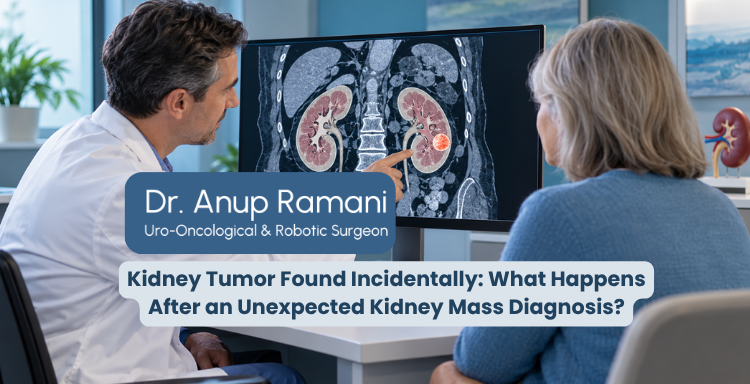
An incidental kidney tumor is a growth found by chance during a scan done for another reason, such as abdominal pain, a urinary infection, or a check of the liver or gallbladder. Hearing this news without warning naturally causes worry.
An unexpected finding does not always mean a serious problem, but it does need careful attention. A structured kidney tumor diagnosis looks at the scan, the kidney, and the patient together. Every patient is different, so diagnosis and treatment may differ from person to person.
What Does an Incidental Kidney Tumor Diagnosis Mean?
An incidental kidney tumour is one found while looking for something else. Ultrasound and CT scans are used widely, so a kidney mass found on ultrasound or a kidney mass found on CT scan is now quite common.
Many kidney masses cause no symptoms early on. Pain, blood in the urine, or a lump usually appear only later.
It also helps to know the difference between a cyst and a tumour:
- A kidney cyst is a fluid-filled sac. Most simple cysts are harmless and need no treatment.
- A solid kidney tumour is made of tissue and needs closer study, because some solid tumours are cancerous.
- Some cysts have thick walls or partitions and are graded by doctors using the Bosniak classification.
During kidney tumour evaluation, doctors look at these key factors:
- Tumour size
- Tumour location within the kidney
- Imaging characteristics
- Growth pattern over time
- Kidney function
- The patient’s overall health condition
How Serious Is an Incidental Kidney Tumor? Is a Kidney Mass Found Accidentally Dangerous?
The seriousness depends on what the tumour turns out to be, not only on the fact that it was found by chance. Many people who find a kidney tumor accidentally have a mass that is small and slow-growing.
Several factors decide how much concern is needed:
- Size, because smaller tumours generally carry a lower risk than larger ones
- Imaging appearance, including how the mass takes up contrast and how its edges look
- Growth, meaning whether the mass changes on repeat scans
- Patient factors such as age, overall health status, and other medical conditions
Some tumours need only monitoring with regular scans, while others need surgery. Finding a tumour before symptoms begin often allows more treatment options, including kidney-preserving surgery.
Kidney Tumour Evaluation: How Doctors Assess a Kidney Mass Found on Ultrasound or CT Scan
The first step is to review the earlier scan reports and images. A specialist then studies them in detail, because the original scan may not have been designed to look closely at the kidney.
A CT scan with contrast dye shows how the mass takes up contrast, which helps separate different types of growth. MRI is a useful option for patients who cannot receive CT contrast or when the CT result is unclear. Blood tests check kidney function, which guides both imaging choices and treatment planning.
This small renal mass evaluation forms the base of the kidney cancer diagnosis process. Specialist review matters because small differences in appearance can change the plan.
Does Every Kidney Mass Mean Cancer? Renal Tumour Diagnosis Explained
No. Many kidney masses are benign, which means they are not cancerous and do not spread. Malignant growths, such as renal cell carcinoma, the most common kidney cancer, can grow and spread if untreated.
Doctors look for clues to tell these apart:
- Imaging features such as how the mass takes up contrast, its edges, and its fat content
- Growth behaviour on repeat scans
- Additional testing, such as MRI or biopsy, when the picture remains unclear
A proper renal tumour diagnosis avoids both unnecessary surgery for harmless growths and delay for those that need treatment.
Small Kidney Tumour Treatment: What Happens After Finding a Small Renal Mass?
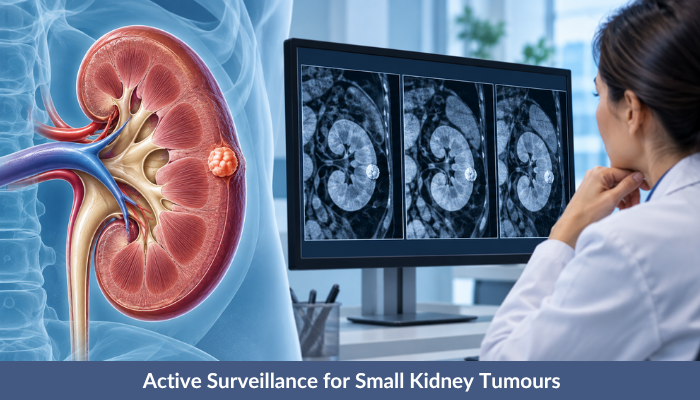
A small renal mass is generally a solid kidney tumour of about 4 cm or less. Many grow slowly, so some may not need immediate surgery. Small kidney tumour treatment ranges from monitoring to surgery.
Active Surveillance and Kidney Tumour Monitoring
Active surveillance means watching the tumour closely with scheduled scans instead of operating straight away. It may suit patients who:
- Have a very small tumour that looks slow-growing
- Are older or have other health conditions that raise surgical risk
- Understand and accept the need for regular follow-up
Monitoring uses imaging at planned intervals, so any change in size or appearance is noticed early.
Further Evaluation
Some patients need more imaging, a biopsy, or a discussion of treatment planning before a decision is made.
Kidney Tumour Biopsy: When Is It Recommended?
A kidney tumour biopsy takes a small tissue sample from the mass with a thin needle, guided by imaging. The sample is examined under a microscope to see whether the cells are benign or cancerous, and if cancerous, what type.
Doctors may consider a biopsy when the imaging result is unclear, when surveillance is being considered, or when the result could change the treatment choice. The result can help avoid surgery for a benign growth or confirm a plan for a cancerous one.
A biopsy has limits. The sample may not fully represent the tumour, and sometimes the result is inconclusive. It is not needed for every patient, so the decision is personalised.
Kidney Cancer Surgery: When Is Surgery Recommended for an Unexpected Kidney Tumour?
Surgery is usually advised when the tumour is likely to be cancerous, is growing, or is large enough to carry a higher risk. Kidney mass treatment by surgery follows two main approaches.
Partial Nephrectomy
Partial nephrectomy removes only the tumour and a small margin of tissue while keeping the healthy part of the kidney. It is often preferred when the tumour is small or moderate in size and can be removed safely. It helps preserve kidney function for the long term.
Radical Nephrectomy
Radical nephrectomy removes the entire kidney. It may be needed for larger or more complex tumours, tumours in difficult locations, or tumours that extend into nearby structures.
What Our Patients Are Saying
Robotic Kidney Surgery and Robotic Partial Nephrectomy
Kidney cancer surgery in India now includes robotic options. In selected patients, robotic kidney surgery allows precise work through small incisions. Robotic partial nephrectomy is one such option. Recovery often involves less pain and a shorter hospital stay, depending on the patient and tumour.
Kidney Mass Treatment Decisions: Monitoring or Surgery?
No single rule fits everyone. Doctors weigh several factors together:
- Tumour size and growth rate
- Imaging findings
- Patient age
- Remaining kidney performance
- Overall health and other medical conditions
- The patient’s own preferences and concerns
Treatment decisions are personalised because a plan that suits one patient may not suit another.
Kidney Tumor Size and Treatment Decision
This table gives a general guide to how tumour size and behaviour shape the approach. Each plan is still personalised.
| Tumour Size / Situation | Possible Approach |
| Small renal mass | Monitoring, biopsy, or partial nephrectomy |
| Growing tumour | Treatment is usually considered |
| Complex or large tumour | Surgery planning, including partial or radical nephrectomy |
| Advanced disease | Systemic treatment options such as targeted therapy or immunotherapy |
Kidney Cancer Treatment and Renal Cell Carcinoma Treatment Options
Kidney cancer treatment depends on the stage of the disease and the characteristics of the tumour. Options include surgical and non-surgical approaches:
- Kidney cancer surgery, which is the main treatment for most localised tumours
- Robotic partial nephrectomy, when the tumour can be removed while saving the kidney
- Radical nephrectomy, when the whole kidney must be removed
- Ablation techniques for selected small tumours in patients who are not suited to surgery
- Targeted therapy and immunotherapy, along with surgery in some cases, for advanced disease
Renal cell carcinoma treatment is planned by the stage, tumour type, and general health.
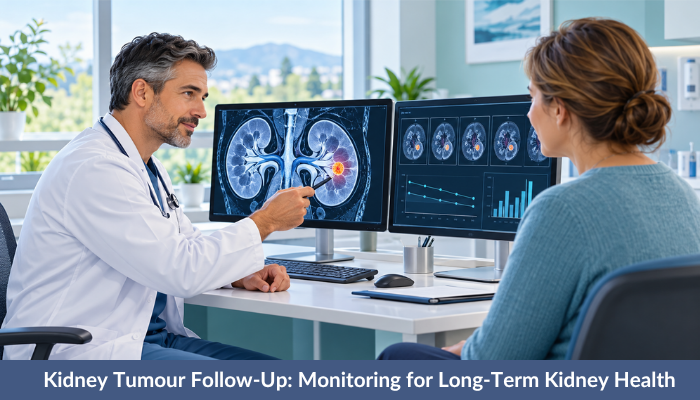
Kidney Tumour Follow Up: Why Monitoring Continues After Diagnosis
Kidney tumour follow-up is important whether a patient is under surveillance or has had surgery.
- Regular monitoring visits with the specialist
- Imaging evaluation at planned intervals
- Kidney function assessment through blood tests
- Early detection of changes over time
Steady follow-up after a kidney tumor diagnosis protects long-term kidney health and catches recurrence early.
How to Choose a Kidney Cancer Specialist in India
When choosing a kidney cancer specialist in India, consider:
- Accuracy and care in tumour evaluation
- Experience in kidney cancer diagnosis and surgery
- Familiarity with kidney-preserving procedures
- Personalised treatment planning
- Attention to long-term kidney health
A robotic uro oncologist is trained in both cancer care and robotic surgical methods, and can guide patients through monitoring, biopsy, and surgery decisions.
Dr. Anup Ramani: Kidney Cancer Specialist in Mumbai
Dr. Anup Ramani is a uro oncologist specialising in kidney cancer care, including evaluation of kidney masses, robotic kidney surgery, and kidney-preserving procedures such as robotic partial nephrectomy. He plans treatment around tumour size, imaging findings, and overall health status.
Patients seeking kidney cancer surgery in Mumbai can consult him for personalised evaluation. His approach focuses on evidence-based care, clear explanation of options such as monitoring, biopsy, and surgery, and protecting long-term kidney health and quality of life.
Conclusion: Kidney Tumor Diagnosis and Next Steps
If you have been told about a kidney mass, start by collecting your earlier scan reports and images and arranging a specialist review. Ask for a kidney function test, because it guides both imaging and treatment choices.
A complete kidney tumor diagnosis then points to the right path, whether that is monitoring, biopsy, or surgery. Ask about the tumour size, the imaging findings, and the follow-up schedule, and keep every scan appointment.
Frequently Asked Questions About Incidental Kidney Tumor and Kidney Cancer
What does an incidental kidney tumour mean?
It means a kidney tumour was found by chance on a scan done for another reason. It may be benign or cancerous, so it needs proper evaluation to find out which.
Does finding a kidney mass always mean cancer?
No. Many kidney masses are benign. Doctors use imaging features, growth behaviour, and sometimes a biopsy to decide whether a mass is cancer.
Can a kidney tumour found accidentally be harmless?
Yes. Some tumours found by chance are benign and never become cancer, while others are early-stage cancer. Imaging, growth on repeat scans, and sometimes a biopsy show which it is.
What happens after a kidney tumour is discovered on a scan?
Doctors review the imaging, check kidney function, and may advise more scans. They then discuss monitoring, biopsy, or surgery based on the cancer risk and your health.
How is a small renal mass evaluated?
A small renal mass is studied with contrast CT or MRI, blood tests, and sometimes biopsy. The goal is to judge cancer risk and choose between monitoring and treatment.
Is a kidney tumour biopsy always required?
No. A biopsy is considered when imaging cannot tell whether a mass is cancer or when the result would change the treatment plan. Many patients proceed without one.
When is surgery recommended for a kidney tumour?
Surgery is advised when a tumour is likely to be cancer, is growing, or is large. Partial nephrectomy is preferred when possible, and radical nephrectomy is used when needed.
Can a kidney tumour be monitored without surgery?
Yes, in selected patients. Active surveillance uses regular imaging to watch small tumours, and treatment is advised if signs of cancer growth appear.
How is kidney cancer treated after diagnosis?
Treatment depends on the stage. Kidney cancer is often treated with partial or radical nephrectomy, and advanced cases may need targeted therapy or immunotherapy.

Uro-Oncological & Robotic Surgeon
Dr. Anup Ramani is a robotic uro-oncological surgeon and an internationally recognized expert in robotic surgery for prostate, kidney and urinary bladder cancers. With more than two decades of robotic experience and 2,000+ robotic procedures, he brings unmatched precision and outcomes to complex uro-oncology cases. He is widely published in his field and is known for a personal, transparent approach-often spending over an hour in initial consultations to educate patients on its disease, surgery and recovery. His expertise spans prostate cancer treatment, kidney and bladder cancer surgery, adrenal gland surgery, kidney stone treatment, penile cancer surgery and enlarged prostate management. Dr. Ramani advocates the advantages of robotic surgery-magnified 3D vision, tremor-filtered precision, minimal scarring, lower blood loss and faster recovery-helping patients return to life sooner.

Table of Contents
Recent Blogs
- Kidney Stone Removal Without Surgery: When Can Ston ...
- Preparing for Bladder Cancer Surgery: Tests, Diet, ...
- Kidney Tumor Found Incidentally: What Happens After an Unexpected Kidney Mass Diagnosis?
- PSA Rising After Prostate Cancer Surgery: What Does ...
- Predicting Complications After Bladder Cancer Surge ...
Best Uro-Oncological surgeon
Specialist in India for Robotic Surgery
MCh, DNB, MS, DNB
Dr. Anup Ramani
CONTACT
Uro-Oncologist in India,
Best Robotic Surgeon for Uro Oncology Surgery
1407, One Lodha Place Next to World Towers Senapati Bapat Marg, Worli, Mumbai. 400013.
Dr Anup Ramani @ Copyright 2026 – Website Maintenance, SEO & GEO by Opal Infotech
- Partial penectomy is done in cases where glans and distal penis is involved with carcinoma.
- Partial penectomy is a type of organ-preserving surgery. Preservation of sexual and micturational function depends on the surgical dissection and reconstruction of residual urethra.
- Patients who develop stones in the kidney or ureter, often experience severe pain.
- This condition usually needs a procedure to remove the kidney stones.
- This procedure is called ureteroscopy and is performed very commonly.
- It does not require any cuts and hence it is painless.
- The procedure is performed with an endoscope inserted through the penis under spinal anesthesia.
- The scope is inserted through the penis into the kidney and stones are dissolved with a laser.
- The procedure takes about 40-50 minutes.
- A catheter (urine pipe) is kept after the procedure to drain the bladder. A stent is kept in the kidney at the same time.
- Patient is mobile and walking in the room the same evening.
- Hospital stay is one night and patient is discharged the next day after removal of the catheter.
- Patient has to come back after six weeks to remove the stent in the kidney.
- Patients can resume office a week after surgery and heavy activities like running, weight lifting, a month after the procedure.
- We offer fixed packages for this procedure which can be obtained by calling our helpline +91 9967666060.
- Men with an enlarged prostate, which is a normal ageing changes, often experiencing difficulty passing urine. This condition usually needs a procedure to trim the prostate and relieve the blockage.
- This procedure is called TURP and is performed very commonly.
- It does not require any cuts and hence it is painless.
- The procedure is performed with an endoscope inserted through the penis under spinal anaesthesia.
- The overgrown prostate is dissolved with a laser bloodlessly.
- The procedure takes about 40 minutes.
- A catheter (urine pipe) is kept after the procedure to drain the bladder.
- Patient is mobile and walking in the room the same evening.
- Hospital stay is two nights and patient is discharged with the catheter, which is removed after 4 days.
- Patients can resume office a week after surgery and heavy activities like running, weight lifting, a month after the procedure.
- We offer fixed packages for this procedure which can be obtained by calling our helpline +91 9967666060.
-
Robotic adrenalectomy is a sophisticated, complex surgery and it is very important that an experienced surgeon performs this surgery to avoid major complications.
-
Once the anesthesia is done, and patient positioned, three micro cuts (3mm each) are made in the patient’s abdomen.
-
The arms of the Da Vinci robot are connected to the cuts via ports (tubes).
-
Dr. Ramani then sits in the controlling console to perform the surgery.
-
On an average, a robotic adrenalectomy takes one hour.
-
The surgery is almost completely bloodless and there has never been any need to transfuse blood after surgery.
-
A urine catheter and bag to drain the bladder is inserted during surgery.
-
A tiny drain pipe may be inserted in the surgical side of the abdomen, connected to a bag.
-
Patient is kept nil-by-mouth the day of the surgery, with IV fluids. Sips of water are started the next day and solid food by day three.
-
The drain pipe, if kept, is removed in the room on day 2 after surgery.
-
The catheter is removed on day two after surgery.
-
Total hospital stay for robotic adrenalectomy is 4 nights (including night before surgery).
-
Post discharge, a doctor from the surgical team visits the patient at home/ hotel room once every day.
On the day of discharge, patient is totally self-sufficient. They are able to walk freely without any pain, dress themselves, shower, toilet and they do not need to hire any nurse or help at home. Almost all patients are back to work within 2 weeks of surgery.
Heavy activities like running, weight lifting can be resumed after a month
Follow up after an adrenalectomy is in the form of CT scans, once a year for 5 years.
Local patients usually meet Dr. Ramani after two weeks to discuss report.Outstation patients are counselled on a phone consultation.
- Dr. Ramani is one of the very few surgeons in India who has the expertise to perform a robotic surgery for bladder cancer, which includes removing the urinary bladder and reconstructing a new bladder robotically.
- Robotic radical cystectomy is an extremely sophisticated, complex surgery and it is very important that an experienced surgeon performs this surgery to avoid major complications.
- Once the anaesthesia is done, and patient positioned, six micro cuts (3mm each) are made in the patient’s abdomen.
- The arms of the Da Vinci robot are connected to the cuts via ports (tubes).
- Dr. Ramani then sits in the controlling console to perform the surgery.
- On an average, a robotic radical cystectomy with an ileal conduit takes 3-4 hours.
- The surgery is almost completely bloodless and there has never been any need to transfuse blood after surgery.
- A urine catheter and bag to drain the new bladder is inserted during surgery.
- Two tiny drain pipe in inserted in the surgical side of the abdomen, connected to a bag.
- Patient is kept nil-by-mouth for 4 days after surgery with IV supplementation of patient’s daily requirements of calories, fats, carbohydrates, proteins and electrolytes.
- The drain pipes are removed in the room on day 3-5 after surgery.
- Total hospital stay for radical cystectomy is 8 nights (including night before surgery).
- Post discharge, a doctor from the surgical team visits the patient at home/ hotel room once every day.
- On the day of discharge, patient is totally self-sufficient. They are able to walk freely without any pain, dress themselves, shower, toilet and they do not need to hire any nurse or help at home.
- Almost all patients are back to work within 6 weeks of surgery. Heavy activities like running, weight lifting can be resumed after two months.
Follow up after a radical a cystectomy is in the form of CT scans, once a year for 5 years.
Histopathology report: Local patients usually meet Dr. Ramani after two weeks to discuss report.
Outstation patients are counselled on a phone consult. Depending on the report, patient may or may not need chemotherapy after surgery.
If chemo is needed, patients may choose to get it done with a medical oncologist of their choice or avail the services of one of the four medical oncologists on our team.
- Robotic partial nephrectomy is a sophisticated, complex surgery and it is very important that an experienced surgeon performs this surgery to avoid major complications. Robotic radical (total) nephrectomy is
- relatively easier but still requires significant experience to consistently deliver results.
- Once the anaesthesia is done, and patient positioned, five micro cuts (3mm each) are made in the patient’s abdomen.
- The arms of the Da Vinci robot are connected to the cuts via ports (tubes).
- Dr. Ramani then sits in the controlling console to perform the surgery.
- On an average, a robotic radical nephrectomy takes one hour and a robotic partial nephrectomy takes about an hour and half.
- The surgery is almost completely bloodless and there has never been any need to transfuse blood after surgery.
- A urine catheter and bag to drain the bladder is inserted during surgery.
- A tiny drain pipe in inserted in the surgical side of the abdomen, connected to a bag.
- Patient is kept nil-by-mouth the day of the surgery, with IV fluids. Sips of water are started the next day and solid food by day three.
- The drain pipe is removed in the room on day 3 after surgery. The catheter is removed on day two after surgery.
- Total hospital stay for radical/partial nephrectomy is 4 nights (including night before surgery).
- Post discharge, a doctor from the surgical team visits the patient at home/ hotel room once every day.
- On the day of discharge, patient is totally self- sufficient.
- They are able to walk freely without any pain, dress themselves, shower, toilet and they do not need to hire any nurse or help at home.
- Almost all patients are back to work within 2-3 weeks of surgery.
- Heavy activities like running, weight lifting can be resumed after a month.
- Follow up after a radical/partial Nephrectomy is in the form of CT scans, once a year for 5 years.
- Local patients usually meet Dr. Ramani after two weeks to discuss report.
- Outstation patients are counselled on a phone consultation.