Read Our Article
The Role of Robotic Adrenalectomy in Managing Bilateral Adrenal Gland TumorsDr Anup Ramani @ Copyright 2024
By Dr. Anup Ramani
Objective:
Making a decision about adrenal gland surgery is significant and often complex. This article aims to guide you through the importance of seeking a second opinion before proceeding with adrenal gland treatment or surgery, helping you make confident, informed choices about your health.
Understanding the Role of the Adrenal Glands
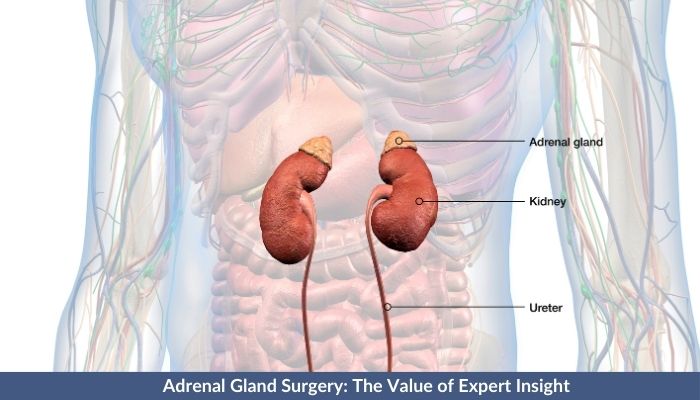
The adrenal glands play a crucial role in maintaining hormonal balance in your body. Located above the kidneys, these small glands regulate hormones related to stress, metabolism, blood pressure and other essential functions. When an issue arises – such as tumors, hormonal imbalances or overactive glands – it can disrupt your entire system, leading to serious health concerns. However, the decision to undergo such a procedure should not be rushed. That’s where the value of a second opinion becomes incredibly important.
Second Opinion for Adrenal Gland Surgery: A Smart Step Forward
When faced with the recommendation for adrenal gland surgery, patients often feel overwhelmed. The procedure could be life-altering and it’s vital to ensure that surgery is truly necessary. A second opinion offers clarity, especially when different approaches – such as medical management, robotic adrenalectomy or watchful waiting – are possible.
By consulting another adrenal gland surgeon, you gain access to a different perspective, possibly with advanced diagnostic insights or alternative treatment strategies. It ensures that all options are considered before making a commitment. In some cases, patients have avoided unnecessary surgery simply by exploring other credible medical opinions.
Adrenal Gland Surgeon Perspective Matters
Not all surgeons approach adrenal gland issues the same way. A second opinion from a highly experienced adrenal gland surgeon in India or elsewhere can shed light on newer, less invasive techniques or offer insight into long-term management without surgery. Especially in metropolitan centers like Mumbai, where adrenal gland surgeons work with advanced technologies, patients might learn about procedures like robotic adrenalectomy that weren’t initially presented.
Adrenal Gland Treatment Isn’t Always Surgical
One of the biggest misconceptions is that adrenal issues always require surgery. In reality, several adrenal gland conditions can be managed with medications, hormonal therapy or simple lifestyle changes. A second opinion can validate whether surgery is your only option or if conservative adrenal gland treatment could be effective.
Many patients have experienced better outcomes simply by being patient, asking the right questions and exploring every option available. A different specialist might spot nuances in your condition that call for a modified or non-surgical approach.
What Our Patients Are Saying
Adrenal Gland Surgery: High-Stakes Decisions Demand Clarity
Surgery on the adrenal gland is delicate and can impact hormone production, blood pressure and overall health. Misdiagnosis or premature decisions could lead to complications. That’s why a second opinion becomes a safety net – it ensures the proposed adrenal gland surgery is based on solid evidence and not just assumptions or limited data.
Whether you’re consulting a robotic adrenalectomy surgeon or a traditional specialist, additional insight helps you understand the risks, potential benefits and alternatives, so you’re not walking into the operation room unprepared.
Our Other Surgery Treatment
Kidney Stone Removal SurgeryRobotic Adrenalectomy Surgeon: Knowing Your Options
With advancements in technology, many adrenal gland surgeries are performed using minimal invasive techniques. If your primary physician hasn’t discussed this option, a second opinion might. This approach offers benefits like shorter recovery time, reduced pain and greater surgical precision.
A robotic adrenalectomy surgeon can provide insights into whether you’re a candidate for this method, based on tumor size, location and overall health. Not every center or surgeon offers this, which is another compelling reason to explore expert opinions beyond your first consultation.
Adrenal Gland Surgeon in Mumbai: Access to Advanced Care
Choosing Dr. Anup Ramani, as a well-known adrenal gland surgeon in Mumbai can open doors to top-tier medical infrastructure, advanced diagnostic facilities and experienced surgical teams. These urban centers often act as hubs for specialized care and robotic procedures that might not be available elsewhere.
A second opinion from a specialist in Mumbai could present treatment strategies that are both less invasive and more effective, especially for complex adrenal disorders.
Adrenal Gland Surgeon in India: A Diverse Network of Experts
India is home to some of the world’s most experienced adrenal gland surgeons, offering patients a wide range of choices. From traditional surgical techniques to cutting-edge robotic adrenalectomy, the expertise available in India spans across public hospitals, private clinics and specialized endocrine centers.
By seeking a second opinion within India, you gain access to this diverse talent pool. This approach also helps compare medical opinions, costs, recovery protocols and the comfort level you feel with each practitioner.
How to Prepare for a Second Opinion
Before visiting another adrenal gland specialist, gather all your medical records, imaging scans and test results. Make a list of questions you’d like to ask – about diagnosis accuracy, surgical necessity, recovery time, long-term hormone management and alternatives to surgery.
Being prepared not only makes your consultation more productive but also ensures you make the most out of your time with the new adrenal gland surgeon. It’s also a chance to compare the communication style and comfort level with different experts.
Emotional Support and Confidence Through Clarity
The anxiety around adrenal gland treatment isn’t just medical – it’s emotional too. Patients worry about what life will be like post-surgery, potential side effects or managing hormonal fluctuations. A second opinion can ease these fears by providing a clearer understanding of the journey ahead.
Clarity breeds confidence. Knowing that two or more experts agree on a treatment plan gives you emotional strength and mental preparedness to go ahead, should surgery be the best option.
Our Other Surgery Treatment
Prostate Cancer SurgeryRobotic Adrenalectomy: Is It the Future of Adrenal Surgery?
Minimal invasive adrenal surgeries are becoming more common due to quicker recovery, reduced blood loss and fewer complications. A second opinion with a Robotic Adrenalectomy Surgeon may introduce you to this advanced option, especially if your primary consultation leaned toward open surgery.
While not every case qualifies for Robotic Adrenalectomy, knowing whether it’s right for you helps you make a better-informed choice – backed by modern medical technology and expert evaluation.
Conclusion
Making decisions about adrenal gland treatment, especially surgery, is a major health milestone. By seeking a second opinion, you ensure that the chosen path is right, necessary and the best option available for your condition. Whether you’re evaluating treatment options, surgical necessity or learning about robotic adrenalectomy, the clarity from another expert helps you make informed, confident decisions.
Second opinions are not about questioning medical authority – they’re about honoring your right to understand all options thoroughly. When it comes to adrenal gland health, one opinion is good – but two are better.
FAQs About Adrenal Gland Surgery
Is a second opinion necessary for adrenal gland surgery?
Yes, it helps confirm the diagnosis and evaluate all available treatment options.
Can I delay surgery while seeking a second opinion?
In most non-emergency cases, yes. Always confirm with your doctor.
What if two adrenal gland surgeons suggest different treatments?
Compare their reasoning, consider a third opinion and weigh your comfort level with each plan.
Does robotic adrenalectomy offer better outcomes?
For many, yes – it’s minimal invasive with faster recovery, but eligibility varies.
How do I choose the right adrenal gland surgeon in India?
Look for experience, specialization, patient reviews and comfort during consultation.
About Author

Uro-Oncological & Robotic Surgeon
Dr. Anup Ramani is a robotic uro-oncological surgeon and an internationally recognized expert in robotic surgery for prostate, kidney and urinary bladder cancers. With more than two decades of robotic experience and 2,000+ robotic procedures, he brings unmatched precision and outcomes to complex uro-oncology cases. He is widely published in his field and is known for a personal, transparent approach-often spending over an hour in initial consultations to educate patients on its disease, surgery and recovery. His expertise spans prostate cancer treatment, kidney and bladder cancer surgery, adrenal gland surgery, kidney stone treatment, penile cancer surgery and enlarged prostate management. Dr. Ramani advocates the advantages of robotic surgery-magnified 3D vision, tremor-filtered precision, minimal scarring, lower blood loss and faster recovery-helping patients return to life sooner.
Table of Contents

Recent Blogs
Best Uro-Oncological surgeon
Specialist in India for Robotic Surgery
MCh, DNB, MS, DNB
Dr. Anup Ramani
CONTACT
Uro-Oncologist in India,
Best Robotic Surgeon for Uro Oncology Surgery
1407, One Lodha Place Next to World Towers Senapati Bapat Marg, Worli, Mumbai. 400013.
Dr Anup Ramani @ Copyright 2024 – Website Maintenance, SEO & GEO by Opal Infotech
- Partial penectomy is done in cases where glans and distal penis is involved with carcinoma.
- Partial penectomy is a type of organ-preserving surgery. Preservation of sexual and micturational function depends on the surgical dissection and reconstruction of residual urethra.
- Patients who develop stones in the kidney or ureter, often experience severe pain.
- This condition usually needs a procedure to remove the kidney stones.
- This procedure is called ureteroscopy and is performed very commonly.
- It does not require any cuts and hence it is painless.
- The procedure is performed with an endoscope inserted through the penis under spinal anesthesia.
- The scope is inserted through the penis into the kidney and stones are dissolved with a laser.
- The procedure takes about 40-50 minutes.
- A catheter (urine pipe) is kept after the procedure to drain the bladder. A stent is kept in the kidney at the same time.
- Patient is mobile and walking in the room the same evening.
- Hospital stay is one night and patient is discharged the next day after removal of the catheter.
- Patient has to come back after six weeks to remove the stent in the kidney.
- Patients can resume office a week after surgery and heavy activities like running, weight lifting, a month after the procedure.
- We offer fixed packages for this procedure which can be obtained by calling our helpline +91 9967666060.
- Men with an enlarged prostate, which is a normal ageing changes, often experiencing difficulty passing urine. This condition usually needs a procedure to trim the prostate and relieve the blockage.
- This procedure is called TURP and is performed very commonly.
- It does not require any cuts and hence it is painless.
- The procedure is performed with an endoscope inserted through the penis under spinal anaesthesia.
- The overgrown prostate is dissolved with a laser bloodlessly.
- The procedure takes about 40 minutes.
- A catheter (urine pipe) is kept after the procedure to drain the bladder.
- Patient is mobile and walking in the room the same evening.
- Hospital stay is two nights and patient is discharged with the catheter, which is removed after 4 days.
- Patients can resume office a week after surgery and heavy activities like running, weight lifting, a month after the procedure.
- We offer fixed packages for this procedure which can be obtained by calling our helpline +91 9967666060.
-
Robotic adrenalectomy is a sophisticated, complex surgery and it is very important that an experienced surgeon performs this surgery to avoid major complications.
-
Once the anesthesia is done, and patient positioned, three micro cuts (3mm each) are made in the patient’s abdomen.
-
The arms of the Da Vinci robot are connected to the cuts via ports (tubes).
-
Dr. Ramani then sits in the controlling console to perform the surgery.
-
On an average, a robotic adrenalectomy takes one hour.
-
The surgery is almost completely bloodless and there has never been any need to transfuse blood after surgery.
-
A urine catheter and bag to drain the bladder is inserted during surgery.
-
A tiny drain pipe may be inserted in the surgical side of the abdomen, connected to a bag.
-
Patient is kept nil-by-mouth the day of the surgery, with IV fluids. Sips of water are started the next day and solid food by day three.
-
The drain pipe, if kept, is removed in the room on day 2 after surgery.
-
The catheter is removed on day two after surgery.
-
Total hospital stay for robotic adrenalectomy is 4 nights (including night before surgery).
-
Post discharge, a doctor from the surgical team visits the patient at home/ hotel room once every day.
On the day of discharge, patient is totally self-sufficient. They are able to walk freely without any pain, dress themselves, shower, toilet and they do not need to hire any nurse or help at home. Almost all patients are back to work within 2 weeks of surgery.
Heavy activities like running, weight lifting can be resumed after a month
Follow up after an adrenalectomy is in the form of CT scans, once a year for 5 years.
Local patients usually meet Dr. Ramani after two weeks to discuss report.Outstation patients are counselled on a phone consultation.
- Dr. Ramani is one of the very few surgeons in India who has the expertise to perform a robotic surgery for bladder cancer, which includes removing the urinary bladder and reconstructing a new bladder robotically.
- Robotic radical cystectomy is an extremely sophisticated, complex surgery and it is very important that an experienced surgeon performs this surgery to avoid major complications.
- Once the anaesthesia is done, and patient positioned, six micro cuts (3mm each) are made in the patient’s abdomen.
- The arms of the Da Vinci robot are connected to the cuts via ports (tubes).
- Dr. Ramani then sits in the controlling console to perform the surgery.
- On an average, a robotic radical cystectomy with an ileal conduit takes 3-4 hours.
- The surgery is almost completely bloodless and there has never been any need to transfuse blood after surgery.
- A urine catheter and bag to drain the new bladder is inserted during surgery.
- Two tiny drain pipe in inserted in the surgical side of the abdomen, connected to a bag.
- Patient is kept nil-by-mouth for 4 days after surgery with IV supplementation of patient’s daily requirements of calories, fats, carbohydrates, proteins and electrolytes.
- The drain pipes are removed in the room on day 3-5 after surgery.
- Total hospital stay for radical cystectomy is 8 nights (including night before surgery).
- Post discharge, a doctor from the surgical team visits the patient at home/ hotel room once every day.
- On the day of discharge, patient is totally self-sufficient. They are able to walk freely without any pain, dress themselves, shower, toilet and they do not need to hire any nurse or help at home.
- Almost all patients are back to work within 6 weeks of surgery. Heavy activities like running, weight lifting can be resumed after two months.
Follow up after a radical a cystectomy is in the form of CT scans, once a year for 5 years.
Histopathology report: Local patients usually meet Dr. Ramani after two weeks to discuss report.
Outstation patients are counselled on a phone consult. Depending on the report, patient may or may not need chemotherapy after surgery.
If chemo is needed, patients may choose to get it done with a medical oncologist of their choice or avail the services of one of the four medical oncologists on our team.
- Robotic partial nephrectomy is a sophisticated, complex surgery and it is very important that an experienced surgeon performs this surgery to avoid major complications. Robotic radical (total) nephrectomy is
- relatively easier but still requires significant experience to consistently deliver results.
- Once the anaesthesia is done, and patient positioned, five micro cuts (3mm each) are made in the patient’s abdomen.
- The arms of the Da Vinci robot are connected to the cuts via ports (tubes).
- Dr. Ramani then sits in the controlling console to perform the surgery.
- On an average, a robotic radical nephrectomy takes one hour and a robotic partial nephrectomy takes about an hour and half.
- The surgery is almost completely bloodless and there has never been any need to transfuse blood after surgery.
- A urine catheter and bag to drain the bladder is inserted during surgery.
- A tiny drain pipe in inserted in the surgical side of the abdomen, connected to a bag.
- Patient is kept nil-by-mouth the day of the surgery, with IV fluids. Sips of water are started the next day and solid food by day three.
- The drain pipe is removed in the room on day 3 after surgery. The catheter is removed on day two after surgery.
- Total hospital stay for radical/partial nephrectomy is 4 nights (including night before surgery).
- Post discharge, a doctor from the surgical team visits the patient at home/ hotel room once every day.
- On the day of discharge, patient is totally self- sufficient.
- They are able to walk freely without any pain, dress themselves, shower, toilet and they do not need to hire any nurse or help at home.
- Almost all patients are back to work within 2-3 weeks of surgery.
- Heavy activities like running, weight lifting can be resumed after a month.
- Follow up after a radical/partial Nephrectomy is in the form of CT scans, once a year for 5 years.
- Local patients usually meet Dr. Ramani after two weeks to discuss report.
- Outstation patients are counselled on a phone consultation.