




Dr Anup Ramani @ Copyright 2024
By Dr. Anup Ramani
AI Summary
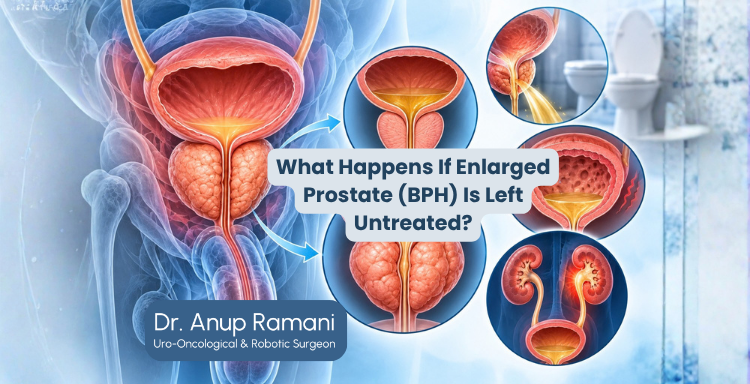
An enlarged prostate, medically known as benign prostatic hyperplasia (BPH), is one of the most common conditions affecting men as they age. It is not prostate cancer, but if left untreated, an enlarged prostate can gradually worsen urinary symptoms, affect bladder function, and in advanced cases, impact kidney health. Understanding what happens if an enlarged prostate is left untreated helps patients recognise warning signs early and make informed treatment decisions before complications develop.
BPH occurs when the prostate enlarges and presses against the urethra, the tube that carries urine out of the body. Since urine flow depends on this passage staying open, prostate enlargement can cause frequent urination, night-time urination, a weak stream, and difficulty starting urination. Symptoms usually progress slowly, which is why many delay seeking care — but ignoring an enlarged prostate untreated over time can lead to urinary retention, infections, and bladder or kidney strain.
This article explains the causes of BPH, why untreated BPH complications develop, how the condition is diagnosed, and the treatment options available today — from lifestyle changes to medications and advanced surgical procedures.
What happens if an enlarged prostate is left untreated? Untreated BPH can gradually worsen urinary symptoms and may lead to urinary retention, infections, bladder damage, and in severe cases, kidney problems.
Enlarged Prostate (BPH): Causes and Definition
The prostate is a small gland below the bladder that surrounds the urethra and contributes to semen production. As men age, hormonal changes cause prostate cells to multiply, leading to gradual enlargement — BPH, a benign, non-cancerous condition distinct from prostate cancer, though the two can cause similar urinary symptoms.
Because the prostate wraps around the urethra, enlargement can compress this passage, restricting urine flow even though the bladder and kidneys are initially unaffected.
Enlarged Prostate Symptoms and Untreated Progression
When the prostate enlarges, it narrows the urethra, forcing the bladder to work harder to push urine out. Over time, this increased effort can cause the bladder muscle to thicken and become less efficient. Common early symptoms include:
- Frequent urination, especially at night
- A weak or interrupted urine stream
- Difficulty starting urination
- A sensation of incomplete bladder emptying
These symptoms often develop gradually, and many men adjust their routines rather than seek care — allowing the obstruction to progress.
Untreated BPH Complications and Prostate Enlargement Risks
Chronic Urinary Retention
As obstruction increases, some men find it harder to empty the bladder fully. This raises pressure within the urinary system and can lead to sudden, complete inability to urinate — a condition requiring urgent medical attention.
Urinary Tract Infections (UTIs)
Urine remaining in the bladder due to incomplete emptying creates conditions where bacteria can multiply, increasing the risk of recurrent infections.
Bladder Damage
Over months or years, the bladder muscle may thicken from the extra effort of pushing urine past the obstruction, eventually reducing its ability to contract effectively — sometimes making the problem harder to reverse even after treatment.
Kidney Problems
In advanced, long-standing cases, backed-up pressure can affect drainage from the kidneys, potentially impairing kidney function. This is uncommon but underscores why untreated BPH complications should not be ignored.
Untreated BPH Progression Speed
Progression varies from man to man. Some remain stable with mild symptoms for years, while others notice a steady decline in urine flow and rising urgency over a much shorter period. Age, prostate size, and overall urinary tract health all influence the pace of change.
Because progression is unpredictable, regular monitoring helps catch a faster-progressing case early. Men with mild symptoms are often followed with periodic check-ups, while those showing faster progression may be advised to start treatment sooner.
Can Enlarged Prostate Become Dangerous?
BPH itself is not cancerous and, for many men, progresses slowly with manageable symptoms. Whether it becomes a more serious concern depends on several factors that doctors evaluate together:
- Prostate size and rate of growth
- PSA (prostate-specific antigen) levels
- Severity and progression of urinary symptoms
- Bladder function and residual urine volume
- Kidney health
Regular evaluation allows a specialist to monitor these factors and intervene before complications develop.
BPH Diagnosis: How Enlarged Prostate Is Diagnosed
Diagnosis typically combines several assessments to build a complete picture:
- A detailed medical history and symptom review
- Digital rectal examination
- PSA blood test
- Urine tests to rule out infection
- Ultrasound to assess prostate size and bladder emptying
- Uroflowmetry to measure urine flow rate
- Post-void residual urine measurement
These tests help determine whether monitoring or treatment is needed.
BPH Treatment: When It Becomes Necessary
Certain signs indicate that evaluation should not be delayed:
- Complete inability to pass urine
- Blood in the urine
- Repeated urinary tract infections
- Progressively worsening urinary difficulty
- Signs of reduced kidney function
- Symptoms significantly disrupting sleep or daily activities
Enlarged Prostate Treatment Options: Lifestyle to Surgery
Treatment is tailored to symptom severity, prostate size, and overall health.
Lifestyle changes often help with mild symptoms: reducing evening fluid intake, limiting bladder irritants like caffeine and alcohol, maintaining a healthy weight, and staying physically active.
Medications are commonly used for moderate symptoms. Alpha blockers relax muscles around the prostate and bladder neck to improve flow, while 5-alpha reductase inhibitors shrink the prostate over time. Combination therapy may suit larger prostates or more pronounced symptoms.
Minimally invasive treatments, including laser-based prostate procedures, offer effective relief with shorter recovery times.
Surgery, such as TURP or laser prostate surgery, is generally considered when symptoms are severe, medications are ineffective, or complications have developed.
BPH Treatment Without Prostate Removal
Most modern BPH treatments aim to relieve the obstruction and improve urine flow rather than remove prostate tissue entirely. The right approach depends on prostate size, symptom severity, and overall health, decided together with a specialist.
What Our Patients Are Saying
Untreated BPH and Quality of Life
Beyond physical symptoms, untreated BPH can affect daily living — disrupted sleep, anxiety around travel or long meetings, reduced social activity, and general frustration. Addressing symptoms early often restores a sense of normalcy.
Enlarged Prostate Specialist in India: How to Choose
When selecting a specialist for prostate enlargement, patients should consider:
- Experience with prostate conditions
- A thorough, accurate diagnostic approach
- Familiarity with minimally invasive treatments
- Willingness to build a personalised treatment plan
Dr. Anup Ramani: Enlarged Prostate Specialist in Mumbai
Dr. Anup Ramani is a uro-oncology and urology specialist with extensive experience diagnosing and treating benign prostatic hyperplasia, combining evidence-based evaluation with advanced, minimally invasive procedures — including laser-based techniques — tailored to each patient’s symptoms, prostate size, and overall health. For patients seeking BPH treatment in Mumbai, he offers comprehensive care from diagnosis through medication management, minimally invasive procedures, and surgery when needed, as a trusted urology specialist in Mumbai and enlarged prostate specialist in India.
Conclusion
Left untreated, BPH can gradually worsen urinary symptoms and, in some cases, lead to urinary retention, infections, bladder changes, or kidney strain. Early evaluation helps identify these risks before they progress. Treatment decisions should be based on individual symptoms, prostate size, bladder function, and overall health — and modern medical and surgical options can significantly improve quality of life.
Frequently Asked Questions
What happens if an enlarged prostate is left untreated?
Symptoms often worsen gradually, and complications such as urinary retention, infections, or bladder changes can develop over time.
Can untreated BPH damage the kidneys?
In advanced, long-standing cases, severe obstruction can affect kidney drainage and function, though this is uncommon with regular monitoring.
Can an enlarged prostate block urine completely?
Yes, in some cases obstruction can progress to acute urinary retention, which requires urgent medical care.
Does BPH always require surgery?
No. Many cases are managed successfully with lifestyle changes or medication; surgery is considered for severe or unresponsive symptoms.
What size prostate requires treatment?
Treatment decisions depend more on symptom severity and complications than prostate size alone.
Can medications shrink an enlarged prostate?
Certain medications, such as 5-alpha reductase inhibitors, can reduce prostate size over time in some patients.
What are the latest treatments for enlarged prostate?
Minimally invasive laser-based procedures are increasingly used alongside traditional medication and surgical options.
Is laser prostate surgery better than TURP?
Both are effective; the right choice depends on prostate size, patient health, and specialist recommendation.
Can BPH turn into prostate cancer?
No, BPH does not turn into prostate cancer, though both conditions can occur independently and share some symptoms.
When should I see a urologist for an enlarged prostate?
If urinary symptoms are worsening, disrupting daily life, or accompanied by blood in urine or repeated infections, prompt evaluation is recommended.

Uro-Oncological & Robotic Surgeon
Dr. Anup Ramani is a robotic uro-oncological surgeon and an internationally recognized expert in robotic surgery for prostate, kidney and urinary bladder cancers. With more than two decades of robotic experience and 2,000+ robotic procedures, he brings unmatched precision and outcomes to complex uro-oncology cases. He is widely published in his field and is known for a personal, transparent approach-often spending over an hour in initial consultations to educate patients on its disease, surgery and recovery. His expertise spans prostate cancer treatment, kidney and bladder cancer surgery, adrenal gland surgery, kidney stone treatment, penile cancer surgery and enlarged prostate management. Dr. Ramani advocates the advantages of robotic surgery-magnified 3D vision, tremor-filtered precision, minimal scarring, lower blood loss and faster recovery-helping patients return to life sooner.

Best Uro-Oncological surgeon
Specialist in India for Robotic Surgery
MCh, DNB, MS, DNB
Dr. Anup Ramani
CONTACT
Uro-Oncologist in India,
Best Robotic Surgeon for Uro Oncology Surgery
1407, One Lodha Place Next to World Towers Senapati Bapat Marg, Worli, Mumbai. 400013.
Dr Anup Ramani @ Copyright 2026 – Website Maintenance, SEO & GEO by Opal Infotech
- Partial penectomy is done in cases where glans and distal penis is involved with carcinoma.
- Partial penectomy is a type of organ-preserving surgery. Preservation of sexual and micturational function depends on the surgical dissection and reconstruction of residual urethra.
- Patients who develop stones in the kidney or ureter, often experience severe pain.
- This condition usually needs a procedure to remove the kidney stones.
- This procedure is called ureteroscopy and is performed very commonly.
- It does not require any cuts and hence it is painless.
- The procedure is performed with an endoscope inserted through the penis under spinal anesthesia.
- The scope is inserted through the penis into the kidney and stones are dissolved with a laser.
- The procedure takes about 40-50 minutes.
- A catheter (urine pipe) is kept after the procedure to drain the bladder. A stent is kept in the kidney at the same time.
- Patient is mobile and walking in the room the same evening.
- Hospital stay is one night and patient is discharged the next day after removal of the catheter.
- Patient has to come back after six weeks to remove the stent in the kidney.
- Patients can resume office a week after surgery and heavy activities like running, weight lifting, a month after the procedure.
- We offer fixed packages for this procedure which can be obtained by calling our helpline +91 9967666060.
- Men with an enlarged prostate, which is a normal ageing changes, often experiencing difficulty passing urine. This condition usually needs a procedure to trim the prostate and relieve the blockage.
- This procedure is called TURP and is performed very commonly.
- It does not require any cuts and hence it is painless.
- The procedure is performed with an endoscope inserted through the penis under spinal anaesthesia.
- The overgrown prostate is dissolved with a laser bloodlessly.
- The procedure takes about 40 minutes.
- A catheter (urine pipe) is kept after the procedure to drain the bladder.
- Patient is mobile and walking in the room the same evening.
- Hospital stay is two nights and patient is discharged with the catheter, which is removed after 4 days.
- Patients can resume office a week after surgery and heavy activities like running, weight lifting, a month after the procedure.
- We offer fixed packages for this procedure which can be obtained by calling our helpline +91 9967666060.
-
Robotic adrenalectomy is a sophisticated, complex surgery and it is very important that an experienced surgeon performs this surgery to avoid major complications.
-
Once the anesthesia is done, and patient positioned, three micro cuts (3mm each) are made in the patient’s abdomen.
-
The arms of the Da Vinci robot are connected to the cuts via ports (tubes).
-
Dr. Ramani then sits in the controlling console to perform the surgery.
-
On an average, a robotic adrenalectomy takes one hour.
-
The surgery is almost completely bloodless and there has never been any need to transfuse blood after surgery.
-
A urine catheter and bag to drain the bladder is inserted during surgery.
-
A tiny drain pipe may be inserted in the surgical side of the abdomen, connected to a bag.
-
Patient is kept nil-by-mouth the day of the surgery, with IV fluids. Sips of water are started the next day and solid food by day three.
-
The drain pipe, if kept, is removed in the room on day 2 after surgery.
-
The catheter is removed on day two after surgery.
-
Total hospital stay for robotic adrenalectomy is 4 nights (including night before surgery).
-
Post discharge, a doctor from the surgical team visits the patient at home/ hotel room once every day.
On the day of discharge, patient is totally self-sufficient. They are able to walk freely without any pain, dress themselves, shower, toilet and they do not need to hire any nurse or help at home. Almost all patients are back to work within 2 weeks of surgery.
Heavy activities like running, weight lifting can be resumed after a month
Follow up after an adrenalectomy is in the form of CT scans, once a year for 5 years.
Local patients usually meet Dr. Ramani after two weeks to discuss report.Outstation patients are counselled on a phone consultation.
- Dr. Ramani is one of the very few surgeons in India who has the expertise to perform a robotic surgery for bladder cancer, which includes removing the urinary bladder and reconstructing a new bladder robotically.
- Robotic radical cystectomy is an extremely sophisticated, complex surgery and it is very important that an experienced surgeon performs this surgery to avoid major complications.
- Once the anaesthesia is done, and patient positioned, six micro cuts (3mm each) are made in the patient’s abdomen.
- The arms of the Da Vinci robot are connected to the cuts via ports (tubes).
- Dr. Ramani then sits in the controlling console to perform the surgery.
- On an average, a robotic radical cystectomy with an ileal conduit takes 3-4 hours.
- The surgery is almost completely bloodless and there has never been any need to transfuse blood after surgery.
- A urine catheter and bag to drain the new bladder is inserted during surgery.
- Two tiny drain pipe in inserted in the surgical side of the abdomen, connected to a bag.
- Patient is kept nil-by-mouth for 4 days after surgery with IV supplementation of patient’s daily requirements of calories, fats, carbohydrates, proteins and electrolytes.
- The drain pipes are removed in the room on day 3-5 after surgery.
- Total hospital stay for radical cystectomy is 8 nights (including night before surgery).
- Post discharge, a doctor from the surgical team visits the patient at home/ hotel room once every day.
- On the day of discharge, patient is totally self-sufficient. They are able to walk freely without any pain, dress themselves, shower, toilet and they do not need to hire any nurse or help at home.
- Almost all patients are back to work within 6 weeks of surgery. Heavy activities like running, weight lifting can be resumed after two months.
Follow up after a radical a cystectomy is in the form of CT scans, once a year for 5 years.
Histopathology report: Local patients usually meet Dr. Ramani after two weeks to discuss report.
Outstation patients are counselled on a phone consult. Depending on the report, patient may or may not need chemotherapy after surgery.
If chemo is needed, patients may choose to get it done with a medical oncologist of their choice or avail the services of one of the four medical oncologists on our team.
- Robotic partial nephrectomy is a sophisticated, complex surgery and it is very important that an experienced surgeon performs this surgery to avoid major complications. Robotic radical (total) nephrectomy is
- relatively easier but still requires significant experience to consistently deliver results.
- Once the anaesthesia is done, and patient positioned, five micro cuts (3mm each) are made in the patient’s abdomen.
- The arms of the Da Vinci robot are connected to the cuts via ports (tubes).
- Dr. Ramani then sits in the controlling console to perform the surgery.
- On an average, a robotic radical nephrectomy takes one hour and a robotic partial nephrectomy takes about an hour and half.
- The surgery is almost completely bloodless and there has never been any need to transfuse blood after surgery.
- A urine catheter and bag to drain the bladder is inserted during surgery.
- A tiny drain pipe in inserted in the surgical side of the abdomen, connected to a bag.
- Patient is kept nil-by-mouth the day of the surgery, with IV fluids. Sips of water are started the next day and solid food by day three.
- The drain pipe is removed in the room on day 3 after surgery. The catheter is removed on day two after surgery.
- Total hospital stay for radical/partial nephrectomy is 4 nights (including night before surgery).
- Post discharge, a doctor from the surgical team visits the patient at home/ hotel room once every day.
- On the day of discharge, patient is totally self- sufficient.
- They are able to walk freely without any pain, dress themselves, shower, toilet and they do not need to hire any nurse or help at home.
- Almost all patients are back to work within 2-3 weeks of surgery.
- Heavy activities like running, weight lifting can be resumed after a month.
- Follow up after a radical/partial Nephrectomy is in the form of CT scans, once a year for 5 years.
- Local patients usually meet Dr. Ramani after two weeks to discuss report.
- Outstation patients are counselled on a phone consultation.