Dr Anup Ramani @ Copyright 2024
By Dr. Anup Ramani
AI Summary:
Diabetic patients who need BPH surgery face higher risks because high blood sugar slows down healing and weakens the body’s ability to fight infections. Keeping blood sugar under control before and after surgery plays a big role in how well and how quickly a patient recovers. With the right preparation and the right surgical approach, diabetic men can go through enlarged prostate surgery safely and recover well.
BPH Surgery Outcomes in Diabetic Patients: Glycemic Control and Wound Healing
Benign prostatic hyperplasia, commonly known as BPH or enlarged prostate, is very common in older men. When a man also has diabetes, planning and carrying out prostate surgery becomes more careful and involved. High blood sugar does not just affect the heart or kidneys – it directly impacts how the body heals after any surgery, including enlarged prostate surgery. Understanding this connection helps patients and their families make informed decisions and prepare better for a safe surgical outcome.
BPH Surgery in Diabetic Patients: Why the Risk Is Higher
BPH surgery in diabetic patients carries more risk than in men without diabetes and the reason lies in how high blood sugar affects the body’s natural defences. When blood glucose stays high for a long time, the white blood cells that fight infections become less effective. The body’s ability to repair tissue after a cut or procedure also slows down significantly.
Men with poorly controlled diabetes also have a higher chance of getting a urinary tract infection after surgery, taking longer to have their catheter removed and spending more days in the hospital. This does not mean that diabetic patients cannot have surgery – it simply means that preparation matters a great deal and choosing an experienced surgeon is especially important.
How to Reduce Enlarged Prostate Complications before Surgery in Diabetic Patients
Knowing how to reduce enlarged prostate surgery risks in diabetic patients starts with getting the body ready well before the operation. The most important goal is bringing blood sugar levels down to a safer range before surgery is performed.
Doctors generally look for an HbA1c reading – a three-month average of blood sugar – below 7.5 to 8% before giving a go-ahead for elective surgery. Alongside this, a few other checks are essential. Kidney function needs to be tested because diabetes can quietly damage the kidneys and this affects how the body handles fluids during and after surgery. A urine test is done to check for any hidden infection, since diabetic patients are more prone to urinary infections even without obvious symptoms. Heart health is reviewed as well, given that diabetes and heart problems often go together.
One important medication note: patients taking SGLT-2 inhibitors – a common class of diabetes drugs – are usually asked to stop them three to four days before surgery. These medications can cause a dangerous chemical imbalance during the surgical period, so the treating physician adjusts the diabetes management plan accordingly.
TURP Surgery for Enlarged Prostate: How It Works for Diabetic Patients
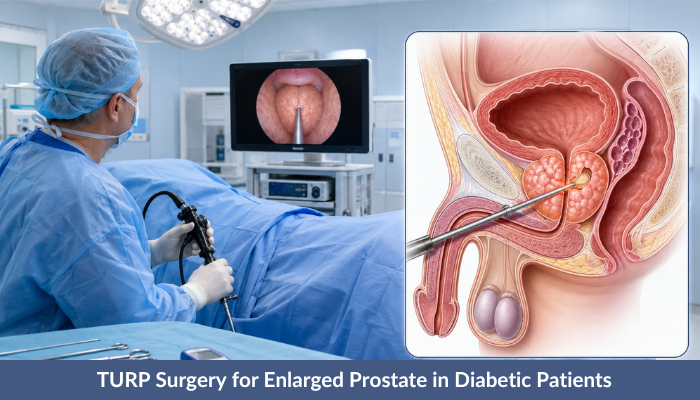
TURP surgery for enlarged prostate is the most widely used surgical treatment for BPH and remains a reliable option even for patients with diabetes, provided blood sugar is reasonably controlled. TURP is done through a small scope inserted through the urethra – there are no cuts on the skin at all, which removes one of the main infection concerns for diabetic patients.
During TURP, the overgrown prostate tissue is trimmed or dissolved to clear the urinary blockage. The procedure typically takes around 40 minutes and the patient is usually walking the same evening. A catheter is placed after the surgery and is removed within a few days.
For diabetic patients specifically, blood sugar tends to rise during surgery due to stress hormones released by the body. This is why continuous glucose monitoring during and after the procedure is important. Laser-based TURP, such as HoLEP (Holmium Laser Enucleation of the Prostate), is increasingly preferred for diabetic patients because it causes less bleeding and the catheter can be removed sooner, reducing infection risk.
What Our Patients Are Saying
Best Treatment for Enlarged Prostate: Choosing the Right Option Based on Diabetes Control
Finding the best treatment for enlarged prostate when diabetes is also present depends largely on how well the blood sugar is managed. There is no single answer that fits everyone – the right approach depends on the individual’s overall health, HbA1c levels and kidney and heart function.
For patients whose diabetes is well controlled, TURP or laser-based prostate surgery can be carried out with results that are very close to those seen in non-diabetic patients. For patients whose blood sugar is not in a safe range, the surgeon may recommend a short waiting period during which medications are used to manage urinary symptoms while diabetes is brought under better control. Medications like alpha-blockers can help relax the prostate and ease urination in the interim.
For men who are not suitable for general or spinal anaesthesia due to their health condition, newer minimal invasive options like Urolift or Rezum may be discussed, though these are considered on a case-by-case basis.
Enlarged Prostate Treatment and Healing: What Diabetes Does to the Body after Surgery
One of the biggest concerns with enlarged prostate treatment in diabetic patients is how the body heals after the procedure. In simple terms, high blood sugar makes healing slower and less effective at every stage.
When sugar levels are high, the building blocks needed to repair tissue – particularly a protein called collagen – are not laid down properly. The blood vessels in diabetic patients often carry less oxygen to healing areas and since oxygen is needed for tissue repair and fighting bacteria, this creates a double problem. The body’s inflammation response, which is actually an early part of healing, also gets stuck in an overactive state in diabetics, meaning the healing process takes longer to move into the repair and recovery phase.
In practical terms, this can mean slower healing of the urethral lining after TURP, a higher chance of developing scar tissue or strictures in the urethra and a greater risk of bleeding complications in patients with unstable blood sugar.
Enlarged Prostate Surgery: Managing Blood Sugar During and After the Procedure
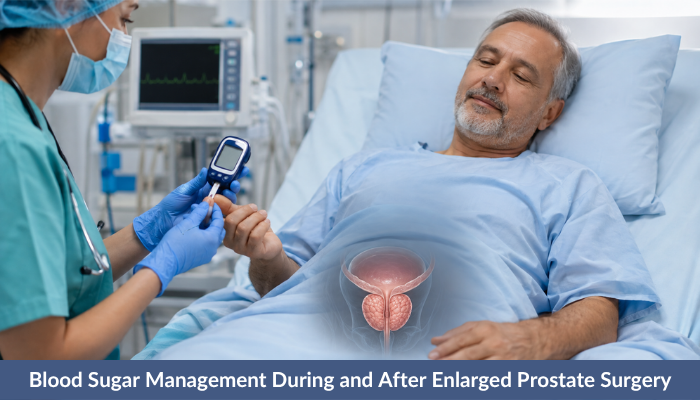
Managing blood sugar properly during enlarged prostate surgery is just as important as the surgery itself. Most hospitals now follow structured glucose management protocols rather than leaving it to chance.
During surgery, blood glucose is kept between 140 and 180 mg/dL – low enough to reduce infection risk but not so low that it causes hypoglycaemia, which can trigger heart problems. After surgery, getting the patient eating and drinking normally as soon as possible helps stabilise blood sugar levels, since prolonged fasting makes glucose harder to control.
An important and often overlooked point – some men who have never been diagnosed with diabetes are found to have high blood sugar when they come in for enlarged prostate surgery evaluation. Post-operative high blood sugar in these patients is also a risk factor for infections and slow healing. This is why many urologists now recommend a routine blood sugar and HbA1c test for all men being evaluated for BPH surgery, regardless of whether they have a diabetes diagnosis.
Enlarged Prostate Treatment in Mumbai: What Diabetic Patients Should Expect
Enlarged prostate treatment in Mumbai at experienced centres is well-equipped to handle the added complexity of diabetic patients. Given that type 2 diabetes is highly prevalent in India, urologists in Mumbai routinely manage BPH surgery in patients with coexisting diabetes.
At high-volume centres, diabetic patients receive joint care from an urologist and an endocrinologist or physician before and after surgery. Laser-based surgical platforms, round-the-clock glucose monitoring and planned post-operative follow-up visits – including home catheter removal – make the recovery period safer and more manageable. Patients are advised to seek care at centres where urological and metabolic management are handled together, rather than separately, for the best surgical outcome.
Dr. Anup Ramani - Leading Surgeon in Enlarged Prostate Treatment
Dr. Anup Ramani is one of Mumbai’s most respected uro-oncological surgeons and a pioneer in robotic urology, with over two decades of experience in India and abroad. He practises at Breach Candy, Lilavati and Saifee Hospitals and specialises in enlarged prostate surgery, prostate cancer, kidney tumours and bladder cancer using minimal invasive and robotic techniques. Known for spending dedicated time with each patient and providing personalised recovery plans, Dr. Ramani is widely regarded for combining surgical precision with genuine patient care.
Conclusion
Diabetes does not prevent a man from having safe and successful BPH surgery, but it does make preparation and post-operative care more important. Blood sugar control before surgery, careful monitoring during the procedure and structured recovery planning all work together to close the gap in outcomes between diabetic and non-diabetic patients. Men with both enlarged prostate and diabetes should consult an experienced urologist early – timely evaluation and a well-coordinated care plan make a significant difference in how smoothly the surgery and recovery go.
FAQs
Can a diabetic patient safely have TURP surgery for an enlarged prostate?
Yes, diabetic patients can safely undergo TURP when blood sugar is reasonably controlled before the procedure. Doctors usually aim for an HbA1c below 7.5–8% and carry out a full health check before scheduling surgery.
How does high blood sugar affect healing after BPH surgery?
High blood sugar slows down tissue repair, weakens infection-fighting cells and reduces oxygen delivery to healing areas. This can lead to slower recovery, higher infection risk and a greater chance of scar tissue forming in the urinary tract.
What is the best treatment for enlarged prostate if my diabetes is not well controlled?
If diabetes is not well controlled, the doctor may first recommend medications to manage urinary symptoms while working to bring blood sugar down. Once stable, surgery can be planned more safely with a significantly lower risk of complications.
Should I stop my diabetes medication before prostate surgery?
Some diabetes medications, particularly SGLT-2 inhibitors, need to be stopped three to four days before surgery. Your doctor will guide you on adjusting your medications before the procedure – do not stop or change them on your own.
Is laser TURP a better choice for diabetic patients?
Laser-based TURP options like HoLEP are generally preferred for diabetic patients because they cause less bleeding and allow for earlier catheter removal, both of which lower the risk of infection and complications in patients with slower healing.

Uro-Oncological & Robotic Surgeon
Dr. Anup Ramani is a robotic uro-oncological surgeon and an internationally recognized expert in robotic surgery for prostate, kidney and urinary bladder cancers. With more than two decades of robotic experience and 2,000+ robotic procedures, he brings unmatched precision and outcomes to complex uro-oncology cases. He is widely published in his field and is known for a personal, transparent approach-often spending over an hour in initial consultations to educate patients on its disease, surgery and recovery. His expertise spans prostate cancer treatment, kidney and bladder cancer surgery, adrenal gland surgery, kidney stone treatment, penile cancer surgery and enlarged prostate management. Dr. Ramani advocates the advantages of robotic surgery-magnified 3D vision, tremor-filtered precision, minimal scarring, lower blood loss and faster recovery-helping patients return to life sooner.

Table of Contents
Recent Blogs
- BPH Surgery Outcomes in Diabetic Patients: Glycemic Control and Wound Healing
- Penile Cancer in Young Men under 40: Different Surg ...
- Metabolic Evaluation after Kidney Stone Removal Sur ...
- Penile Cancer: Symptoms, Diagnosis, Treatment, and ...
- Kidney Stones: Causes, Prevention, and Treatment, A ...
Best Uro-Oncological surgeon
Specialist in India for Robotic Surgery
MCh, DNB, MS, DNB
Dr. Anup Ramani
CONTACT
Uro-Oncologist in India,
Best Robotic Surgeon for Uro Oncology Surgery
1407, One Lodha Place Next to World Towers Senapati Bapat Marg, Worli, Mumbai. 400013.
Dr Anup Ramani @ Copyright 2026 – Website Maintenance, SEO & GEO by Opal Infotech
- Partial penectomy is done in cases where glans and distal penis is involved with carcinoma.
- Partial penectomy is a type of organ-preserving surgery. Preservation of sexual and micturational function depends on the surgical dissection and reconstruction of residual urethra.
- Patients who develop stones in the kidney or ureter, often experience severe pain.
- This condition usually needs a procedure to remove the kidney stones.
- This procedure is called ureteroscopy and is performed very commonly.
- It does not require any cuts and hence it is painless.
- The procedure is performed with an endoscope inserted through the penis under spinal anesthesia.
- The scope is inserted through the penis into the kidney and stones are dissolved with a laser.
- The procedure takes about 40-50 minutes.
- A catheter (urine pipe) is kept after the procedure to drain the bladder. A stent is kept in the kidney at the same time.
- Patient is mobile and walking in the room the same evening.
- Hospital stay is one night and patient is discharged the next day after removal of the catheter.
- Patient has to come back after six weeks to remove the stent in the kidney.
- Patients can resume office a week after surgery and heavy activities like running, weight lifting, a month after the procedure.
- We offer fixed packages for this procedure which can be obtained by calling our helpline +91 9967666060.
- Men with an enlarged prostate, which is a normal ageing changes, often experiencing difficulty passing urine. This condition usually needs a procedure to trim the prostate and relieve the blockage.
- This procedure is called TURP and is performed very commonly.
- It does not require any cuts and hence it is painless.
- The procedure is performed with an endoscope inserted through the penis under spinal anaesthesia.
- The overgrown prostate is dissolved with a laser bloodlessly.
- The procedure takes about 40 minutes.
- A catheter (urine pipe) is kept after the procedure to drain the bladder.
- Patient is mobile and walking in the room the same evening.
- Hospital stay is two nights and patient is discharged with the catheter, which is removed after 4 days.
- Patients can resume office a week after surgery and heavy activities like running, weight lifting, a month after the procedure.
- We offer fixed packages for this procedure which can be obtained by calling our helpline +91 9967666060.
-
Robotic adrenalectomy is a sophisticated, complex surgery and it is very important that an experienced surgeon performs this surgery to avoid major complications.
-
Once the anesthesia is done, and patient positioned, three micro cuts (3mm each) are made in the patient’s abdomen.
-
The arms of the Da Vinci robot are connected to the cuts via ports (tubes).
-
Dr. Ramani then sits in the controlling console to perform the surgery.
-
On an average, a robotic adrenalectomy takes one hour.
-
The surgery is almost completely bloodless and there has never been any need to transfuse blood after surgery.
-
A urine catheter and bag to drain the bladder is inserted during surgery.
-
A tiny drain pipe may be inserted in the surgical side of the abdomen, connected to a bag.
-
Patient is kept nil-by-mouth the day of the surgery, with IV fluids. Sips of water are started the next day and solid food by day three.
-
The drain pipe, if kept, is removed in the room on day 2 after surgery.
-
The catheter is removed on day two after surgery.
-
Total hospital stay for robotic adrenalectomy is 4 nights (including night before surgery).
-
Post discharge, a doctor from the surgical team visits the patient at home/ hotel room once every day.
On the day of discharge, patient is totally self-sufficient. They are able to walk freely without any pain, dress themselves, shower, toilet and they do not need to hire any nurse or help at home. Almost all patients are back to work within 2 weeks of surgery.
Heavy activities like running, weight lifting can be resumed after a month
Follow up after an adrenalectomy is in the form of CT scans, once a year for 5 years.
Local patients usually meet Dr. Ramani after two weeks to discuss report.Outstation patients are counselled on a phone consultation.
- Dr. Ramani is one of the very few surgeons in India who has the expertise to perform a robotic surgery for bladder cancer, which includes removing the urinary bladder and reconstructing a new bladder robotically.
- Robotic radical cystectomy is an extremely sophisticated, complex surgery and it is very important that an experienced surgeon performs this surgery to avoid major complications.
- Once the anaesthesia is done, and patient positioned, six micro cuts (3mm each) are made in the patient’s abdomen.
- The arms of the Da Vinci robot are connected to the cuts via ports (tubes).
- Dr. Ramani then sits in the controlling console to perform the surgery.
- On an average, a robotic radical cystectomy with an ileal conduit takes 3-4 hours.
- The surgery is almost completely bloodless and there has never been any need to transfuse blood after surgery.
- A urine catheter and bag to drain the new bladder is inserted during surgery.
- Two tiny drain pipe in inserted in the surgical side of the abdomen, connected to a bag.
- Patient is kept nil-by-mouth for 4 days after surgery with IV supplementation of patient’s daily requirements of calories, fats, carbohydrates, proteins and electrolytes.
- The drain pipes are removed in the room on day 3-5 after surgery.
- Total hospital stay for radical cystectomy is 8 nights (including night before surgery).
- Post discharge, a doctor from the surgical team visits the patient at home/ hotel room once every day.
- On the day of discharge, patient is totally self-sufficient. They are able to walk freely without any pain, dress themselves, shower, toilet and they do not need to hire any nurse or help at home.
- Almost all patients are back to work within 6 weeks of surgery. Heavy activities like running, weight lifting can be resumed after two months.
Follow up after a radical a cystectomy is in the form of CT scans, once a year for 5 years.
Histopathology report: Local patients usually meet Dr. Ramani after two weeks to discuss report.
Outstation patients are counselled on a phone consult. Depending on the report, patient may or may not need chemotherapy after surgery.
If chemo is needed, patients may choose to get it done with a medical oncologist of their choice or avail the services of one of the four medical oncologists on our team.
- Robotic partial nephrectomy is a sophisticated, complex surgery and it is very important that an experienced surgeon performs this surgery to avoid major complications. Robotic radical (total) nephrectomy is
- relatively easier but still requires significant experience to consistently deliver results.
- Once the anaesthesia is done, and patient positioned, five micro cuts (3mm each) are made in the patient’s abdomen.
- The arms of the Da Vinci robot are connected to the cuts via ports (tubes).
- Dr. Ramani then sits in the controlling console to perform the surgery.
- On an average, a robotic radical nephrectomy takes one hour and a robotic partial nephrectomy takes about an hour and half.
- The surgery is almost completely bloodless and there has never been any need to transfuse blood after surgery.
- A urine catheter and bag to drain the bladder is inserted during surgery.
- A tiny drain pipe in inserted in the surgical side of the abdomen, connected to a bag.
- Patient is kept nil-by-mouth the day of the surgery, with IV fluids. Sips of water are started the next day and solid food by day three.
- The drain pipe is removed in the room on day 3 after surgery. The catheter is removed on day two after surgery.
- Total hospital stay for radical/partial nephrectomy is 4 nights (including night before surgery).
- Post discharge, a doctor from the surgical team visits the patient at home/ hotel room once every day.
- On the day of discharge, patient is totally self- sufficient.
- They are able to walk freely without any pain, dress themselves, shower, toilet and they do not need to hire any nurse or help at home.
- Almost all patients are back to work within 2-3 weeks of surgery.
- Heavy activities like running, weight lifting can be resumed after a month.
- Follow up after a radical/partial Nephrectomy is in the form of CT scans, once a year for 5 years.
- Local patients usually meet Dr. Ramani after two weeks to discuss report.
- Outstation patients are counselled on a phone consultation.