



By Dr. Anup Ramani
Share At:
Google AI ChatGPT Grok Perplexity

Listening Article

AI Summary

Most patients can live a normal life after adrenal gland removal surgery, especially when only one adrenal gland is removed. Outcomes depend on the reason for surgery, whether one or both glands are removed, hormone levels, kidney function, and overall health. The remaining adrenal gland usually adjusts to keep hormone production stable, while patients who lose both glands need lifelong hormone replacement. With proper follow up, most patients maintain good quality of life.

Life After Adrenal Gland Removal Surgery: An Overview

The adrenal glands are small glands above each kidney that produce hormones such as cortisol, aldosterone, and adrenaline. When a tumour or other condition affects one gland, doctors may recommend adrenal gland removal surgery, or adrenalectomy.

Yes, most people can live a normal life after removal of one adrenal gland because the remaining gland usually produces enough hormones. Outcomes depend on the underlying condition and surgical approach.


What Is Adrenal Gland Removal Surgery?

Adrenalectomy is the surgical removal of one or both adrenal glands. Surgery may be recommended when a tumour is producing excess hormones, when there is a risk of cancer, or when the gland is significantly enlarged.

Doctors consider several factors before recommending surgery, including tumour type, size, location, cancer risk, and the patient’s overall health.

Does Adrenal Tumour Size Affect the Need for Surgery?

Not every adrenal tumour requires surgery; the decision depends on several factors, not size alone.

  • Tumour size: Larger tumours, above four centimetres, are more likely to need removal.
  • Hormone activity: A hormone producing tumour is usually removed regardless of size.
  • Imaging appearance: CT or MRI features help judge whether a tumour looks concerning.
  • Cancer suspicion: Any tumour with cancer risk features is typically removed, even if small.

A specialist assessment guides this decision.

What Happens Immediately After Adrenal Gland Removal Surgery?

The first few days after adrenalectomy, usually spent in hospital, focus on pain management, close monitoring of hormone levels and the wound, and gradually introducing movement and a light diet. Following post surgery instructions closely supports a smoother recovery.

Living Without One Adrenal Gland: What to Expect

Yes, most people can live a normal life with only one adrenal gland. The remaining gland usually compensates by increasing its hormone output.

  • The healthy gland gradually adjusts cortisol and aldosterone production.
  • The stress response continues to function through the remaining gland.
  • Regular blood tests confirm hormone levels stay normal.
  • Most patients do not need long term hormone replacement.

Doctors schedule follow up visits in the weeks and months after surgery to confirm hormone function has stabilised.

Hormone Replacement After Adrenalectomy: When Both Glands Are Removed

When both adrenal glands are removed, the body loses its natural source of cortisol and aldosterone, so lifelong hormone replacement becomes necessary.

  • Corticosteroid medication replaces cortisol.
  • Some patients also need medication for aldosterone and salt balance.
  • Regular blood tests help doctors adjust doses.
  • Patients are taught to increase medication during illness or physical stress.

With consistent medication and monitoring, these patients can still lead an active life.

What Is the Recovery Timeline After Adrenalectomy?

Recovery after adrenal gland removal surgery generally happens in stages.

  • First few weeks: Wound healing, rest, and gradually increasing activity.
  • One to two months: Return to light daily activities and, often, work.
  • Long term adjustment: Hormone levels stabilise with periodic follow up visits.

The exact timeline can vary depending on whether surgery was robotic or open, and the patient’s health beforehand.

What Changes After Adrenal Gland Removal Surgery?

Life after adrenalectomy can involve some adjustments, though most patients find these manageable over time.

  • Hormonal changes: May need monitoring or replacement, depending on how many glands were removed.
  • Medication: Some patients need daily medication, others do not.
  • Lifestyle: Managing stress, diet, and activity within comfort level.
  • Emotional adaptation: Support from family and the medical team eases this transition.

Managing Life After Adrenal Gland Removal Surgery

Managing life after adrenal gland removal combines medical monitoring with everyday habits.

  • Attending scheduled follow up appointments
  • Taking prescribed medication consistently, if required
  • Reporting new symptoms such as fatigue or dizziness promptly
  • Maintaining a balanced diet, sleep pattern, and activity level

This ongoing follow up after adrenalectomy allows doctors to catch hormone imbalance early.

What Are the Possible Complications After Adrenal Gland Removal Surgery?

Most patients recover well, but possible complications include:

  • Temporary or lasting hormone imbalance
  • Low cortisol levels, causing fatigue or low blood pressure
  • Infection at the surgical site
  • Changes in blood pressure needing monitoring

Seek prompt medical attention for severe fatigue, dizziness, or unusual weakness after surgery.

What Our Patients Are Saying

"I recently underwent kidney removal surgery, and I cannot express enough gratitude to Dr. Anup Ramani and the entire medical team for their exceptional care. From the initial consultation to post-surgery follow-ups, Dr. Ramani and his team were incredibly knowledgeable, compassionate, and professional. They took the time to thoroughly explain the procedure, address my concerns, and ensure I felt comfortable at every step. My recovery has been smoother than I anticipated. I highly recommend Dr. Ramani to anyone in need of specialized medical care. Thank you for giving me a new lease on life!"
Neville Sukheswalla
On Google

Adrenal Tumour Recurrence After Surgery

Adrenal tumour recurrence after surgery is uncommon but possible, particularly with cancerous cases.

  • Periodic CT or MRI imaging is typically recommended.
  • Blood or hormone tests are repeated at intervals.
  • Follow up frequency depends on whether the tumour was benign or malignant.

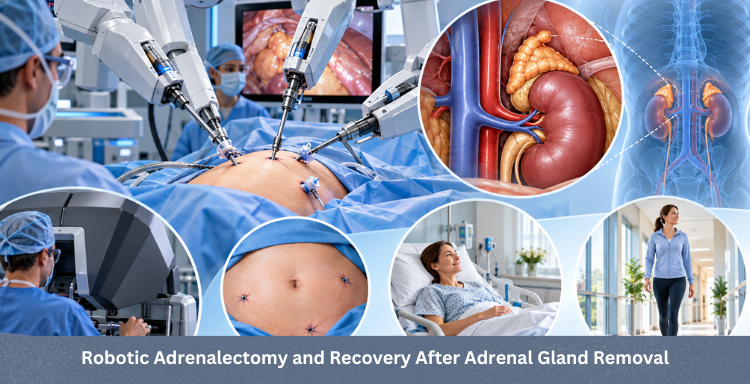
Robotic Adrenalectomy and Recovery After Adrenal Gland Removal

Robotic adrenalectomy is a minimally invasive approach many surgeons now use for suitable adrenal tumour cases.

  • Smaller incisions compared to open surgery
  • Often a shorter hospital stay and faster return to activity
  • Precise movement valuable near delicate structures

The robotic approach may be selected when tumour size, location, or anatomy make precise dissection valuable, or when a patient’s health favours a less invasive procedure. Surgeon experience is a key factor, since familiarity with the anatomy helps manage unexpected findings and reduce complication risk.

Importance of Follow Up After Adrenal Gland Removal Surgery

Consistent follow up care after adrenalectomy, including hormone evaluation, imaging surveillance, and ongoing communication about new symptoms, is essential for long term health.

Choosing an Adrenal Tumour Specialist in India

Choosing the right specialist matters. Patients should look for:

  • Experience evaluating adrenal tumours and cancer risk
  • A track record in adrenal surgery, including robotic approaches
  • A personalised, long term approach to care

A robotic uro oncologist with dedicated adrenal tumour experience offers a more coordinated journey.

 
Let’s Discuss! Request a Call Now!
White Call Now!
 

Dr. Anup Ramani: Adrenal Tumour Treatment in Mumbai

Dr. Anup Ramani is a uro oncologist based in Mumbai focused on adrenal tumour diagnosis, surgery, and post treatment care, with a practice centred on robotic urological surgery, including robotic adrenalectomy.

His approach involves personalised planning based on tumour type, size, hormone activity, kidney function, and each patient’s health and goals, helping patients make informed decisions with evidence based, patient focused care.

Discuss Your Adrenal Tumour Treatment Options

Every adrenal tumour requires individual assessment based on hormone activity, tumour characteristics, and overall health. Patients are encouraged to seek a personalised consultation to determine whether surgery, robotic adrenalectomy, or monitoring is most appropriate.

Life After Adrenal Gland Removal Surgery: Final Thoughts

Living a normal life after adrenal gland removal surgery is possible for most patients, especially when only one gland is removed and the remaining gland adapts well. Recovery and long term outcomes depend on factors such as tumour type, overall health, and consistent follow up, and with the right care, patients can expect good quality of life after adrenalectomy.

Conclusion

Recovery after bladder removal surgery is a gradual journey that unfolds over weeks and months, shaped by the type of urinary diversion, cancer stage, and overall health. While the early days focus on healing and adjusting to a new way of passing urine, most patients go on to regain confidence, resume daily activities, and settle into a manageable routine with the right support.

Staying consistent with follow up care, monitoring kidney function, and watching for any signs of recurrence all play an important part in long term wellbeing. With guidance from an experienced bladder cancer specialist, patients can approach life after bladder removal surgery with clarity and confidence.

Life After Adrenal Gland Removal Surgery: Frequently Asked Questions

Yes, most patients can live a normal life after adrenal gland removal, especially when only one gland is removed.

Yes, most people can live normally with one adrenal gland because the remaining gland usually adapts and produces enough hormones to support normal body functions.

Patients recover briefly in hospital, with hormone levels and the wound monitored before a gradual return to normal activities.

Only if both glands are removed. One healthy remaining gland often needs no replacement.

Initial recovery takes a few weeks, with light activities resuming within one to two months.

Usually yes, as the remaining gland increases its hormone output over time.

Managing stress, eating well, staying active, and attending follow up appointments.

Recurrence is uncommon but possible, so long term imaging and hormone monitoring are recommended.

It is minimally invasive, often allowing smaller incisions and a faster return to activity.

Yes, though robotic and minimally invasive techniques have made recovery smoother for many patients.

The body can no longer produce essential hormones, so lifelong hormone replacement and monitoring are required.

Uncommon but possible, which is why periodic imaging and hormone testing are recommended.

Most patients resume daily activities within a few weeks, with a shorter hospital stay than open surgery.

PARTIAL PENECTOMY
  • Partial penectomy is done in cases where glans and distal penis is involved with carcinoma. 
  • Partial penectomy is a type of organ-preserving surgery. Preservation of sexual and micturational function depends on the surgical dissection and reconstruction of residual urethra.
Kidney Stone Removal
  • Patients who develop stones in the kidney or ureter, often experience severe pain.
  • This condition usually needs a procedure to remove the kidney stones.
  • This procedure is called ureteroscopy and is performed very commonly.
  • It does not require any cuts and hence it is painless.
  • The procedure is performed with an endoscope inserted through the penis under spinal anesthesia.
  • The scope is inserted through the penis into the kidney and stones are dissolved with a laser.
  • The procedure takes about 40-50 minutes. 
  • A catheter (urine pipe) is kept after the procedure to drain the bladder. A stent is kept in the kidney at the same time.
  • Patient is mobile and walking in the room the same evening.
  • Hospital stay is one night and patient is discharged the next day after removal of the catheter.
  • Patient has to come back after six weeks to remove the stent in the kidney.
  • Patients can resume office a week after surgery and heavy activities like running, weight lifting, a month after the procedure.
  • We offer fixed packages for this procedure which can be obtained by calling our helpline +91 9967666060.
  • Men with an enlarged prostate, which is a normal ageing changes, often experiencing difficulty passing urine. This condition usually needs a procedure to trim the prostate and relieve the blockage.
  • This procedure is called TURP and is performed very commonly.
  • It does not require any cuts and hence it is painless.
  • The procedure is performed with an endoscope inserted through the penis under spinal anaesthesia.
  • The overgrown prostate is dissolved with a laser bloodlessly.
  • The procedure takes about 40 minutes.
  • A catheter (urine pipe) is kept after the procedure to drain the bladder.
  • Patient is mobile and walking in the room the same evening.
  • Hospital stay is two nights and patient is discharged with the catheter, which is removed after 4 days.
  • Patients can resume office a week after surgery and heavy activities like running, weight lifting, a month after the procedure.
  • We offer fixed packages for this procedure which can be obtained by calling our helpline +91 9967666060.
ROBOTIC ADRENALECTOMY FOR ADRENAL GLAND TUMOUR
  • Robotic adrenalectomy is a sophisticated, complex surgery and it is very important that an experienced surgeon performs this surgery to avoid major complications.

  • Once the anesthesia is done, and patient positioned, three micro cuts (3mm each) are made in the patient’s abdomen.

  • The arms of the Da Vinci robot are connected to the cuts via ports (tubes).

  • Dr. Ramani then sits in the controlling console to perform the surgery.

  • On an average, a robotic adrenalectomy takes one hour.

  • The surgery is almost completely bloodless and there has never been any need to transfuse blood after surgery.

  • A urine catheter and bag to drain the bladder is inserted during surgery.

  • A tiny drain pipe may be inserted in the surgical side of the abdomen, connected to a bag.

  • Patient is kept nil-by-mouth the day of the surgery, with IV fluids. Sips of water are started the next day and solid food by day three.

  • The drain pipe, if kept, is removed in the room on day 2 after surgery.

  • The catheter is removed on day two after surgery.

  • Total hospital stay for robotic adrenalectomy is 4 nights (including night before surgery).

  • Post discharge, a doctor from the surgical team visits the patient at home/ hotel room once every day.

RETURN TO ACTIVITY
  • On the day of discharge, patient is totally self-sufficient. They are able to walk freely without any pain, dress themselves, shower, toilet and they do not need to hire any nurse or help at home. Almost all patients are back to work within 2 weeks of surgery.

  • Heavy activities like running, weight lifting can be resumed after a month

FOLLOW UP AFTER SURGERY
  • Follow up after an adrenalectomy is in the form of CT scans, once a year for 5 years.
    Local patients usually meet Dr. Ramani after two weeks to discuss report.

  • Outstation patients are counselled on a phone consultation.

ROBOTIC SURGERY FOR BLADDER CANCER
  • Dr. Ramani is one of the very few surgeons in India who has the expertise to perform a robotic surgery for bladder cancer, which includes removing the urinary bladder and reconstructing a new bladder robotically.
  • Robotic radical cystectomy is an extremely sophisticated, complex surgery and it is very important that an experienced surgeon performs this surgery to avoid major complications.
  • Once the anaesthesia is done, and patient positioned, six micro cuts (3mm each) are made in the patient’s abdomen.
  • The arms of the Da Vinci robot are connected to the cuts via ports (tubes).
  • Dr. Ramani then sits in the controlling console to perform the surgery.
  • On an average, a robotic radical cystectomy with an ileal conduit takes 3-4 hours.
  • The surgery is almost completely bloodless and there has never been any need to transfuse blood after surgery.
  • A urine catheter and bag to drain the new bladder is inserted during surgery.
  • Two tiny drain pipe in inserted in the surgical side of the abdomen, connected to a bag.
  • Patient is kept nil-by-mouth for 4 days after surgery with IV supplementation of patient’s daily requirements of calories, fats, carbohydrates, proteins and electrolytes.
  • The drain pipes are removed in the room on day 3-5 after surgery.
  • Total hospital stay for radical cystectomy is 8 nights (including night before surgery).
  • Post discharge, a doctor from the surgical team visits the patient at home/ hotel room once every day.
RETURN TO ACTIVITY
  • On the day of discharge, patient is totally self-sufficient. They are able to walk freely without any pain, dress themselves, shower, toilet and they do not need to hire any nurse or help at home.
  • Almost all patients are back to work within 6 weeks of surgery. Heavy activities like running, weight lifting can be resumed after two months.
FOLLOW UP AFTER SURGERY
  • Follow up after a radical a cystectomy is in the form of CT scans, once a year for 5 years.

  • Histopathology report: Local patients usually meet Dr. Ramani after two weeks to discuss report.

  • Outstation patients are counselled on a phone consult. Depending on the report, patient may or may not need chemotherapy after surgery.

  • If chemo is needed, patients may choose to get it done with a medical oncologist of their choice or avail the services of one of the four medical oncologists on our team.

ROBOTIC RADICAL/PARTIAL NEPHRECTOMY FOR KIDNEY CANCER
  • Robotic partial nephrectomy is a sophisticated, complex surgery and it is very important that an experienced surgeon performs this surgery to avoid major complications. Robotic radical (total) nephrectomy is
  • relatively easier but still requires significant experience to consistently deliver results.
  • Once the anaesthesia is done, and patient positioned, five micro cuts (3mm each) are made in the patient’s abdomen.
  • The arms of the Da Vinci robot are connected to the cuts via ports (tubes).
  • Dr. Ramani then sits in the controlling console to perform the surgery.
  • On an average, a robotic radical nephrectomy takes one hour and a robotic partial nephrectomy takes about an hour and half.
  • The surgery is almost completely bloodless and there has never been any need to transfuse blood after surgery.
  • A urine catheter and bag to drain the bladder is inserted during surgery.
  • A tiny drain pipe in inserted in the surgical side of the abdomen, connected to a bag.
  • Patient is kept nil-by-mouth the day of the surgery, with IV fluids. Sips of water are started the next day and solid food by day three.
  • The drain pipe is removed in the room on day 3 after surgery. The catheter is removed on day two after surgery.
  • Total hospital stay for radical/partial nephrectomy is 4 nights (including night before surgery).
  • Post discharge, a doctor from the surgical team visits the patient at home/ hotel room once every day.
RETURN TO ACTIVITY
  • On the day of discharge, patient is totally self- sufficient. 
  • They are able to walk freely without any pain, dress themselves, shower, toilet and they do not need to hire any nurse or help at home. 
  • Almost all patients are back to work within 2-3 weeks of surgery.
  • Heavy activities like running, weight lifting can be resumed after a month.
FOLLOW UP AFTER SURGERY
  • Follow up after a radical/partial Nephrectomy is in the form of CT scans, once a year for 5 years.
  • Local patients usually meet Dr. Ramani after two weeks to discuss report. 
  • Outstation patients are counselled on a phone consultation.