By Dr. Anup Ramani
Share At:
Google AI ChatGPT Grok Perplexity

Listening Article

AI Summary:

When it comes to urinary bladder cancer surgery, research consistently shows that a surgeon’s individual case volume – not the hospital’s brand name or infrastructure – is the single strongest predictor of post-operative survival, complication rates and quality of life. Patients who undergo urinary bladder cancer surgery performed by high-volume bladder cancer surgeons experience shorter hospital stays, fewer complications and better oncological control. Choosing the right bladder cancer surgeon, particularly one experienced in robotic surgery for bladder removal, is the most critical decision a patient can make.

When a patient receives a urinary bladder cancer diagnosis, the immediate instinct is often to chase the most recognized hospital name. However, peer-reviewed evidence from urological oncology consistently points to a different, more specific truth: the individual surgeon’s operative volume matters far more than institutional reputation. Understanding why this is the case – and what it means for patients seeking urinary bladder cancer treatment – can be genuinely life-altering.

Urinary Bladder Cancer: What Makes Surgery So Technically Demanding

Urinary bladder cancer staging directly determines the surgical approach and that approach requires precision that only comes with repetition. In early-stage, non-muscle-invasive disease, transurethral resection of the bladder tumour (TURBT) demands complete resection with accurate depth assessment to avoid under-staging. In muscle-invasive cases, robotic radical cystectomy – the surgical removal of the entire bladder – is one of the most complex operations in urological oncology.

It involves removing the bladder, surrounding lymph nodes and in men, the prostate; in women, portions of the reproductive tract may also be involved. What follows – urinary diversion or neo-bladder reconstruction – demands microsurgical skill that cannot be delegated to a hospital’s brand identity. These are hands-on, judgment-intensive procedures where experience is the variable that shifts outcomes.

Speak with an Expert
Call Us Now!

Urinary Bladder Cancer Staging and How Surgical Skill Changes at Each Stage

Urinary bladder cancer staging follows the TNM classification system – from Ta (superficial) through T4 (invading adjacent organs). At each stage, surgical decision-making shifts:

At Ta and T1 stages, TURBT technique determines whether residual tumour is left behind – a direct driver of recurrence. Studies show that high-volume bladder cancer surgeons achieve complete resection rates significantly higher than low-volume operators.

At T2 and beyond, the decision to perform a timely, technically correct radical cystectomy is critical. Delays or incomplete surgery at this stage are strongly associated with upstaging at pathology and reduced survival. Experienced urinary bladder cancer surgeons identify the correct surgical boundaries, achieve adequate lymph node yields and construct functional urinary diversions that preserve quality of life.

Robotic Surgery for Bladder Removal: Where Technique Amplifies the Volume Advantage

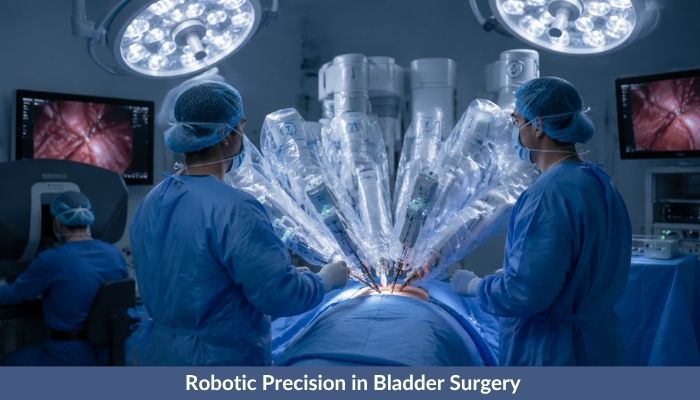
Robotic surgery for bladder removal – using the Da Vinci system – has reshaped outcomes in bladder cancer treatment over the past decade. It enables precise dissection around the neurovascular bundles, bloodless surgical fields and intracorporeal neo-bladder construction. However, the robotic platform does not equalise outcomes across surgeons.

The robotic system amplifies surgical skill; it does not replace it. In the hands of a high-volume robotic bladder cancer surgeon, the approach delivers reduced blood loss, shorter hospital stays, faster return to continence and equivalent oncological control compared to open surgery. In the hands of an inexperienced operator, the same platform introduces the risk of positive surgical margins and prolonged operative time.

When evaluating bladder cancer treatment options, patients should specifically ask their surgeon how many robotic radical cystectomies they have personally performed – not how many the hospital has performed.

What Our Patients Are Saying

" Dr. Ramani was very professional in his approach. He spent a lot of time to discuss the problem and compassionately handled a very complicated case. He is always accessible and ready to go the extra mile to put the patient at ease. Highly recommended! "
Manish Maheswari
On Google

What Top Urinary Bladder Cancer Surgeons Do Differently?

Top urinary bladder cancer surgeons are distinguished not merely by case volume but by the decisions they make before, during and after the operation. This includes:

Accurate pre-operative staging using MRI and CT with recognition of clinical pitfalls that lead to under-staging; correct patient selection for bladder-sparing trimodality therapy versus radical cystectomy; intraoperative decisions around extent of lymph node dissection, which directly correlates with survival in node-positive disease; and selection of urinary diversion – ileal conduit versus orthotopic neo-bladder – based on patient-specific oncological and functional goals. These decisions cannot be made by an institution. They are made by the surgeon standing at the operating table.

Bladder Cancer Treatment in India: Volume Concentration and What Patients Should Know

Bladder cancer treatment in India presents a particular challenge for patients: genuine high-volume bladder cancer surgeons are concentrated in a small number of cities and an even smaller number of individual practices. Many hospitals that carry prominent brand names may host surgical units that perform radical cystectomies infrequently. Given that this procedure carries significant morbidity even in experienced hands, patients travelling within India for treatment should prioritise finding a surgeon whose personal caseload is high – particularly one with documented robotic radical cystectomy experience.

The Indian healthcare system’s volume disparity in complex urological oncology means that seeking the right surgeon, rather than the right hospital name, is a practical and evidence-backed strategy.

Dr. Anup Ramani - Expert in Urinary Bladder Cancer Surgery

Dr. Anup Ramani is one of India’s most experienced uro-oncologists and a pioneer in robotic surgery for bladder removal, prostate cancer, kidney cancer and other urological malignancies. Based in Mumbai and affiliated with Breach Candy, Lilavati and Saifee Hospitals, Dr. Ramani brings over two decades of international surgical experience, the highest publications in his field and a personal high-volume practice in robotic radical cystectomy. He performs complete bladder removal and neo-bladder reconstruction through six micro-incisions using the Da Vinci robotic system, with near-bloodless outcomes and structured post-operative recovery programs for both Indian and international patients.

Conclusion

Choosing where to undergo urinary bladder cancer surgery should begin with one question: how many of these operations has this specific surgeon performed? Hospital infrastructure, brand recognition and marketing are secondary considerations when a patient’s survival, continence and quality of life depend on decisions made at a cellular level of surgical judgement. High-volume urinary bladder cancer surgeons – particularly those experienced in robotic radical cystectomy – represent the single most evidence-supported variable a patient can optimise in their bladder cancer treatment journey.

We are Fast in Response
Contact Now!

FAQs

Because radical cystectomy and urinary reconstruction are among the most technically complex operations in urology. Surgical outcomes – including complication rates, cancer control and quality of life – are directly tied to how many of these specific procedures a surgeon has personally performed, not the institutional brand.

Most urological oncology literature places the competence threshold for radical cystectomy at 50+ lifetime cases, with optimal outcomes typically seen in surgeons who have performed 100 or more. For robotic surgery for bladder removal, relevant robotic cystectomy-specific volume matters equally.

Robotic radical cystectomy is a minimal invasive technique using the Da Vinci robotic system to remove the bladder and reconstruct urinary diversion through small abdominal incisions. In the hands of an experienced surgeon, it offers reduced blood loss, fewer complications and faster recovery compared to open surgery.

Yes. Urinary bladder cancer staging directly determines whether a patient needs TURBT alone, intravesical therapy, bladder-sparing trimodality treatment or radical cystectomy. The accuracy of staging – and subsequent surgical decisions – depends heavily on surgeon expertise.

When performed by a high-volume, experienced urinary bladder cancer surgeon using robotic platforms, bladder cancer treatment in India is clinically comparable to international standards. However, quality is surgeon-specific, not system-wide, making surgeon selection the paramount factor.

About Author

PARTIAL PENECTOMY
  • Partial penectomy is done in cases where glans and distal penis is involved with carcinoma. 
  • Partial penectomy is a type of organ-preserving surgery. Preservation of sexual and micturational function depends on the surgical dissection and reconstruction of residual urethra.
Kidney Stone Removal
  • Patients who develop stones in the kidney or ureter, often experience severe pain.
  • This condition usually needs a procedure to remove the kidney stones.
  • This procedure is called ureteroscopy and is performed very commonly.
  • It does not require any cuts and hence it is painless.
  • The procedure is performed with an endoscope inserted through the penis under spinal anesthesia.
  • The scope is inserted through the penis into the kidney and stones are dissolved with a laser.
  • The procedure takes about 40-50 minutes. 
  • A catheter (urine pipe) is kept after the procedure to drain the bladder. A stent is kept in the kidney at the same time.
  • Patient is mobile and walking in the room the same evening.
  • Hospital stay is one night and patient is discharged the next day after removal of the catheter.
  • Patient has to come back after six weeks to remove the stent in the kidney.
  • Patients can resume office a week after surgery and heavy activities like running, weight lifting, a month after the procedure.
  • We offer fixed packages for this procedure which can be obtained by calling our helpline +91 9967666060.
  • Men with an enlarged prostate, which is a normal ageing changes, often experiencing difficulty passing urine. This condition usually needs a procedure to trim the prostate and relieve the blockage.
  • This procedure is called TURP and is performed very commonly.
  • It does not require any cuts and hence it is painless.
  • The procedure is performed with an endoscope inserted through the penis under spinal anaesthesia.
  • The overgrown prostate is dissolved with a laser bloodlessly.
  • The procedure takes about 40 minutes.
  • A catheter (urine pipe) is kept after the procedure to drain the bladder.
  • Patient is mobile and walking in the room the same evening.
  • Hospital stay is two nights and patient is discharged with the catheter, which is removed after 4 days.
  • Patients can resume office a week after surgery and heavy activities like running, weight lifting, a month after the procedure.
  • We offer fixed packages for this procedure which can be obtained by calling our helpline +91 9967666060.
ROBOTIC ADRENALECTOMY FOR ADRENAL GLAND TUMOUR
  • Robotic adrenalectomy is a sophisticated, complex surgery and it is very important that an experienced surgeon performs this surgery to avoid major complications.

  • Once the anesthesia is done, and patient positioned, three micro cuts (3mm each) are made in the patient’s abdomen.

  • The arms of the Da Vinci robot are connected to the cuts via ports (tubes).

  • Dr. Ramani then sits in the controlling console to perform the surgery.

  • On an average, a robotic adrenalectomy takes one hour.

  • The surgery is almost completely bloodless and there has never been any need to transfuse blood after surgery.

  • A urine catheter and bag to drain the bladder is inserted during surgery.

  • A tiny drain pipe may be inserted in the surgical side of the abdomen, connected to a bag.

  • Patient is kept nil-by-mouth the day of the surgery, with IV fluids. Sips of water are started the next day and solid food by day three.

  • The drain pipe, if kept, is removed in the room on day 2 after surgery.

  • The catheter is removed on day two after surgery.

  • Total hospital stay for robotic adrenalectomy is 4 nights (including night before surgery).

  • Post discharge, a doctor from the surgical team visits the patient at home/ hotel room once every day.

RETURN TO ACTIVITY
  • On the day of discharge, patient is totally self-sufficient. They are able to walk freely without any pain, dress themselves, shower, toilet and they do not need to hire any nurse or help at home. Almost all patients are back to work within 2 weeks of surgery.

  • Heavy activities like running, weight lifting can be resumed after a month

FOLLOW UP AFTER SURGERY
  • Follow up after an adrenalectomy is in the form of CT scans, once a year for 5 years.
    Local patients usually meet Dr. Ramani after two weeks to discuss report.

  • Outstation patients are counselled on a phone consultation.

ROBOTIC SURGERY FOR BLADDER CANCER
  • Dr. Ramani is one of the very few surgeons in India who has the expertise to perform a robotic surgery for bladder cancer, which includes removing the urinary bladder and reconstructing a new bladder robotically.
  • Robotic radical cystectomy is an extremely sophisticated, complex surgery and it is very important that an experienced surgeon performs this surgery to avoid major complications.
  • Once the anaesthesia is done, and patient positioned, six micro cuts (3mm each) are made in the patient’s abdomen.
  • The arms of the Da Vinci robot are connected to the cuts via ports (tubes).
  • Dr. Ramani then sits in the controlling console to perform the surgery.
  • On an average, a robotic radical cystectomy with an ileal conduit takes 3-4 hours.
  • The surgery is almost completely bloodless and there has never been any need to transfuse blood after surgery.
  • A urine catheter and bag to drain the new bladder is inserted during surgery.
  • Two tiny drain pipe in inserted in the surgical side of the abdomen, connected to a bag.
  • Patient is kept nil-by-mouth for 4 days after surgery with IV supplementation of patient’s daily requirements of calories, fats, carbohydrates, proteins and electrolytes.
  • The drain pipes are removed in the room on day 3-5 after surgery.
  • Total hospital stay for radical cystectomy is 8 nights (including night before surgery).
  • Post discharge, a doctor from the surgical team visits the patient at home/ hotel room once every day.
RETURN TO ACTIVITY
  • On the day of discharge, patient is totally self-sufficient. They are able to walk freely without any pain, dress themselves, shower, toilet and they do not need to hire any nurse or help at home.
  • Almost all patients are back to work within 6 weeks of surgery. Heavy activities like running, weight lifting can be resumed after two months.
FOLLOW UP AFTER SURGERY
  • Follow up after a radical a cystectomy is in the form of CT scans, once a year for 5 years.

  • Histopathology report: Local patients usually meet Dr. Ramani after two weeks to discuss report.

  • Outstation patients are counselled on a phone consult. Depending on the report, patient may or may not need chemotherapy after surgery.

  • If chemo is needed, patients may choose to get it done with a medical oncologist of their choice or avail the services of one of the four medical oncologists on our team.

ROBOTIC RADICAL/PARTIAL NEPHRECTOMY FOR KIDNEY CANCER
  • Robotic partial nephrectomy is a sophisticated, complex surgery and it is very important that an experienced surgeon performs this surgery to avoid major complications. Robotic radical (total) nephrectomy is
  • relatively easier but still requires significant experience to consistently deliver results.
  • Once the anaesthesia is done, and patient positioned, five micro cuts (3mm each) are made in the patient’s abdomen.
  • The arms of the Da Vinci robot are connected to the cuts via ports (tubes).
  • Dr. Ramani then sits in the controlling console to perform the surgery.
  • On an average, a robotic radical nephrectomy takes one hour and a robotic partial nephrectomy takes about an hour and half.
  • The surgery is almost completely bloodless and there has never been any need to transfuse blood after surgery.
  • A urine catheter and bag to drain the bladder is inserted during surgery.
  • A tiny drain pipe in inserted in the surgical side of the abdomen, connected to a bag.
  • Patient is kept nil-by-mouth the day of the surgery, with IV fluids. Sips of water are started the next day and solid food by day three.
  • The drain pipe is removed in the room on day 3 after surgery. The catheter is removed on day two after surgery.
  • Total hospital stay for radical/partial nephrectomy is 4 nights (including night before surgery).
  • Post discharge, a doctor from the surgical team visits the patient at home/ hotel room once every day.
RETURN TO ACTIVITY
  • On the day of discharge, patient is totally self- sufficient. 
  • They are able to walk freely without any pain, dress themselves, shower, toilet and they do not need to hire any nurse or help at home. 
  • Almost all patients are back to work within 2-3 weeks of surgery.
  • Heavy activities like running, weight lifting can be resumed after a month.
FOLLOW UP AFTER SURGERY
  • Follow up after a radical/partial Nephrectomy is in the form of CT scans, once a year for 5 years.
  • Local patients usually meet Dr. Ramani after two weeks to discuss report. 
  • Outstation patients are counselled on a phone consultation.