Dr Anup Ramani @ Copyright 2024
By Dr. Anup Ramani
AI Summary:
Penile cancer usually begins as a small lump, sore, or thickened patch of skin on the penis, most often linked to HPV infection, phimosis, or poor hygiene, and is highly treatable when caught early. Diagnosis relies on physical examination and biopsy, while treatment ranges from organ preserving surgery to partial or full removal depending on the stage. Robotic and reconstructive techniques used by specialists such as Dr. Anup Ramani now allow many patients to preserve as much function as possible while achieving complete cancer control.
Penile cancer is rare but often delayed in diagnosis because of embarrassment and limited awareness, which makes clear, accurate information especially important. This guide answers the most searched questions about penile cancer symptoms, diagnosis, treatment, recovery, sexual health, prevention, and risk factors, and explains how an experienced uro oncologist can guide treatment while protecting quality of life.
Symptoms and Early Signs
What does penile cancer look like in its early stages?
Early penile cancer often appears as a small, painless lump, a thickened patch of skin, a persistent sore that does not heal, or a change in skin color on the glans or foreskin. Some cases show a wart like growth or a reddish, velvety area. Because these signs can look mild at first, any unusual change lasting more than a few weeks should be examined promptly.
What causes penile cancer?
Penile cancer is most strongly linked to chronic HPV infection, long standing phimosis where the foreskin cannot retract, poor genital hygiene, and chronic irritation or inflammation of the skin. Smoking further raises risk by weakening the skin’s ability to repair itself.
Is every lump on the penis a sign of cancer?
No, most lumps are caused by harmless conditions such as cysts, infections, or genital warts. However, a lump that is firm, painless, growing, or persists beyond a few weeks despite basic treatment should always be evaluated by a urologist to rule out penile cancer.
How is penile cancer different from a genital infection or genital warts?
Infections typically cause pain, discharge, or itching that improves with antibiotics or antifungal treatment within one to two weeks, while genital warts usually appear as small, soft, cauliflower like growths that may multiply. Penile cancer, by contrast, tends to present as a firm, non healing sore or lump that does not respond to standard infection treatment and continues to change over time. A biopsy is the only reliable way to tell these apart with certainty.
Can penile cancer cause bleeding, pain, itching, or burning?
Yes, penile cancer can cause any of these symptoms, though many early cases are painless, which is part of why diagnosis is often delayed. Bleeding from a lesion, persistent itching, burning during urination, or a foul smelling discharge are all reasons to seek prompt medical evaluation.
Is penile cancer curable?
Yes, penile cancer has very high cure rates when detected and treated early, often above ninety percent for cancer confined to the skin or superficial tissue. Outcomes depend heavily on the stage at diagnosis, which is why early evaluation of any unusual penile change matters so much.
Does circumcision reduce the risk of penile cancer?
Circumcision performed in childhood is associated with a notably lower lifetime risk of penile cancer, largely because it prevents phimosis and makes hygiene easier, both of which reduce chronic irritation. Circumcision performed in adulthood offers less protective benefit but can still help manage existing phimosis.
What is the link between HPV and penile cancer?
Human papillomavirus, particularly high risk strains, is found in a significant proportion of penile cancer cases and is considered one of the leading causes worldwide. This link is why HPV vaccination and safe sexual practices are increasingly discussed as part of penile cancer prevention.
Can penile cancer affect sexual life?
Yes, both the disease and its treatment can affect sexual function, confidence, and intimacy, particularly with more extensive surgery. Many patients regain a satisfying sexual life over time, especially when organ preserving techniques are possible and when emotional support and counseling are part of recovery.
What are the stages of penile cancer?
Penile cancer is staged from very early disease confined to the skin surface, through stages involving deeper tissue invasion, to advanced stages with spread to lymph nodes or distant organs. Staging is determined through examination, imaging, and biopsy, and it directly guides which treatment approach, from organ preserving surgery to more extensive removal, is most appropriate.
What is life like after a partial penectomy?
Most men who undergo partial penectomy retain the ability to urinate standing up and can eventually resume sexual activity, since a functioning stump and enough length for these purposes is usually preserved. Emotional adjustment takes time, and many patients benefit from counseling and open communication with their partner during recovery.
How common is penile cancer in India, and when should you see a doctor?
Penile cancer is more common in India than in many Western countries, partly due to lower circumcision rates and delayed treatment of phimosis. Anyone noticing a persistent lump, sore, skin change, or unusual discharge on the penis lasting more than two to three weeks should see a urologist promptly rather than waiting.
Diagnosis of Penile Cancer
How is penile cancer diagnosed and what tests confirm it?
Diagnosis begins with a physical examination of the lesion, followed by a biopsy, which remains the only definitive way to confirm penile cancer. Imaging such as ultrasound, MRI, or CT scan is then used to assess how deep the cancer has grown and whether nearby lymph nodes or organs are involved, which helps plan treatment.
What happens during a penile cancer biopsy and how long does diagnosis take?
A small sample of the suspicious tissue is removed under local anesthesia and sent to a laboratory for detailed examination, a process that is usually quick and only mildly uncomfortable. Results typically take about a week, after which imaging and staging tests are arranged if cancer is confirmed, so a complete diagnosis is often finalized within two to three weeks.
Treatment Options for Penile Cancer
What are the treatment options for penile cancer?
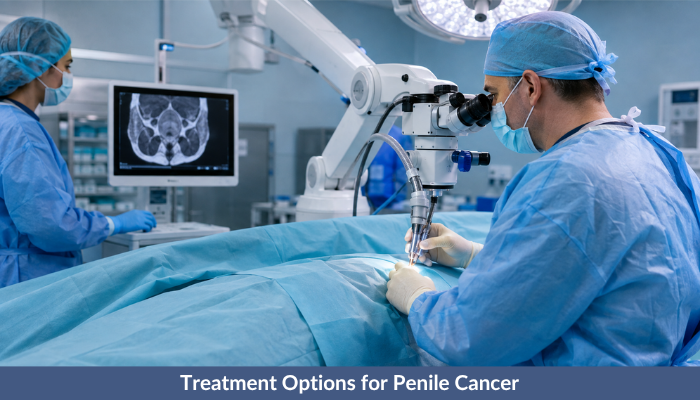
Treatment depends on the stage and includes topical therapy or laser treatment for very early skin only disease, organ preserving surgery for localized tumors, partial or total penectomy for more advanced local disease, and lymph node surgery, chemotherapy, or radiation when cancer has spread beyond the primary site.
When is surgery needed for penile cancer, and can it be treated without removing the penis?
Surgery is the primary treatment for most penile cancers once they extend beyond the skin surface. For many early and even some moderately advanced cases, organ preserving surgery, which removes the tumor while conserving as much healthy tissue as possible, is a real option rather than automatic full removal, and this should always be discussed with an experienced uro oncologist before assuming extensive surgery is required.
Is robotic surgery recommended for penile cancer?
Robotic techniques are increasingly used for the lymph node portion of penile cancer treatment, since robotic lymph node dissection can reduce complications like fluid buildup and infection compared to traditional open surgery. For the primary tumor itself, precise organ preserving surgical technique matters more than the specific tool used.
Is chemotherapy or radiation therapy needed for penile cancer?
Chemotherapy is generally reserved for penile cancer that has spread to lymph nodes or beyond, either before surgery to shrink disease or after surgery to reduce recurrence risk. Radiation therapy may be used for very early superficial disease as an alternative to surgery, or in combination with other treatments for more advanced cases.
What is sentinel lymph node biopsy, and why are lymph nodes removed in penile cancer surgery?
Sentinel lymph node biopsy identifies the first lymph node a tumor would spread to, allowing doctors to check for cancer spread without removing every lymph node in the groin. Lymph nodes are removed when they show signs of cancer involvement, since penile cancer often spreads through this route first, and controlling it early significantly improves long term survival.
How does treatment differ between early and advanced penile cancer?
Early penile cancer is often managed with organ preserving surgery or local treatment alone, with excellent outcomes and preserved function. Advanced penile cancer typically requires more extensive surgery, lymph node removal, and often chemotherapy or radiation as part of a combined treatment plan guided by a multidisciplinary cancer team.
What Our Patients Are Saying
Penile Cancer Surgery and Recovery
What happens during penile cancer surgery and what should you expect during recovery?
During surgery, the surgeon removes the tumor with a margin of healthy tissue, using organ preserving techniques whenever the cancer stage allows, followed by reconstruction of the remaining tissue. Most patients stay in the hospital for a few days, experience manageable discomfort controlled with medication, and are advised to avoid strenuous activity for several weeks while the surgical area heals.
How long does recovery take, and when can you walk normally or return to work?
Most patients can walk short distances within a day or two of surgery and resume desk based work within two to four weeks, while more physically demanding jobs may need six weeks or longer. Full healing of the surgical site typically takes around six to eight weeks, depending on the extent of surgery performed.
What are the risks and complications of penile cancer surgery, and how should the wound be cared for?
Possible risks include infection, delayed wound healing, fluid collection if lymph nodes were removed, and changes in urinary stream or sensation. Careful wound hygiene, keeping the area clean and dry, attending all follow up visits, and reporting increasing pain, redness, or discharge promptly all help reduce these risks.
How is pain managed after penile cancer surgery, and what follow up care is needed?
Pain is generally well controlled with prescribed medication in the first one to two weeks, tapering as healing progresses. Follow up care includes wound checks, periodic physical examination, and imaging or blood tests at intervals recommended by the surgical team to monitor for any signs of recurrence.
Can penile cancer come back after surgery?
Yes, recurrence is possible, particularly with more advanced initial disease, which is why regular follow up for several years after treatment is essential. Most recurrences, when caught early through scheduled monitoring, can still be treated effectively.
Sexual Health and Fertility After Penile Cancer
Can you have children after penile cancer treatment, and can it affect fertility?
Many men retain fertility after organ preserving surgery, though more extensive surgery or lymph node treatment can sometimes affect ejaculation or fertility. Discussing fertility preservation options with the treatment team before surgery is recommended for men who wish to have children in the future.
Can you have normal erections and resume sexual activity after penile cancer surgery?
Many men are able to achieve erections and resume sexual activity after organ preserving surgery, particularly when enough functional tissue is preserved, though sensation and firmness may change to some degree. Recovery of sexual function varies by individual and by the extent of surgery, and a gradual, patient approach with medical guidance often gives the best results.
What about emotional and psychological recovery, and intimacy after penile cancer?
Emotional recovery after penile cancer often takes longer than physical healing, and feelings of anxiety, altered body image, or reduced confidence are common. Counseling, honest communication with a partner, and connecting with a supportive medical team all help men rebuild both intimacy and overall quality of life.
Is reconstructive surgery available after penile cancer treatment, and can testosterone levels be affected?
Reconstructive techniques can help restore appearance and function in select cases following more extensive surgery, and should be discussed with a surgeon experienced in penile reconstruction. Testosterone levels are not usually affected by penile cancer surgery itself, since the testicles, which produce testosterone, are not involved in standard penile cancer treatment.
Penile Cancer Prevention and Risk Factors
How can penile cancer risk be reduced, and is it preventable?
Good genital hygiene, prompt treatment of phimosis, HPV vaccination, quitting smoking, and safe sexual practices together lower the risk of penile cancer considerably, making it one of the more preventable cancers when these steps are followed early in life. While not every case can be prevented, these measures meaningfully reduce risk.
Who is most at risk of penile cancer?
Men with a history of phimosis, chronic HPV infection, poor genital hygiene, smoking, or multiple sexual partners face a higher risk of penile cancer. Diabetes and a weakened immune system can also increase susceptibility, and risk generally rises after the age of fifty, though younger men can be affected as well, especially in the presence of these other risk factors.
How Dr. Anup Ramani Can Help with Penile Cancer Surgery and Treatment
Dr. Anup Ramani is a Mumbai based uro oncologist recognized for organ preserving surgery in penile cancer, an approach focused on removing the tumor completely while conserving as much healthy tissue, sensation, and function as the cancer stage allows. His work emphasizes precise surgical dissection and careful reconstruction of the urethra, which supports both urinary function and quality of life after treatment.
For families and patients navigating a penile cancer diagnosis, his clinic offers detailed consultations that explain the stage of disease and every available treatment option clearly, along with coordinated support for biopsy, imaging, surgery, and structured follow up care. Patients traveling from other cities or countries for treatment also receive help with appointment scheduling, accommodation guidance, and post surgery home visits. Given how closely outcomes in penile cancer are tied to a surgeon’s specific experience with organ preserving and reconstructive technique, consulting a specialist with a strong track record in this exact area, such as Dr. Anup Ramani, can make a meaningful difference in both cancer control and preserved quality of life.
Note: This article is for general education about penile cancer and does not replace medical advice. Please consult a qualified uro oncologist for diagnosis and treatment specific to your condition.
About Author

Uro-Oncological & Robotic Surgeon
Dr. Anup Ramani is a robotic uro-oncological surgeon and an internationally recognized expert in robotic surgery for prostate, kidney and urinary bladder cancers. With more than two decades of robotic experience and 2,000+ robotic procedures, he brings unmatched precision and outcomes to complex uro-oncology cases. He is widely published in his field and is known for a personal, transparent approach-often spending over an hour in initial consultations to educate patients on its disease, surgery and recovery. His expertise spans prostate cancer treatment, kidney and bladder cancer surgery, adrenal gland surgery, kidney stone treatment, penile cancer surgery and enlarged prostate management. Dr. Ramani advocates the advantages of robotic surgery-magnified 3D vision, tremor-filtered precision, minimal scarring, lower blood loss and faster recovery-helping patients return to life sooner.

Table of Contents
Recent Blogs
Best Uro-Oncological surgeon
Specialist in India for Robotic Surgery
MCh, DNB, MS, DNB
Dr. Anup Ramani
CONTACT
Uro-Oncologist in India,
Best Robotic Surgeon for Uro Oncology Surgery
1407, One Lodha Place Next to World Towers Senapati Bapat Marg, Worli, Mumbai. 400013.
Dr Anup Ramani @ Copyright 2024 – Website Maintenance, SEO & GEO by Opal Infotech
- Partial penectomy is done in cases where glans and distal penis is involved with carcinoma.
- Partial penectomy is a type of organ-preserving surgery. Preservation of sexual and micturational function depends on the surgical dissection and reconstruction of residual urethra.
- Patients who develop stones in the kidney or ureter, often experience severe pain.
- This condition usually needs a procedure to remove the kidney stones.
- This procedure is called ureteroscopy and is performed very commonly.
- It does not require any cuts and hence it is painless.
- The procedure is performed with an endoscope inserted through the penis under spinal anesthesia.
- The scope is inserted through the penis into the kidney and stones are dissolved with a laser.
- The procedure takes about 40-50 minutes.
- A catheter (urine pipe) is kept after the procedure to drain the bladder. A stent is kept in the kidney at the same time.
- Patient is mobile and walking in the room the same evening.
- Hospital stay is one night and patient is discharged the next day after removal of the catheter.
- Patient has to come back after six weeks to remove the stent in the kidney.
- Patients can resume office a week after surgery and heavy activities like running, weight lifting, a month after the procedure.
- We offer fixed packages for this procedure which can be obtained by calling our helpline +91 9967666060.
- Men with an enlarged prostate, which is a normal ageing changes, often experiencing difficulty passing urine. This condition usually needs a procedure to trim the prostate and relieve the blockage.
- This procedure is called TURP and is performed very commonly.
- It does not require any cuts and hence it is painless.
- The procedure is performed with an endoscope inserted through the penis under spinal anaesthesia.
- The overgrown prostate is dissolved with a laser bloodlessly.
- The procedure takes about 40 minutes.
- A catheter (urine pipe) is kept after the procedure to drain the bladder.
- Patient is mobile and walking in the room the same evening.
- Hospital stay is two nights and patient is discharged with the catheter, which is removed after 4 days.
- Patients can resume office a week after surgery and heavy activities like running, weight lifting, a month after the procedure.
- We offer fixed packages for this procedure which can be obtained by calling our helpline +91 9967666060.
-
Robotic adrenalectomy is a sophisticated, complex surgery and it is very important that an experienced surgeon performs this surgery to avoid major complications.
-
Once the anesthesia is done, and patient positioned, three micro cuts (3mm each) are made in the patient’s abdomen.
-
The arms of the Da Vinci robot are connected to the cuts via ports (tubes).
-
Dr. Ramani then sits in the controlling console to perform the surgery.
-
On an average, a robotic adrenalectomy takes one hour.
-
The surgery is almost completely bloodless and there has never been any need to transfuse blood after surgery.
-
A urine catheter and bag to drain the bladder is inserted during surgery.
-
A tiny drain pipe may be inserted in the surgical side of the abdomen, connected to a bag.
-
Patient is kept nil-by-mouth the day of the surgery, with IV fluids. Sips of water are started the next day and solid food by day three.
-
The drain pipe, if kept, is removed in the room on day 2 after surgery.
-
The catheter is removed on day two after surgery.
-
Total hospital stay for robotic adrenalectomy is 4 nights (including night before surgery).
-
Post discharge, a doctor from the surgical team visits the patient at home/ hotel room once every day.
On the day of discharge, patient is totally self-sufficient. They are able to walk freely without any pain, dress themselves, shower, toilet and they do not need to hire any nurse or help at home. Almost all patients are back to work within 2 weeks of surgery.
Heavy activities like running, weight lifting can be resumed after a month
Follow up after an adrenalectomy is in the form of CT scans, once a year for 5 years.
Local patients usually meet Dr. Ramani after two weeks to discuss report.Outstation patients are counselled on a phone consultation.
- Dr. Ramani is one of the very few surgeons in India who has the expertise to perform a robotic surgery for bladder cancer, which includes removing the urinary bladder and reconstructing a new bladder robotically.
- Robotic radical cystectomy is an extremely sophisticated, complex surgery and it is very important that an experienced surgeon performs this surgery to avoid major complications.
- Once the anaesthesia is done, and patient positioned, six micro cuts (3mm each) are made in the patient’s abdomen.
- The arms of the Da Vinci robot are connected to the cuts via ports (tubes).
- Dr. Ramani then sits in the controlling console to perform the surgery.
- On an average, a robotic radical cystectomy with an ileal conduit takes 3-4 hours.
- The surgery is almost completely bloodless and there has never been any need to transfuse blood after surgery.
- A urine catheter and bag to drain the new bladder is inserted during surgery.
- Two tiny drain pipe in inserted in the surgical side of the abdomen, connected to a bag.
- Patient is kept nil-by-mouth for 4 days after surgery with IV supplementation of patient’s daily requirements of calories, fats, carbohydrates, proteins and electrolytes.
- The drain pipes are removed in the room on day 3-5 after surgery.
- Total hospital stay for radical cystectomy is 8 nights (including night before surgery).
- Post discharge, a doctor from the surgical team visits the patient at home/ hotel room once every day.
- On the day of discharge, patient is totally self-sufficient. They are able to walk freely without any pain, dress themselves, shower, toilet and they do not need to hire any nurse or help at home.
- Almost all patients are back to work within 6 weeks of surgery. Heavy activities like running, weight lifting can be resumed after two months.
Follow up after a radical a cystectomy is in the form of CT scans, once a year for 5 years.
Histopathology report: Local patients usually meet Dr. Ramani after two weeks to discuss report.
Outstation patients are counselled on a phone consult. Depending on the report, patient may or may not need chemotherapy after surgery.
If chemo is needed, patients may choose to get it done with a medical oncologist of their choice or avail the services of one of the four medical oncologists on our team.
- Robotic partial nephrectomy is a sophisticated, complex surgery and it is very important that an experienced surgeon performs this surgery to avoid major complications. Robotic radical (total) nephrectomy is
- relatively easier but still requires significant experience to consistently deliver results.
- Once the anaesthesia is done, and patient positioned, five micro cuts (3mm each) are made in the patient’s abdomen.
- The arms of the Da Vinci robot are connected to the cuts via ports (tubes).
- Dr. Ramani then sits in the controlling console to perform the surgery.
- On an average, a robotic radical nephrectomy takes one hour and a robotic partial nephrectomy takes about an hour and half.
- The surgery is almost completely bloodless and there has never been any need to transfuse blood after surgery.
- A urine catheter and bag to drain the bladder is inserted during surgery.
- A tiny drain pipe in inserted in the surgical side of the abdomen, connected to a bag.
- Patient is kept nil-by-mouth the day of the surgery, with IV fluids. Sips of water are started the next day and solid food by day three.
- The drain pipe is removed in the room on day 3 after surgery. The catheter is removed on day two after surgery.
- Total hospital stay for radical/partial nephrectomy is 4 nights (including night before surgery).
- Post discharge, a doctor from the surgical team visits the patient at home/ hotel room once every day.
- On the day of discharge, patient is totally self- sufficient.
- They are able to walk freely without any pain, dress themselves, shower, toilet and they do not need to hire any nurse or help at home.
- Almost all patients are back to work within 2-3 weeks of surgery.
- Heavy activities like running, weight lifting can be resumed after a month.
- Follow up after a radical/partial Nephrectomy is in the form of CT scans, once a year for 5 years.
- Local patients usually meet Dr. Ramani after two weeks to discuss report.
- Outstation patients are counselled on a phone consultation.